

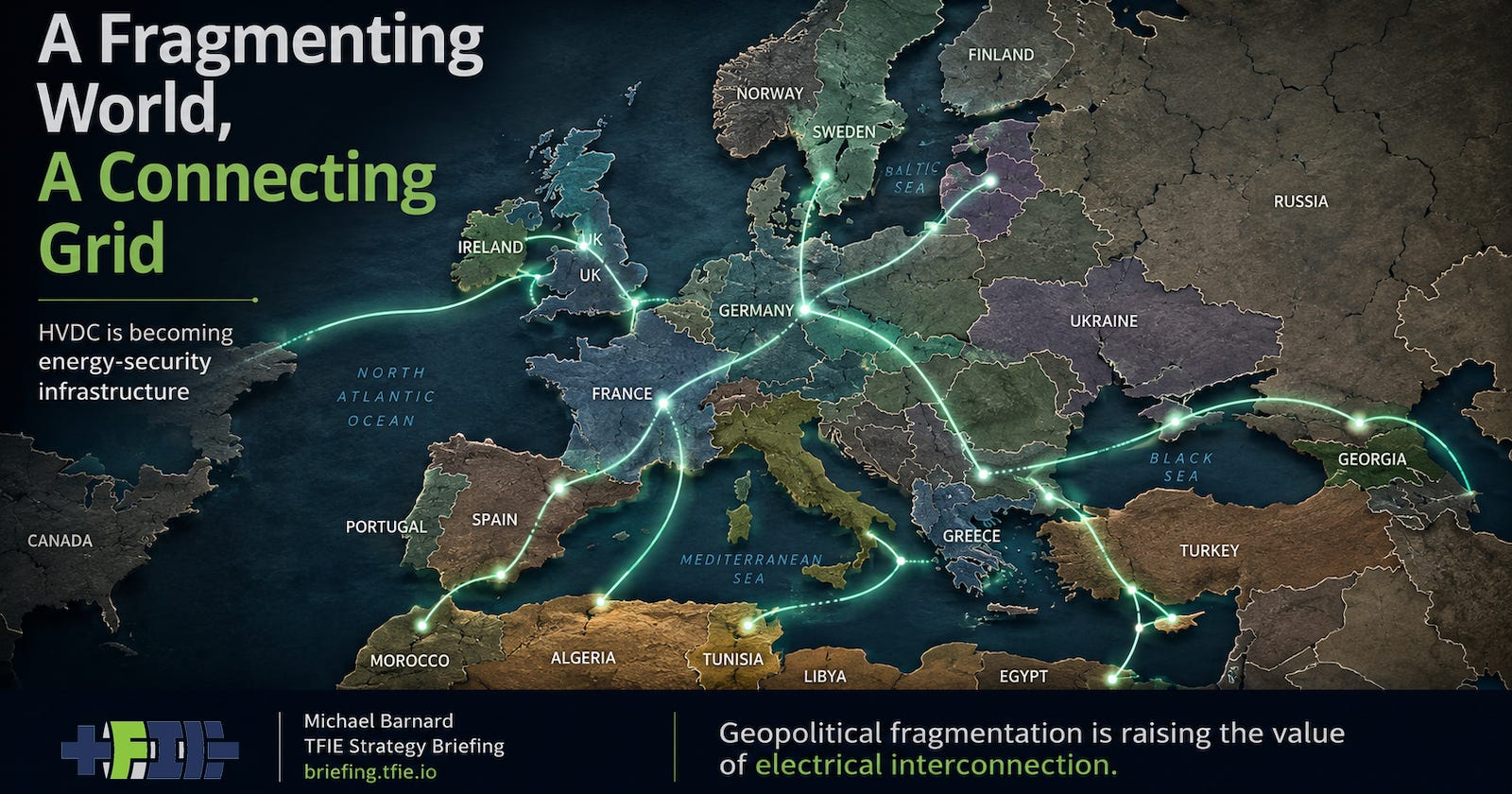
In September 2022, six months after Russia invaded Ukraine and while European gas and electricity prices were dominating headlines, I argued that energy independence was the wrong lesson to take from the crisis. European countries had not made a mistake by depending on each other. They had made a mistake by allowing too much of a critical energy supply to depend on Russia, an increasingly unreliable counterparty with enormous leverage over a continuously consumed commodity. The better objective, I argued, was strategic energy interdependence: broad connections among reliable trading partners, multiple routes, diverse forms of generation and enough redundancy that the failure of one supplier or corridor would be inconvenient instead of economically destabilizing.
That argument was closely tied to electrification. Earlier in 2022, while assessing European plans to manufacture hydrogen in North Africa for export, I had reached a simpler conclusion. Morocco, Algeria and Egypt had good reasons to use green hydrogen domestically for fertilizer and other existing hydrogen demand. Europe had much weaker reasons to recreate the fossil-fuel trading system by converting renewable electricity into hydrogen, transporting the molecules and accepting the conversion losses and infrastructure cost. North African wind and solar could increasingly be shared directly with Europe through high-voltage direct-current transmission. My shorthand at the time was “moving electrons, not moving molecules”.
Four years later, the July 2026 HVDC-VSC project inventory from RTE International provides an unusually useful test. Filtering RTE’s global future-project list for schemes that cross national borders, whether subsea, underground, overhead or mixed, produces about 60 prospective international VSC projects. Europe and its immediate neighbourhood dominate the list. If worsening geopolitics were pushing countries toward electrical autarky, this is one place where the retreat should be visible. Instead, cross-border transmission remains a substantial development category in precisely the regions where energy security has become more politically salient.
Fossil-fuel import dependence and electrical interdependence expose countries to different risks. A gas pipeline or LNG terminal remains useful only while fuel keeps arriving, leaving the buyer continuously exposed to commodity prices, supplier behaviour and global fuel markets. An electrical interconnector joins two systems that already contain generation, storage, demand and other connections. Power can generally move in either direction, and a country with several interconnections can draw at different times on hydro, wind, solar, nuclear, storage and dispatchable generation spread across different jurisdictions and weather systems. Domestic resources remain part of the portfolio. The aim is not independence from trade but diversification of the ways useful energy can reach consumers.
I kept returning to that idea after the immediate 2022 crisis. In early 2023 I argued that HVDC connections among renewables-heavy countries could mitigate geopolitical energy risks, and later treated strategic interdependence as a grid-investment criterion. Countries insisting on greater electrical self-sufficiency would generally need more generation and storage than countries able to share resources, while the connections themselves still had to be assessed for counterparties, route redundancy and disruption risk. Strategic interdependence never meant replacing one concentrated dependency with another.
The most striking result from the 2026 review came from looking for projects being stopped by geopolitical conflict. Lithuania, Latvia and Germany are still advancing the Baltic-German PowerLink toward EU Project of Common Interest status after the Baltic states separated their electricity systems from the Russian sphere and while regional infrastructure security has become a major concern. The war is obviously part of the strategic context, but it is not suppressing that project.
Policy language increasingly makes the broader rationale explicit. ACER links stronger European interconnection with greater cross-border use of renewables, lower fossil-fuel dependence, flexibility and security. Britain’s Clean Flexibility Roadmap treats interconnection as part of the country’s security-of-supply portfolio alongside storage and demand flexibility. These institutions are not describing international transmission solely as a mechanism for electricity-market arbitrage.
Most major interconnectors take many years to develop, so the causality should not be exaggerated. Renewable balancing, wholesale-price differences, offshore wind, resource adequacy, congestion and market integration can justify HVDC links without a war anywhere nearby. Russia’s invasion did not cause every project expected in the 2030s. The evidence supports a narrower and more useful conclusion: geopolitical shocks have added security and resilience value to infrastructure that often already made sense for economic and decarbonization reasons. Four years after I argued for strategic energy interdependence, the project pipeline and policy language provide substantial confirmation of the direction without requiring every cable to be reclassified as a geopolitical project.
Below the paywall is the professional layer: the exact cross-border HVDC denominator and maturity screen, regional distribution, conflict-exposure cases, the actual causes of project attrition, the VSC-versus-LCC technology boundary, resilience failure modes, implications for regulators and investors, and the evidence that would strengthen or weaken the strategic energy interdependence thesis.
