

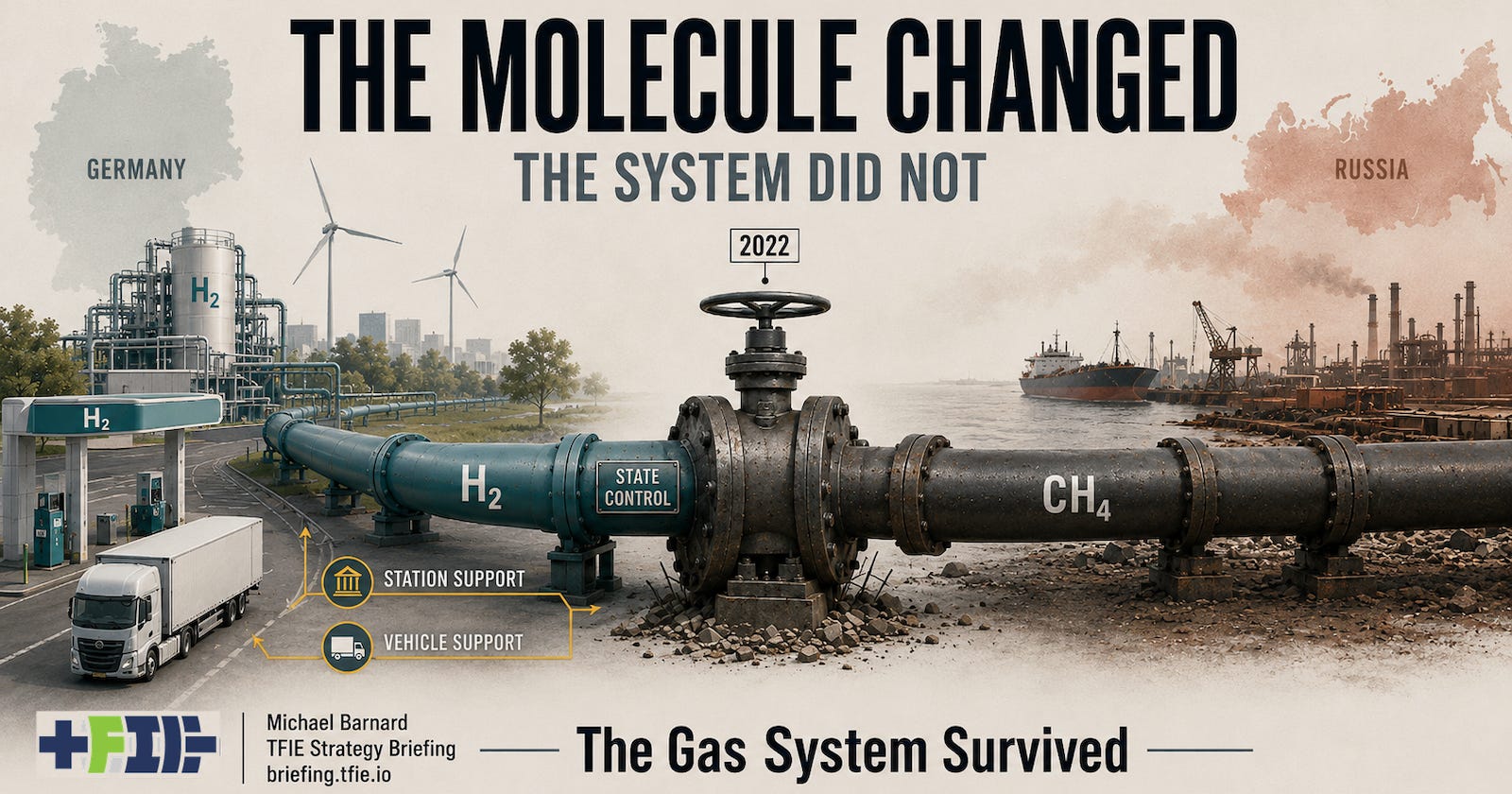
Germany’s latest hydrogen freight program has been called oversubscribed. It attracted 526 applications seeking €455 million from a €220 million fund, including 71 applications for refueling stations and 455 for vehicles or fleets. That sounds like a market arriving until the terms of the offer are examined.
The program can pay up to 50% of a station’s eligible investment cost and up to 80% of the additional cost of a hydrogen truck over a conventional vehicle. The preferred applications combine stations with fleets, and the subsidized vehicles need to cover only 10% of the station’s daily capacity. As I noted in my earlier assessment of the program, the applications prove that companies are interested in grants. They do not prove that freight operators want to buy hydrogen trucks, pay for hydrogen and support refueling stations without them.
Germany is paying for the station and paying for enough trucks to give the station some customers. That is more than solving a chicken-and-egg problem. It is buying the chicken, the egg and the first few breakfasts.
This would be less interesting if it were an isolated transport experiment. It sits at the end of a much longer effort to give Germany’s gas institutions, infrastructure and industrial constituencies a future after the collapse of Russian gas.
Gerhard Schröder remains the most visible symbol of how close the relationship became. Gazprom owned 51% of the original Nord Stream company and appointed four of the eight members of its shareholders’ committee. Schröder, who had just left the German chancellery, was one of Gazprom’s appointees and became chairman.
Schröder does not explain every German gas decision, still less every hydrogen model produced by a German research institute. He does show what had become politically normal. A German chancellor could promote a strategic Russian gas relationship while in office and move almost directly into a senior role within the Gazprom-controlled company delivering it.
Hydrogen was initially supposed to extend that relationship, not replace it. Germany and Russia signed a declaration on sustainable energy in 2021. At the beginning of 2022, Germany opened a Hydrogen Diplomacy Office in Moscow to connect officials, researchers and companies and develop bilateral hydrogen cooperation. Russia invaded Ukraine weeks later, and the office’s work was suspended.
The benign reading is that Germany was exploring every possible source of future low-carbon hydrogen. The harder reading is that Berlin expected Russian methane to be followed by Russian hydrogen, ammonia or hydrogen-derived fuels. Germany would continue importing molecules through large energy partnerships. Pipelines, traders, equipment suppliers and established political relationships would remain relevant. Decarbonization would change the product without dismantling the business model.
The invasion destroyed that political project, but Germany preserved much of the machinery. It placed Gazprom Germania under trusteeship, renamed it Securing Energy for Europe, or SEFE, and transferred it into federal ownership. Stabilizing the company during the 2022 energy crisis was necessary. It controlled important trading, storage and infrastructure assets, and allowing it to collapse would have put energy security at further risk.
The rescue did not end with stabilization. In 2024, SEFE bought the remaining 50.02% of WIGA, parent of the pipeline operators GASCADE and NEL. Its own reporting described the acquisition as part of a growth strategy, noted that the pipelines would represent about 20% of Germany’s hydrogen core network and celebrated the expansion of SEFE’s regulated asset base.
That phrase deserves attention. A regulated asset base earns regulated returns. Germany did not merely rescue the former German arm of Gazprom. It gave the rescued company a larger portfolio of regulated pipelines and a hydrogen mandate that could preserve their value for decades.
The continuity is visible in the ground. GASCADE has converted roughly 400 km of natural gas pipelines between the Baltic coast and Saxony-Anhalt for hydrogen. The route includes OPAL North, part of the onshore pipeline system built to carry Nord Stream 1 gas south from Lubmin. A pipeline created for Russian methane is now an early section of Germany’s hydrogen backbone.
Reusing existing pipe can be sensible. It may cost less than building a new hydrogen line, and concentrated industrial hydrogen demand could justify portions of the network. The problem is the order of operations. Germany has been converting, financing and regulating the network before sufficient low-carbon supply, contracted customers or commercial throughput exist.
I examined that inversion in my earlier work on Germany’s hydrogen backbone and the long shadow of Russian gas. Normal infrastructure development begins with credible demand and builds the capacity needed to serve it. Germany’s hydrogen system often begins with infrastructure and then asks policy to produce the demand.
Once a pipeline has been converted, included in a national strategy and placed in a regulated asset base, the empty pipe becomes an argument for further subsidies. Electrolyzers must be supported because the pipe needs supply. Industrial conversions must be supported because the pipe needs customers. Trucks and refueling stations must be supported because hydrogen needs visible demand outside industry.
The policy becomes self-justifying. Infrastructure built on a forecast creates pressure to subsidize the forecast into existence.
German research institutions helped make the original forecast appear credible. My earlier review of the German Energy Agency’s hydrogen work found a recurring pattern: cheap electricity, inexpensive electrolyzers, high utilization, abbreviated supply chains, low infrastructure costs and slow battery progress. Hydrogen was modeled into competitiveness, then the resulting scenarios were used to justify pipelines, import agreements, vehicle programs and industrial policy.
This does not require researchers to falsify results. Institutions learn which questions attract funding, which assumptions are considered balanced and which conclusions preserve their relevance. A research program established to plan a hydrogen economy is unlikely to conclude quickly that most of the hydrogen economy should not exist.
Germany has a useful phrase for the resulting system: institutioneller Filz. Filz is felt, a dense mat of fibres that becomes difficult to pull apart. In politics and business, it describes an interwoven network of public officials, institutions and commercial interests that protects itself because every strand benefits from the others.
Pipeline companies retain valuable pipelines. Regulated utilities expand their asset bases. Fuel suppliers gain a new market. Manufacturers receive grants for products customers will not yet buy unaided. Research institutions keep their programs, ministries keep their strategies and politicians keep their industrial announcements.
That is institutional corruption. I am not alleging bribes, criminal coordination or secret instructions from Moscow. The corruption lies in public power being repeatedly used to preserve incumbent assets, revenues and organizational relevance after the stated public case has weakened. Each decision can be legal, procedurally correct and sincerely defended. The combined system can still divert money and attention away from the cheapest route to decarbonization and toward the organizations best positioned to influence policy.
The public purpose is affordable emissions reduction. The institutional result is a hydrogen economy being assembled around the needs of the former gas economy.
Transport provides the clearest evidence. Germany’s hydrogen refueling network has already failed the utilization test. Stations dispensing small quantities of fuel cannot recover their fixed construction, maintenance and operating costs. A grant can build the station, but it cannot make low throughput economical.
Battery-electric trucks also changed the comparison. In 2025, French and German economic advisers put battery trucks first, recommending that governments concentrate on depot charging, megawatt charging and direct electrification instead of treating hydrogen as an equal freight pathway. Volvo’s subsequent long-range electric truck reinforced the same point: the truck was moving faster than the strategy.
Germany is spending €1 billion over four years on heavy-truck charging infrastructure, so it is not ignoring battery-electric freight. But the policy treatment is still asymmetric. Battery trucks receive support for the charging system they need. Hydrogen receives support for the station and up to 80% of the truck’s additional purchase cost.
That can make the weaker lifetime-cost pathway look attractive on the invoice. It does not change what happens over hundreds of thousands of kilometres. Hydrogen still carries conversion losses, compression, distribution, dispensing, station access and fuel-price exposure that battery trucks avoid.
The correct denominator is not applications submitted, stations opened, kilometres of pipeline converted or euros committed. It is commercially produced low-carbon hydrogen, contracted demand, pipeline throughput, kilograms dispensed per day, delivered cost per kilometre and repeat purchases after the grants end.
Germany’s Federal Audit Office has now reached its own version of that conclusion, warning that the country is missing the objectives of its hydrogen strategy despite billions in public support. The problem is no longer that critics have failed to appreciate hydrogen’s potential. It is that public institutions continue expanding the commitment after the expected supply, demand and cost reductions have failed to arrive.
Germany will still need low-carbon hydrogen for ammonia, chemicals and selected industrial processes. Some reused pipelines may prove valuable. The nationalization of SEFE was justified by an energy emergency. None of that requires a national hydrogen economy large enough to preserve every pipeline, every gas-sector institution and every demand forecast produced during the height of hydrogen optimism.
The burden of proof should now run in the other direction. Industrial users should show why they require hydrogen. Pipeline developers should show contracted supply, contracted customers, expected utilization and delivered cost. Transport projects should be compared with battery-electric vehicles rather than merely with diesel. Public support should follow credible demand instead of being used to manufacture it.
Germany needs some hydrogen. It does not need to rebuild the gas economy around it.
Free posts carry the public argument. Paid TFIE Strategy Briefing posts add the professional layer: evidence notes, scorecards, denominator checks and decision-grade context for people working around the transition.