

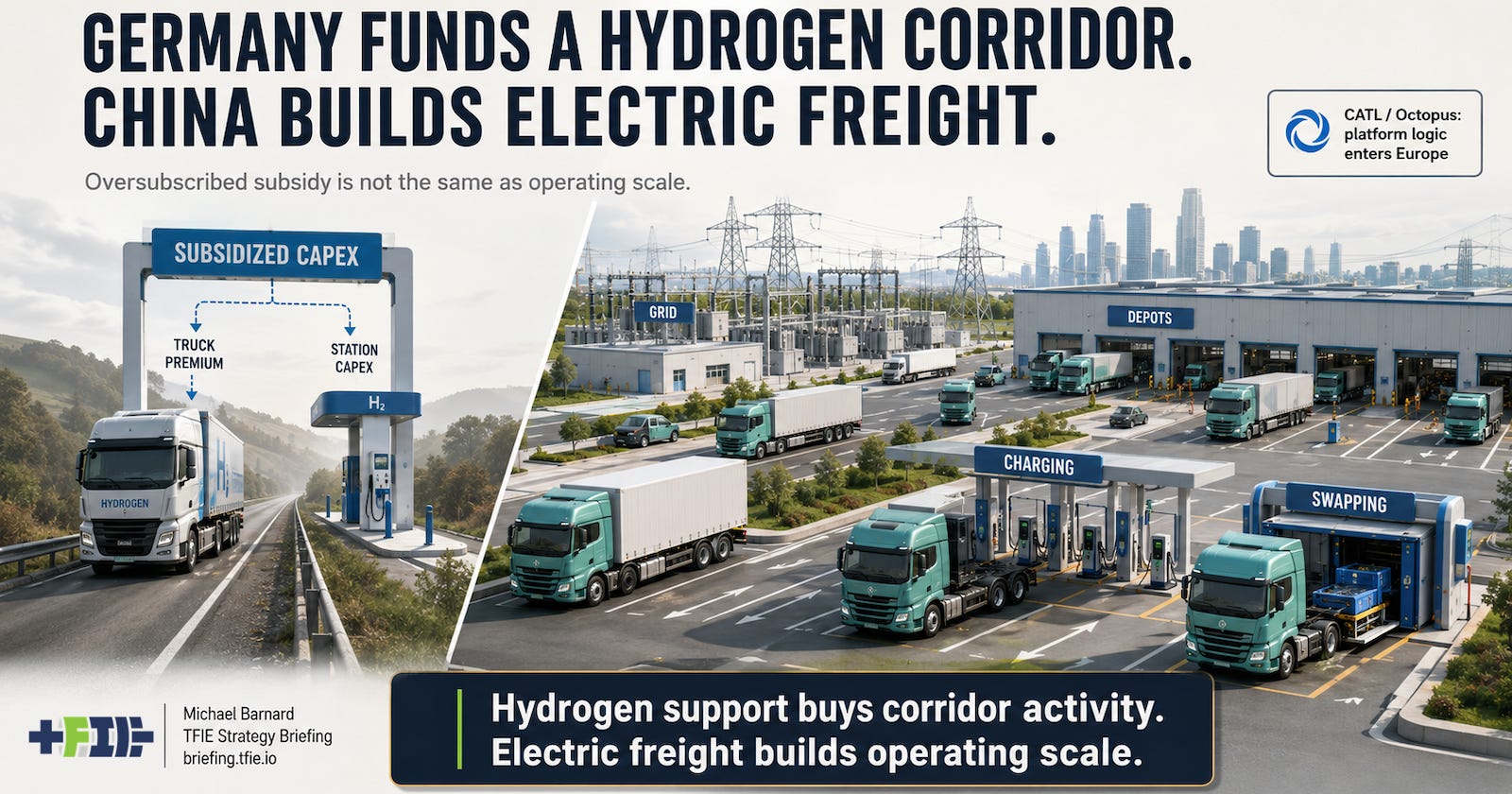
Germany’s hydrogen truck and refueling-station subsidy call was oversubscribed. On its face, that sounds like the hydrogen freight market finally showing up. The German transport ministry’s implementation agency reported 526 applications by the deadline, requesting €455 million against €220 million available, with 71 applications for refueling stations and 455 for vehicles or fleets. That is a strong response in the narrow sense that companies will apply when the state offers enough money. It is not proof that hydrogen trucks have become competitive freight assets.
The more useful interpretation is simpler and less flattering. Germany is still trying to make hydrogen road transport happen. The country is doing it at the same time that the freight evidence is increasingly pointing in the other direction: battery-electric trucks, depot charging, corridor charging, battery swapping where routes justify it, grid planning, service ecosystems, insurance, finance and data platforms. Hydrogen road freight is still being treated as a strategic option to preserve. Electric freight is becoming an operating system to build.
The denominator matters. What was oversubscribed was not an unsubsidized market for hydrogen freight. It was a subsidy programme. Germany is offering public support for hydrogen refueling stations and N2/N3 commercial vehicles in a combined package, with up to 50% of eligible hydrogen station expenses and up to 80% of eligible additional vehicle cost compared with a diesel truck. The policy design is explicit: build stations and vehicles together so each gives the other a reason to exist.
That framing addresses the chicken-and-egg problem by funding both sides of it. The policy problem is not that Germany is spending money on clean freight. It is that the programme buys down the hydrogen supply chain’s capital problem while leaving fleet operators exposed to hydrogen’s operating-cost problem. Capex support helps with the entrance fee. Freight economics are paid by the kilometre.
The asymmetry should make fleet operators pause. Germany is not just supporting hydrogen refueling infrastructure. It is also offering purchase support for hydrogen trucks by buying down a large share of their diesel-cost premium. Battery-electric trucks, by contrast, do not appear to have a comparable current federal vehicle-purchase subsidy. Germany previously cut its broader climate-friendly commercial-vehicle purchase funding, while the electric truck support now visible at federal scale is mainly through heavy-duty charging infrastructure and motorway charging corridors. That means the policy can make hydrogen look better at the moment of procurement, even if battery-electric trucks remain stronger on lifetime cost.
That would be questionable even in isolation. It looks worse against the live freight comparator. China is not merely subsidizing electric trucks as vehicles. It is building an electric freight system around corridors, depots, charging, swapping, grid planning, standards, service networks and defined freight use cases. In my earlier article on how China is tying electric trucks to corridors, depots, service areas, charging, swapping, grids, batteries, standards and freight operations, the point was not the 40% new-energy heavy-truck sales target alone. The point was that China is not asking electric trucks to succeed one fleet at a time, unsupported by the rest of the system.
This also cuts against the serious institutional direction of travel. In my earlier article on how France and Germany’s economic councils endorsed electric trucks over hydrogen, the point was not that hydrogen trucks can never move freight. It was that the comparator had changed. Battery-electric trucks are no longer a distant possibility in heavy road freight. They are the pathway with the shorter energy chain, lower energy cost, improving vehicle availability and more obvious fit with the power system.
Germany’s hydrogen subsidy looks weaker in that light. It is spending public capital to preserve a parallel fuel system while the strategic layer of freight electrification is moving toward batteries, grids, charging, swapping, data and finance. A subsidized hydrogen corridor can create activity. It does not create the freight-energy platform that fleets will use if electric trucks become cheaper, easier to dispatch, easier to finance and easier to integrate into logistics operations.
Hydrogen truck advocates point to range, refueling speed and corridor use cases. Those are real operational attributes. They do not erase the delivered-energy chain. Hydrogen has to buy, convert, compress, distribute and dispense energy that a battery-electric truck can use more directly. A hydrogen truck can be subsidized into service, and a hydrogen station can be subsidized into existence, but the operator still has to run the route, pay the fuel bill, manage station access and carry the residual-value risk.
Below the paywall is the professional layer: the capex comparison across diesel, battery-electric and hydrogen trucks; the subsidy arithmetic that can make hydrogen look cheaper at procurement; the per-100-km energy-cost comparison where the advantage reverses; the station-utilization denominator; the China and CATL/Octopus comparator; and the update triggers I’ll use to judge whether Germany’s hydrogen freight corridor is scaling or merely preserving a road-transport hydrogen narrative with public money.