

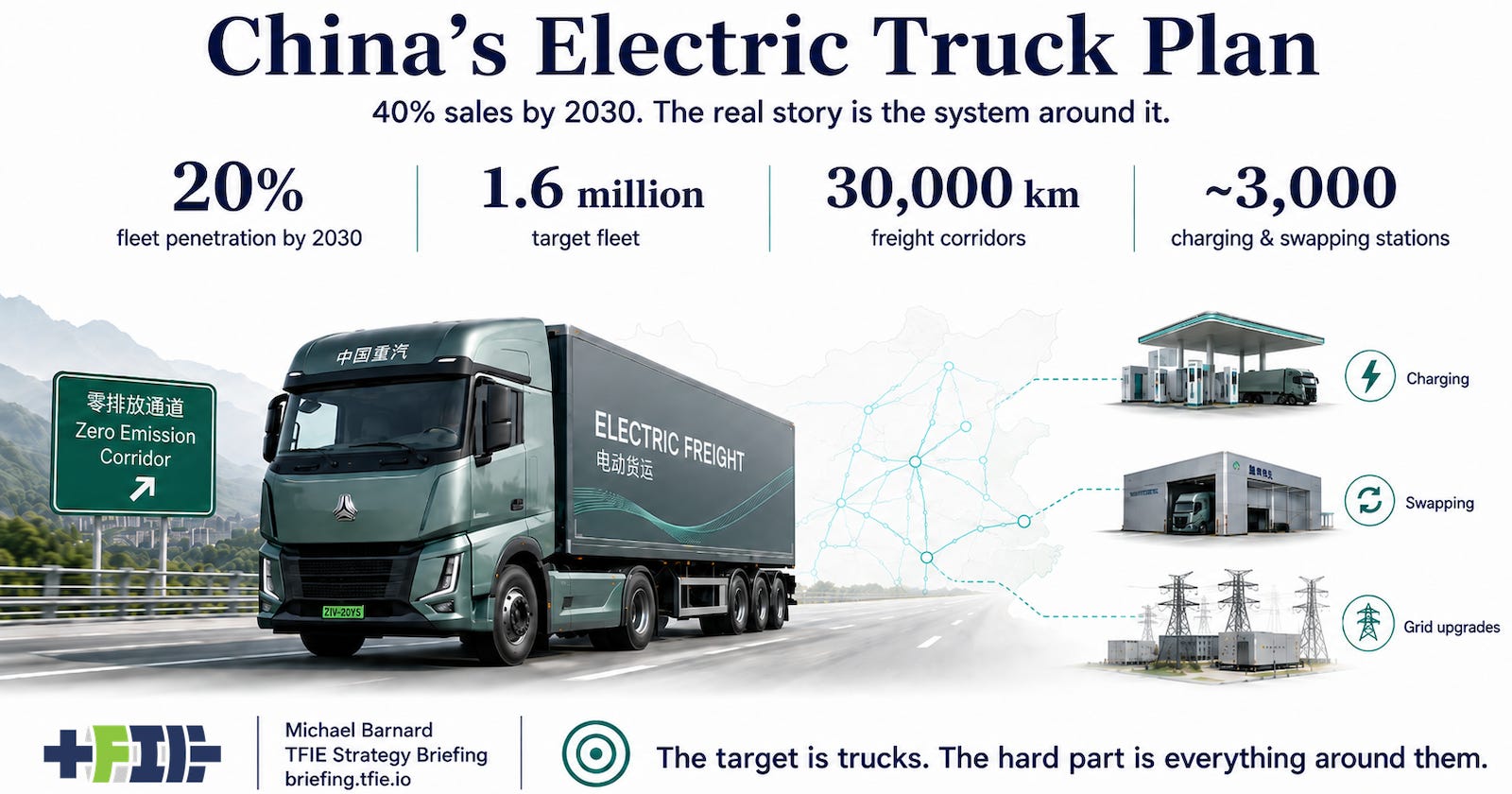
China’s latest heavy-truck electrification plan is easy to file under “large target, large country, large number.” That would be the least useful reading of it. The 40% target for new-energy heavy-truck sales by 2030 is the headline, but the policy is more interesting than the headline because it is not merely a vehicle sales ambition. It is a plan for where the trucks run, where they charge or swap, and who has to make the rest of the freight system work.
The official target is that new-energy heavy trucks should reach 40% of sales by 2030, exceed 1.6 million vehicles in the fleet, represent about 20% of the total heavy-truck fleet, and carry 18% of highway freight volumes. Those numbers are large enough to matter, but they also keep the denominator honest. Even in China, with the world’s largest electric vehicle market and a state apparatus that can coordinate infrastructure at scale, diesel does not disappear from heavy freight by 2030. This is partial displacement at industrial scale, not a declaration that the whole problem has been solved.
The other reason the target should not be read as a stretch goal is that China is already well into the curve. Battery-electric heavy trucks were already around one-fifth of heavy-duty sales in the first half of 2025, and full-year new-energy heavy-truck sales reached about 231,000 units. CATL’s truck-swapping push is not a slide-deck concept either. Its Qiji battery-swap system has hundreds of truck swap stations already, a first trunk route of roughly 1,250 km, and a stated plan to build a national truck-swap network across major freight corridors. The 2030 plan is not asking China to invent the transition from a standing start. It is taking an existing market movement and wrapping national infrastructure, standards, finance, and freight-policy machinery around it.
That distinction matters because truck electrification debates outside China still too often behave as if the question is mainly whether a battery truck can handle a specific duty cycle. Some can, some cannot yet, and some routes require infrastructure before the economics sharpen. The Chinese plan does not stop at that question. It moves quickly to corridors, service areas, logistics parks, ports, mines, depots, power systems, battery ownership models, insurance, maintenance, data standards, and the places where trucks are worked hard enough for the economics to show up.
That is why the policy is a better signal than the 40% figure alone. It calls for roughly 30,000 km of zero-carbon highway freight corridors across major national expressway routes, supports about 3,000 heavy-truck charging and battery-swapping stations, and requires new and upgraded highway service areas to build heavy-truck charging and swapping facilities or reserve space for them. It also tells grid companies to include heavy-truck charging and swapping demand in distribution-grid planning, while encouraging valley-power charging, local renewable consumption, vehicle-grid interaction trials, and integrated wind, solar, storage, charging, and swapping facilities where they make sense.
That is the part many western freight discussions still miss. Electricity is not just another fuel. It works best when the electricity supply, duty cycle, utilization, depot pattern, power price, and maintenance model line up. A diesel truck carries its fuel system, engine complexity, emissions control, fuel-price exposure, and local pollution with every trip. A battery-electric truck moves more of that burden into infrastructure that can be planned, shared, upgraded, and increasingly powered with low-carbon electricity. The truck does not become simple in isolation, but the freight task can become simpler where the route and the infrastructure are designed together.
The plan also shows where China thinks the early and middle markets are. Fixed short-haul routes in key air-pollution regions are supposed to exceed 80% electrification, while ports, mines, logistics parks, freight hubs, construction sites, concrete mixers, urban delivery, postal and express freight, container routes, and bulk commodity corridors all appear in the document. That is not an accident. These are places where high utilization, known routes, centralized operations, repeat loading points, air-quality pressure, and depot or corridor infrastructure can make batteries work before universal long-haul coverage exists.
The hydrogen language in the policy should not be overread. The official implementation plan mentions hydrogen stations and green-fuel refueling in selected scenarios, which is unsurprising in a Chinese policy that preserves optionality across ministries and industries. But the working detail is overwhelmingly around charging, swapping, distribution-grid expansion, battery lifecycle traceability, battery leasing, vehicle-battery separation, power-price management, charging standards, swapping interoperability, and grid integration. Hydrogen appears in the document. Electricity gets most of the implementation machinery.
That distinction lines up with what the heavy-truck market has been saying for several years. Hydrogen transport remains dominated by pilots, policy-shaped niches, and infrastructure support tails. Battery-electric freight plugs into the much larger battery and electricity industrial base already scaling through cars, buses, vans, stationary storage, ports, mines, and grids. Freight fleets do not buy narratives. They buy uptime, cost control, maintainability, financing, insurance, service, and confidence that the truck can be dispatched tomorrow without special handling.
China’s plan is also more mature than a procurement subsidy story. It includes scrappage and purchase support, but it spends at least as much attention on the dull pieces that determine whether fleets keep using the trucks after the ribbon cutting. Battery safety and lifecycle traceability are specified, along with repair parts, three-electric-system maintenance, authorized service networks, insurance pricing, secondhand vehicle assessment, standards, charging and swapping interoperability, data sharing, and market supervision. These are not the parts that make headlines. They are the parts that separate pilots from fleet transition.
A 20% fleet share by 2030 means most Chinese heavy trucks would still not be new-energy trucks at that date, and an 18% highway freight-volume share means the heavier and harder parts of the market are not all solved. Battery swapping has to prove utilization, standardization, and economics across manufacturers and routes. High-power charging at service areas has to be integrated into distribution grids without creating avoidable bottlenecks. Safety, maintenance, insurance, and residual values have to become normal fleet-management questions rather than special cases. China is not declaring victory. It is building a route to partial victory that can be measured.
That is the professional lesson. In freight electrification, targets matter less than whether the target is attached to corridors, grid planning, priority use cases, vehicle purchase support, charging and swapping infrastructure, standards, safety, repair, insurance, finance, and data systems. China’s plan treats electric trucks as part of a freight-and-power buildout rather than as clean vehicles waiting for individual fleet buyers to take a flyer on them.
For everyone else, the comparison is uncomfortable. Countries that keep hydrogen, biofuels, e-fuels, overhead wires, batteries, and “technology neutrality” equally alive on paper are not always being neutral. They are often avoiding the infrastructure choices fleets need. China’s plan is not perfect and it is not complete, but it is clear about the main work: where duty cycles and infrastructure line up, electrify the truck, build the charging and swapping network, bring the grid into the plan, and make the service ecosystem boring enough for freight managers to trust.
China’s 40% sales target will get the coverage. The more useful lesson is that the plan does not ask electric trucks to succeed one fleet at a time, unsupported by the rest of the freight system. It attaches them to corridors, depots, grid upgrades, service areas, swapping stations, battery rules, repair networks, and freight markets where the economics can become ordinary. That is the part other countries should be studying.
Free TFIE Strategy Briefing posts carry the public argument. Paid posts add the professional layer: denominator checks, evidence notes, scorecards, update triggers, and decision-grade context for people working around the transition.
Thank you for underlining the systems thinking and strategic importance of the policy! Not seeing this is a repeat of the misunderstanding how China works in the West. Policymakers should watch and learn, how this unfolds, and they will not have to wait long to get useful insights, I am sure!
The numbers sound to me like minima, simply because there is that powerful mix of leaders in the party trying to impress and the private sector driving their own agenda: BYD and CATL will push their respective plans forward. The good thing about the policy is that it will bring more standardisation and targeting of the right segments!