

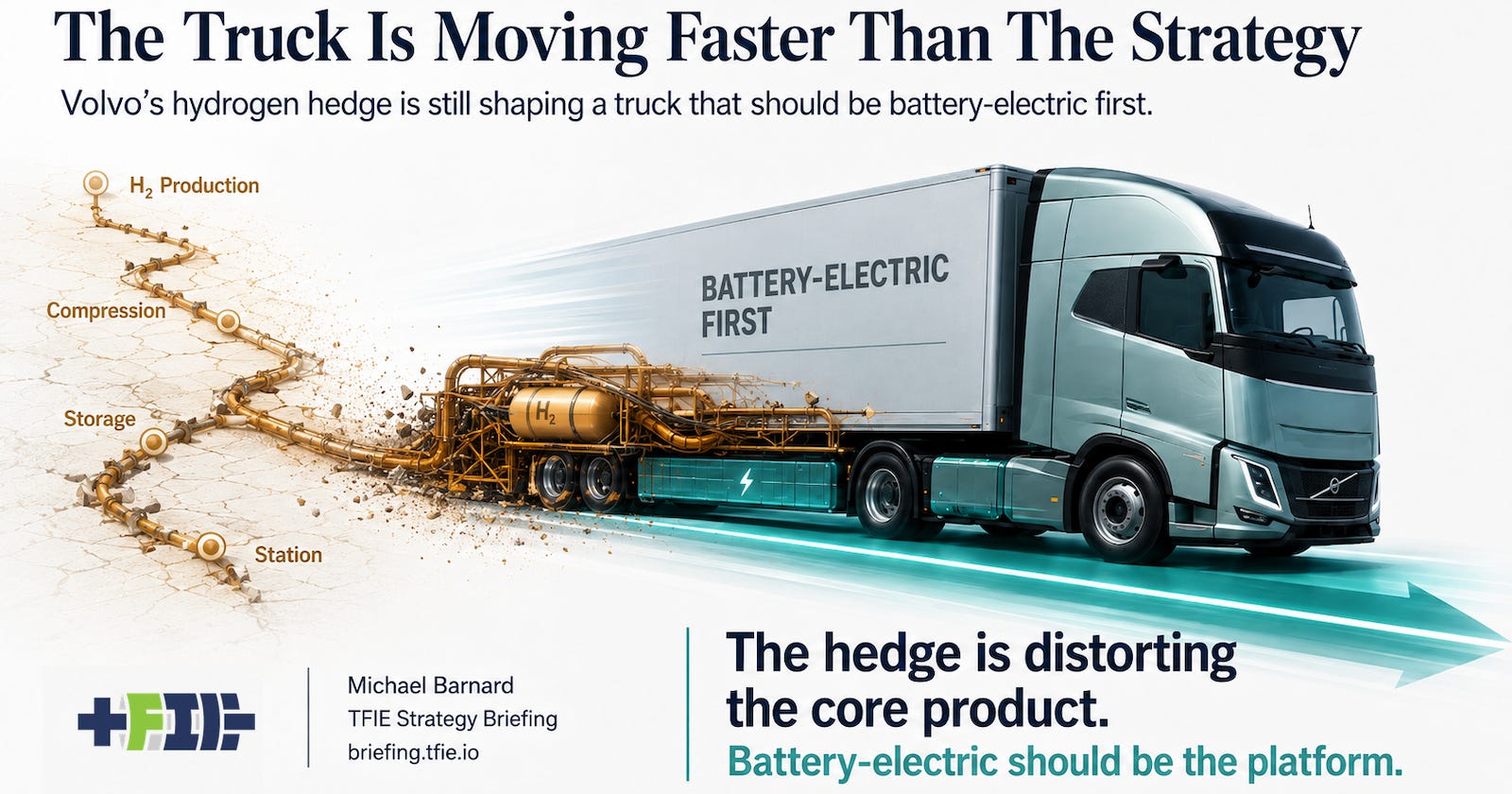
Volvo’s new FH Aero Electric is the kind of truck legacy manufacturers used to imply battery-electric trucking could not really become. It claims up to 700 km of range, carries up to 725 kWh of usable battery energy, supports megawatt charging, and uses a new e-axle to free more chassis space for batteries. That is the headline. The worm inside it is that Volvo is still presenting road freight through a multi-drivetrain strategy that preserves hydrogen combustion and fuel cells as peer options, even as its own electric truck shows how much of the long-haul problem batteries are now taking away.
The extended-range FH Aero Electric is a serious product signal. Volvo says it can charge from 20% to 80% in about 50 minutes at 700 kW, which starts to fit the rhythm of real freight operations rather than only depot return-to-base use. Range still depends on weather, weight, wind, route, driver performance and the usual truck realities, but the old discussion has changed. This is no longer a question about whether battery-electric trucks can handle meaningful freight. It is a question about which routes, charging assets, grid connections and fleet operating patterns get electrified first.
The architecture matters more than the press-release number. Volvo gets the extra range by integrating motors, power electronics, transmission and axle into the rear e-axle, creating room for six to eight battery packs. That is good engineering, and it moves Volvo beyond the first-generation feel of simply putting electric parts into spaces left by a diesel truck. But it is still a battery-optimized version of the FH system, not a battery-first heavy-truck platform designed around the pack, charging system and electric duty cycle from the beginning.
That compromise would be easier to defend if the evidence still supported deep uncertainty about the main road-freight pathway. It does not. Volvo’s public strategy still talks about battery-electric trucks, fuel-cell electric trucks and combustion engines using renewable fuels, including green hydrogen. Its hydrogen-combustion truck is presented as a fit for longer distances and regions with limited charging infrastructure or limited time for recharging batteries. That sounded prudent when the heavy-truck transition was mostly pilot programs, regulatory scenarios and engineering roadmaps. It sounds weaker after the last few years of evidence.
The European Court of Auditors warned that the EU’s 2030 renewable hydrogen production and import targets were based more on political will than robust analysis, and that the bloc was unlikely to meet them despite billions in available funding. That is not a marginal quibble about one subsidy program. It is an institutional warning that the hydrogen economy was being counted through targets before the production, buyers, infrastructure and costs had formed.
France’s Cour des comptes made the same point in national form. It reviewed public support for decarbonized hydrogen and called the ambitions unrealistic. France lowered its 2030 electrolyser target from 6.5 GW to 4.5 GW, yet the Court still found only 0.5 GW fully secured, or 3.1 GW under very optimistic assumptions. It also noted that a large share of effectively committed public spending had gone to road transport even though hydrogen had become a second-rank road-transport solution behind batteries. That matters because it turns the strategy problem from abstraction into budget allocation: public money and industrial attention were still flowing into road hydrogen after batteries had already become the stronger comparator.
Germany and France then made the road-freight point directly. In my CleanTechnica piece on how France and Germany’s economic councils endorsed electric trucks over hydrogen, the useful signal was not just that the French Conseil d’Analyse Économique and the German Council of Economic Experts preferred battery-electric trucks. It was that their policy prescription was coherent: focus on battery-electric freight, build megawatt-scale charging, stop treating hydrogen as a symmetric freight option, and adjust infrastructure policy accordingly. That was the economic comparator showing up in one of Europe’s core industrial-policy debates.
The broader hydrogen economy also failed to arrive on the schedule implied by strategy decks. The International Energy Agency has continued to find growing project announcements and investment decisions, but also weak demand formation, early-stage project pipelines and hydrogen consumption still dominated by unabated fossil supply. Developers have cancelled, postponed or scaled back projects because delivered costs are high and buyers are not signing contracts at the required pace. Hydrogen remains important for some industrial molecules. It has not become the general-purpose clean fuel system that road-transport hydrogen strategies quietly depend on.
Meanwhile, China ran the heavy-truck experiment that should have changed the diagnosis. In my Briefing piece on how China’s hydrogen trucks are a policy side bet, not the main freight market, the central denominator was stark. Battery-electric heavy trucks were no longer a pilot story in China. They had reached a 22% sales share in China’s heavy truck and tractor-trailer market in the first half of 2025, full-year electric heavy truck sales were around 230,000 units, and cumulative hydrogen fuel-cell vehicle sales across all categories were only around 40,000 by the end of 2025.
That Briefing analysis also matters because it was not just a vehicle-count comparison. China’s heavy-truck electrification story is about battery swapping, corridor logistics, station economics, battery-as-a-service, and freight work measured in ton-km. The article’s synthesis was that battery-electric heavy trucks, especially with swapping on structured freight routes, were becoming the commercially rational default, while hydrogen survived as a narrower state-supported niche serving policy, SOEs and molecule incumbents. That is exactly the kind of evidence that should have been changing European OEM strategy.
Put those signals together and the diagnosis should have changed. European auditors were warning that hydrogen targets had outrun reality. French auditors were documenting lowered ambitions, thin secured capacity and misplaced road-transport spending. French and German economic advisers were pointing to the lower infrastructure-cost case for battery-electric heavy trucks. The IEA was showing a hydrogen economy not yet forming around real demand. China was putting battery-electric heavy trucks into the market at scale.
Volvo can reasonably answer that it sells globally and cannot design only for the best-prepared corridors in Europe or China. Some customers operate where grids are weak. Some routes will see depot charging and megawatt corridors late. Some applications are unusually payload-sensitive or schedule-sensitive. A global incumbent also has to manage factories, dealers, service tooling, engine assets, regulatory credits, fleet relationships and customers that do not want to feel stranded by a single technology bet.
That is the charitable reading, and it is not trivial. Optionality is useful when the facts are unclear. The problem is that optionality becomes expensive when the facts are clear enough. Battery-electric was not only winning in passenger cars, city buses and delivery vehicles. It was beginning to win in the heavy commercial segment that had been treated as hydrogen’s best road-transport refuge.
This is where Richard Rumelt’s diagnosis test is useful without turning the article into a business-school lecture. Good strategy starts with the crux. If Volvo’s crux is customer diversity under infrastructure uncertainty, then preserving battery-electric, fuel-cell, hydrogen-combustion and renewable-fuel combustion options looks coherent. If the crux is that battery-electric freight is becoming the dominant design while hydrogen road transport is failing as a system, the same optionality starts to look like drag.
Hydrogen road transport is not failing because truck engineers are lazy or fuel-cell stacks need one more generation. It is failing because the vehicle is only one part of the claim. Hydrogen also needs production, compression or liquefaction, distribution, storage, dispensing, fuel quality control, station maintenance, high utilization and a delivered fuel price that can beat electricity. The denominator is not the number of hydrogen truck announcements. It is the number of high-utilization freight systems that beat battery-electric trucks on cost, uptime, infrastructure productivity and repeat procurement.
Battery-electric trucks have an infrastructure problem, but it is a different class of problem. Charging extends the power system. Hydrogen road transport adds a fuel system. For long-haul trucking, the comparator is not diesel nostalgia. It is depot charging, hub-to-hub charging, megawatt charging corridors, battery-buffered sites, route-energy software, scheduled driver breaks, grid connections, electricity procurement and falling battery costs. Those are hard tasks, but they are being built on top of the dominant energy system of the transition.
That is why the FH Aero Electric reads as more than a new model. Once an incumbent can package 725 kWh of usable battery energy on a European long-haul truck, claim up to 700 km of range and align megawatt charging with a practical operating window on suitable routes, the remaining hydrogen space becomes more conditional. Remote routes, weak grids, unusual payload constraints, extreme utilization patterns and subsidy-shaped markets will keep hydrogen claims alive. Edge cases, however, are not a platform strategy. They are exceptions that should carry the burden of proof.
The architectural compromise now reads differently. The extended-range FH Aero Electric is a serious electric truck inside the Volvo FH system, and it has narrower configuration space than the broader FH Aero Electric range. Some of that reflects European weight rules, battery mass, payload optimization and the reality that Volvo has to serve many truck categories. But the product still reads as battery-electric optimization inside a multi-powertrain envelope, not a battery-first platform.
That is the strategic misstep. The hydrogen hedge is not just an investor-relations paragraph or a harmless future option. It shapes the product story. As long as the organizing idea is “same chassis, many propulsion systems,” the battery is not fully allowed to be the platform. It becomes one powertrain option among several, fitted into a product logic designed to preserve combustion relevance. The e-axle is a clever answer to that constraint. It is also evidence that the constraint exists.
This does not make Volvo weak in electric trucks. Quite the opposite. Volvo has one of the more serious electric truck portfolios among legacy manufacturers, and the extended-range FH Aero Electric is a strong product signal. The engineers are pushing the product toward the reality that road freight electrification is becoming less about exotic drivetrains and more about batteries, charging, grid integration and operational planning.
The practical conclusion is not that Volvo should abandon every non-battery research thread tomorrow morning. Global OEMs do not turn like bicycles, and there may be narrow industrial or regional cases worth watching. The conclusion is that hydrogen should no longer be allowed to define the center of the road-freight architecture. Battery-electric should be the platform. Hydrogen should be forced to prove an exception.
At some point, optionality stops protecting strategy and starts distorting product. For Volvo, that point has likely passed. The FH Aero Electric shows what the core product should now be. The remaining question is how long Volvo will keep designing and describing the rest of the strategy as though the hydrogen hedge still deserves equal architectural room.
Subscribe to TFIE Strategy Briefing for the deeper professional layer behind transition claims: denominator checks, comparator cases, capital filters, procurement reality, scorecards and decision context for what is scaling, what is stalled, and what is still narrative momentum.
The hydrogen in transport story is becoming a costly misstep for many truck makers. Same with Mercedes Benz and their Actros line: the eActros is a brilliant etruck and they have now managed to expand the versions to a low-liner an important step to stay relevant for particularly the Automotive Industry. At the same time they just announced the H2 version build together with a partner.
But just like for cars, when the first ground-up electric trucks appear there will be an issue, as they will allow weight reduction on the chassis, potentially just enough to give some operators the flexibility they fear to lose.
But I wonder, how logistics will evolve in general, when vertical integration replaces Just-in-time delivery, replacement parts come out of 3D printers, and general localisation of production through automation changes the flows of goods?