

The Netherlands has cut its expected 2040 gaseous hydrogen demand by 57%, from 460 to 200 petajoules. Its updated National Energy System Plan puts domestic renewable hydrogen production costs at €6.70 to €6.80 per kilogram in 2040 and identifies electrification as the main pathway for inland shipping toward 2050. As I noted in my assessment of the Dutch hydrogen reset, hydrogen is more expensive than expected, and direct electrification makes economic sense in more applications. Europe’s inland shipping strategy still relies on assumptions from the cheap-hydrogen era.
The Netherlands accounts for 50% of the Rhine region’s dry cargo vessels and 48% of its tankers. It held the presidency of the Central Commission for the Navigation of the Rhine (CCNR) in 2024 and 2025. Yet CCNR’s October 2026 market report repeats that there is no single solution for inland shipping’s energy transition. The government of the country with the largest Rhine fleet has identified its main propulsion technology for 2050. CCNR hasn’t.
Electricity is expected to supply 52% of Dutch domestic final energy in 2040, rising to 63% with electrically enabled ambient and geothermal heat. I estimate that electricity and the heat it enables will account for about 70% of useful energy, as combustion wastes much more of the energy it consumes. These figures exclude chemical feedstocks and international bunkers. The Dutch government expects inland shipping to need just 2–4 PJ of sustainable carbon-based fuels in 2040, compared with 54–73 PJ for aviation. It sees a potential role for methanol in some larger vessels.
CCNR helps shape European inland navigation’s technical rules and transition priorities. Batteries don’t have to work for every vessel to dominate inland shipping. Establish how much freight can be moved with batteries, then determine how much fuel and bunkering infrastructure the remaining vessels need.
CCNR commissioned its financing study in 2019. Completed in 2021, it calculated the costs of predetermined mixes of propulsion technologies for the commission’s roadmap. Some of the same researchers and assumptions appear in the 2026 assessments by two European projects, PLATINA4Action and SYNERGETICS.
In its June 2025 roadmap progress report, CCNR counted the spread of its technology-neutral message as an institutional achievement. Its outreach included European policymakers, industry organizations and Flemish Green Deal experts. Its secretariat sits on the advisory boards of SYNERGETICS and RH2INE, the latter promoting hydrogen in inland shipping. CCNR helps shape the research and policy environment, rather than merely reporting on it.
The authors of the Flemish inland shipping infrastructure study used CCNR’s scenarios as a starting point and found them wanting. On page 61, they conclude that RED III has made the conservative pathway largely outdated and that the scenarios lack a logical chain of reasoning leading to conclusions about fuel use.
The Flemish study has problems of its own. Its executive summary says energy demand rises 37% in a scenario in which 80% of vessels are electric by 2050. The detailed narrative and energy table put the increase at about 2%, despite roughly 59% cargo growth. That is a serious error for infrastructure planners. Much more freight can move with little additional purchased energy.
In an April 2025 submission, PLATINA4Action and European inland shipping and port organizations cited CCNR’s research to identify its combustion-heavy conservative pathway as the most cost-efficient way of reducing emissions by 90% through 2050. They requested support for 1.6 million tons of hydrotreated vegetable oil (HVO) annually at prices competitive with diesel by around 2030.
That is approximately the sector’s entire conventional diesel consumption in 2015 and 45% more than the EU’s entire 2025 sustainable aviation fuel supply. The organizations also advocate batteries, methanol and hydrogen, but their version of the conservative pathway still calls for about 685,000 tons of HVO annually in 2050. This is more than a short-term bridge for existing engines.
The organizations said operators could not pass the additional cost of HVO to customers. Cargo owners can hire competitors burning cheaper diesel. A fuel surcharge tied to diesel prices won’t cover the extra cost of choosing HVO. CCNR’s 2026 annual report weights fuel at 35% of dry bulk costs, 30% for tankers and 28% for containers in its cost indices. Cost-adjusted dry cargo spot freight rates averaged 11% below their 2021 baseline in 2024 and 2025. Supporting the requested HVO volume at €500 per ton above diesel costs €800 million annually, rising to €1.6 billion at a €1,000 premium.
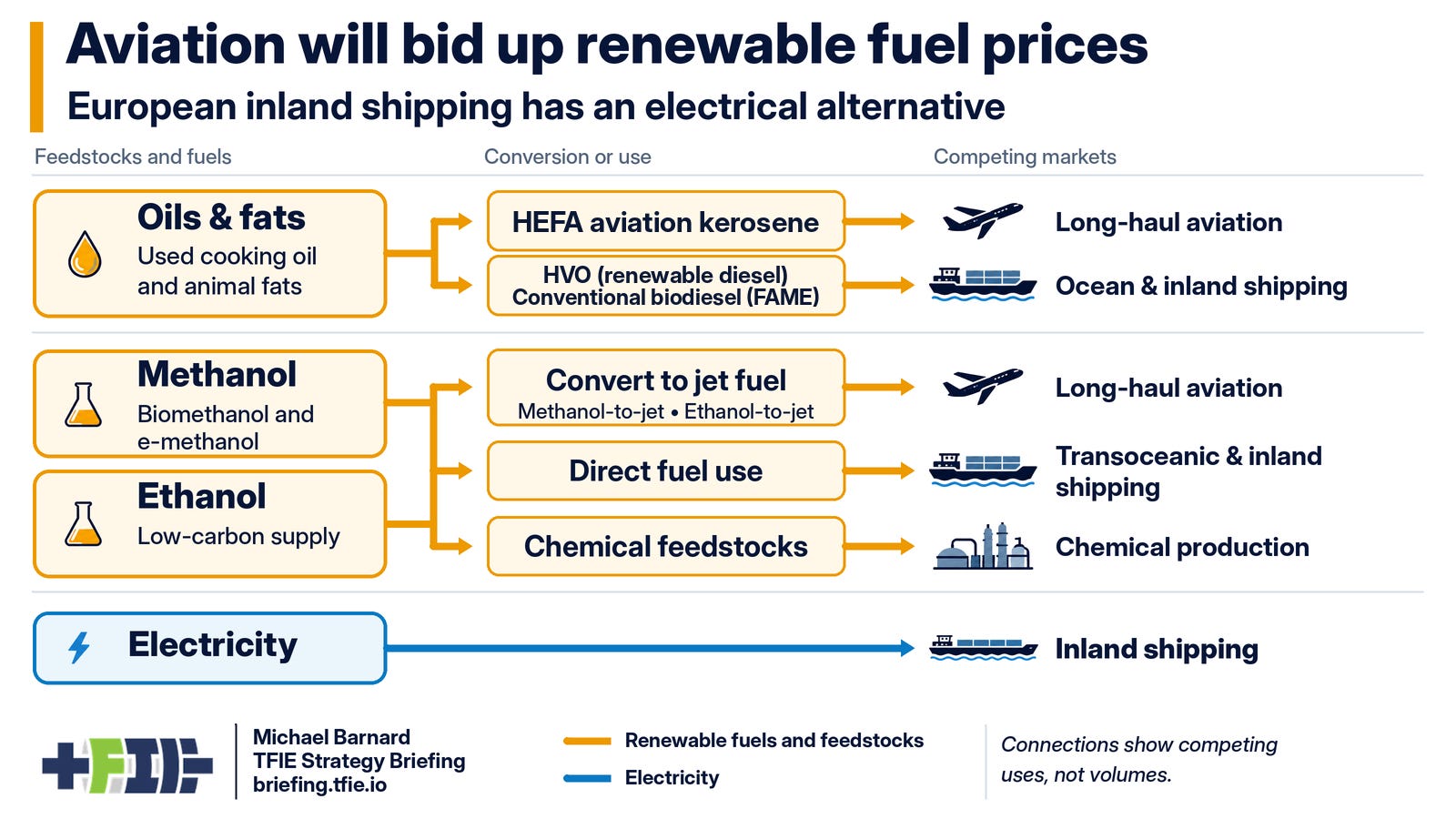
HVO, conventional biodiesel and the most common form of renewable aviation kerosene are made from the same types of oils and fats. Aviation has fewer electrification options, and European mandates require airlines to use renewable kerosene. EASA reports that 80% of the EU’s 1.1 million tons of sustainable aviation fuel in 2025 was made from used cooking oil. My merit order for these molecules prioritizes aviation over water routes that can be served by batteries. The Flemish researchers recognize this competition. Their strong-innovation scenario assumes that most e-fuels, biofuels and hydrogen go to industry and aviation, and that renewable electricity is readily available.
At what fuel price does CCNR’s conservative pathway lose its economic advantage? How badly are synthetic fuels underpriced and batteries overpriced? What does correcting those assumptions mean for inland shipping investment? The analysis below answers those questions.