

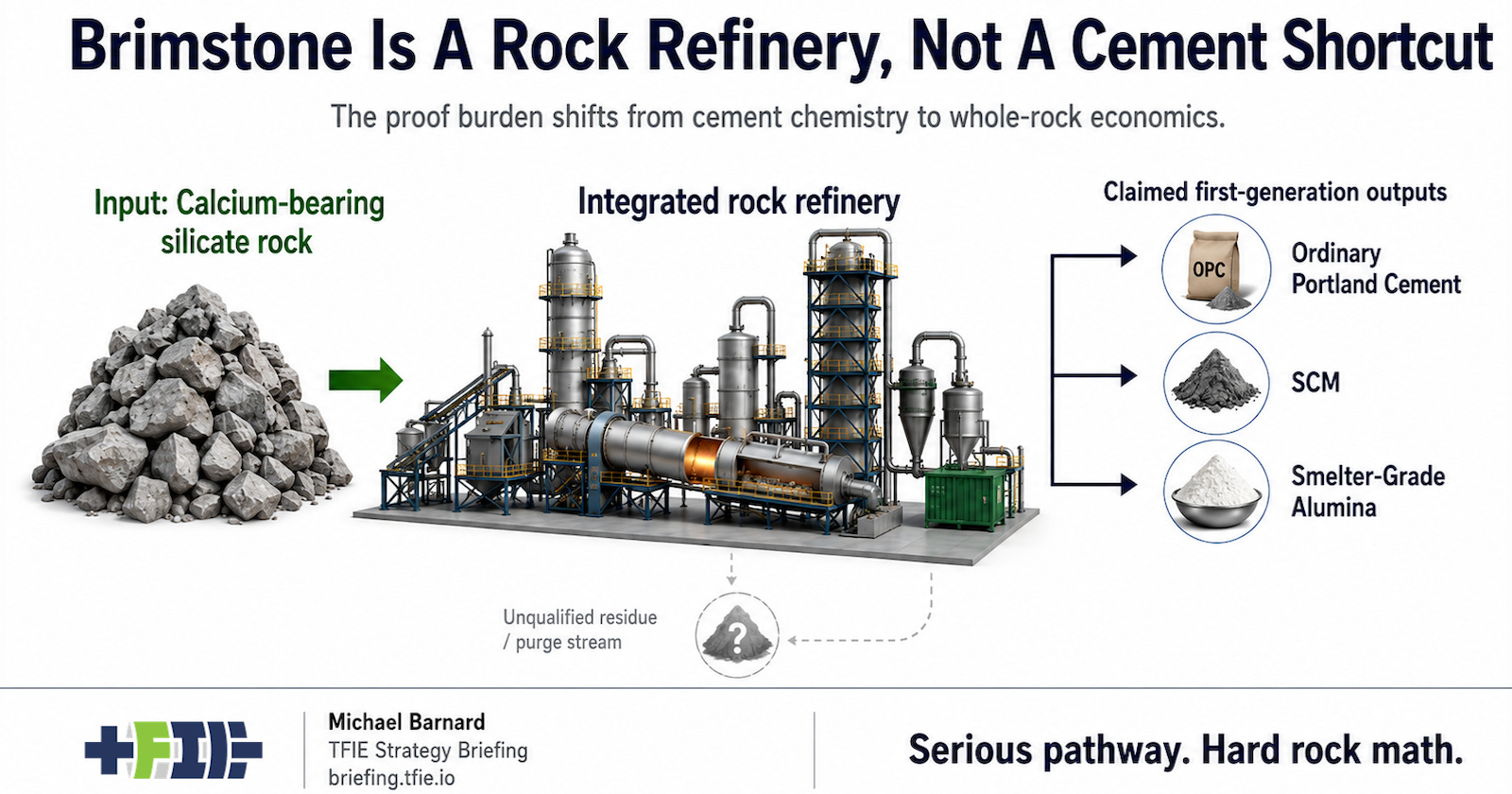
Brimstone first came onto my radar during the cement assessment cycle that led to the Beyond Portland work. The attraction was easy to understand: ordinary Portland cement without the process CO₂ released by limestone. That is a serious target. Cement has a heat problem and a chemistry problem, and replacing calcium carbonate with non-carbonate calcium-bearing rock directly attacks the chemistry problem. The skepticism then was about the denominator. Calcium-bearing silicate rocks can contain far less lime-equivalent calcium than limestone, which means a lot more rock has to be processed to obtain the calcium needed for ordinary Portland cement, leaving a large non-calcium fraction that has to become useful product or managed residue.
Brimstone’s polite answer to that critique, in effect, was that the residual material is not waste because it can become supplementary cementitious material. That is the right answer if it works. It is also not a complete answer. “Use it as SCM” moves the question from disposal to absorption: how much material is produced, whether it performs at useful replacement ratios, where it can be sold, what it competes with, how much processing it needs, and whether it actually displaces clinker rather than another low-carbon SCM.
Brimstone’s current public materials make the issue more interesting. The company is no longer framed only as a low-carbon cement process. Its technology page says the first-generation process produces three products from calcium-bearing silicate rock: Portland cement, SCM and smelter-grade alumina. Its broader “Fourth Great Refinery” positioning extends the roadmap to aluminum, steel, magnesium, titanium and other critical minerals from the same general feedstock. That is not a minor marketing adjustment. It changes the reference class from cement process to rock refinery.
That could be smart. Mature refineries exist because co-production can turn a complex feedstock into a set of saleable products with better economics than any one stream could support alone. The issue is dependency. If the non-calcium fraction of the rock must become SCM, alumina and eventually other mineral products to make the cement economics work, those co-products are not upside. They are the business case.
Brimstone deserves credit on the product side. A lot of alternative cement stories stumble because they require conservative construction markets, engineers, insurers, codes and contractors to adopt unfamiliar binders. Brimstone is targeting ordinary Portland cement. The company says its cement meets ASTM C150, and Amazon-linked third-party testing found that Brimstone’s OPC performed in accordance with ASTM C150 requirements and comparably to conventional materials in Amazon slab mix designs. That does not prove refinery economics, but it does mean the output is aimed at the right adoption bottleneck.
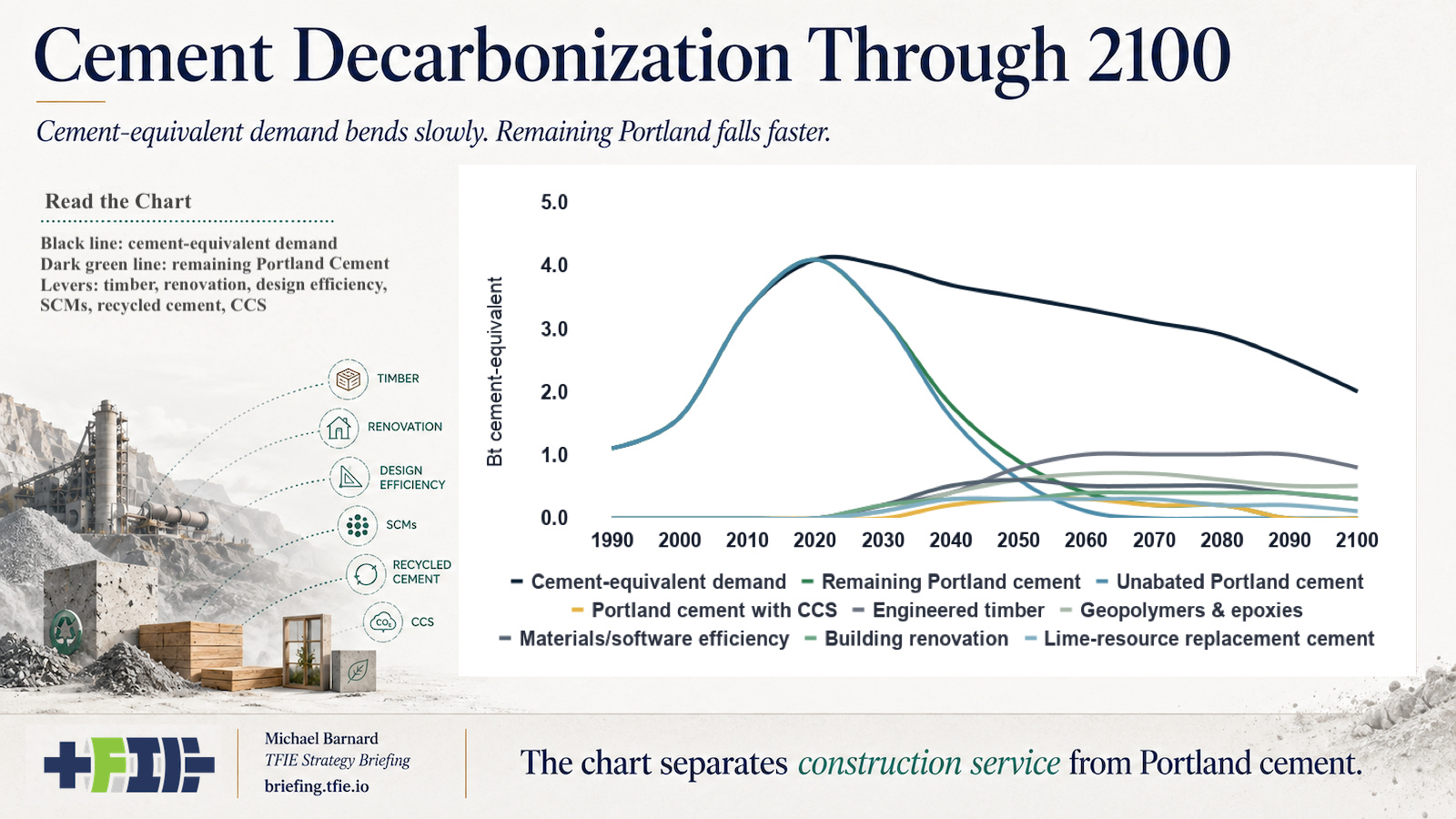
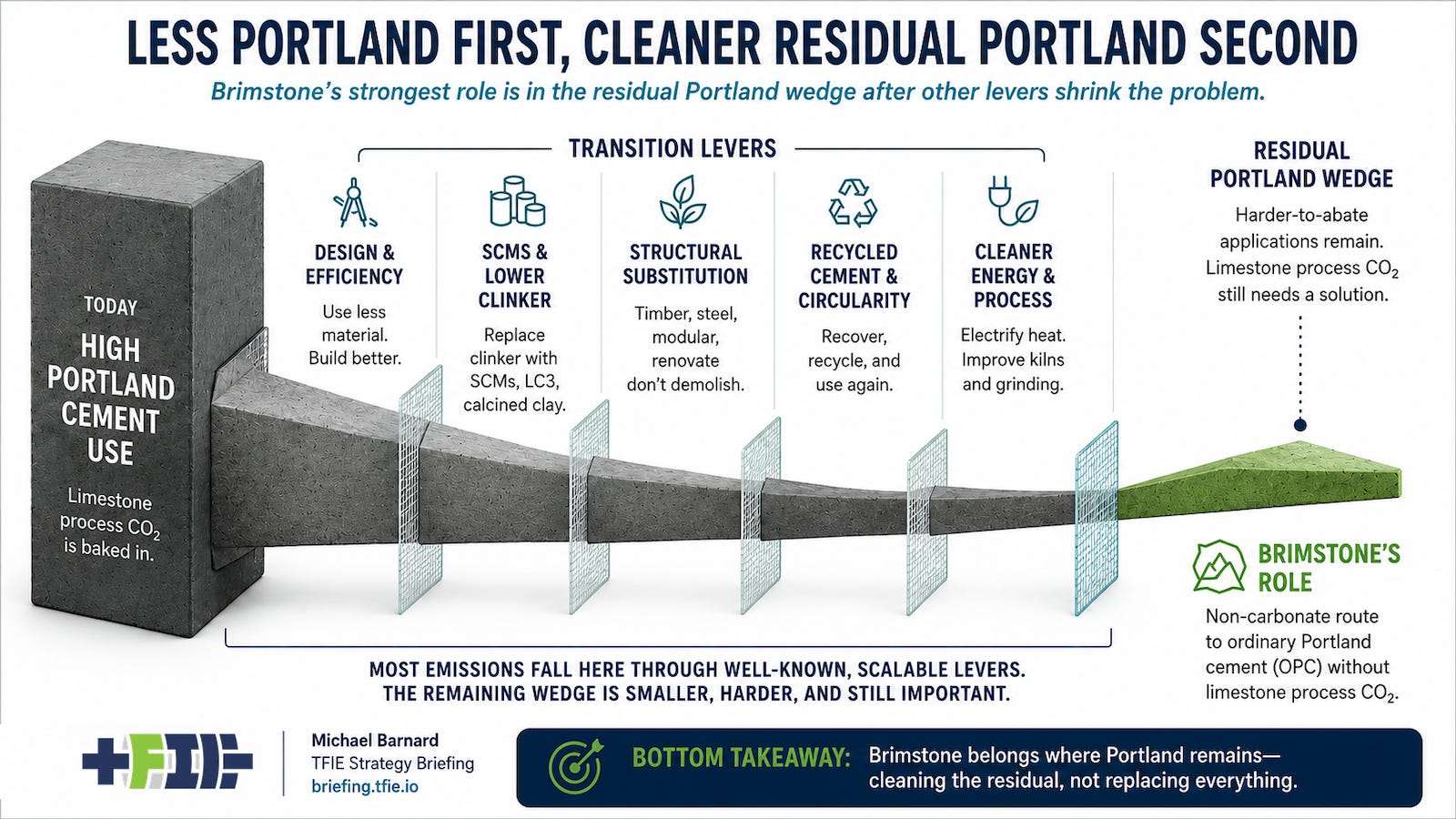
That matters in my Beyond Portland frame. Cement’s future is not one replacement cement sweeping through global construction. It is less Portland first: better engineering, less overbuilding, renovation instead of demolition where possible, mass timber and other structural substitution where suitable, lower clinker factors, SCMs, LC3 and calcined clay where they fit, recycled cement pathways, cleaner heat and selective residual solutions. The Beyond Portland report and the shorter Less Portland, Not One Magic Cement article both make the same point: total construction service does not disappear, but remaining Portland cement falls faster than total cement-equivalent demand.
That makes Brimstone more strategically relevant and more bounded at the same time. It is more relevant because ordinary Portland cement without limestone process CO₂ is exactly the kind of residual-Portland pathway worth watching. It is more bounded because the correct market is not today’s entire Portland cement demand as if every ton remains. The correct market is the residual Portland wedge after the other levers reduce the size of the problem.
The broader product slate also raises a simple alumina question. If Brimstone has a generally superior route to smelter-grade alumina, the obvious high-grade feedstock test is bauxite, where commercial ore typically contains far more alumina than calcium-bearing silicate rock. The Bayer process has a real red-mud problem, and an alternative route would be valuable. But Brimstone is publicly emphasizing non-bauxite calcium-bearing silicate rock, with cement and SCM as co-products. That suggests the alumina claim should be treated as part of a co-production refinery thesis, not yet as proof of a standalone Bayer replacement.
This is a stronger but tougher assessment than my original quicklime critique. Brimstone is not a simple cement shortcut. It is a proposed first-of-a-kind refinery using calcium-bearing silicate rock to make ordinary Portland cement, SCM and smelter-grade alumina, with additional products on the roadmap. That may be the only plausible answer to the mass-balance problem, but it also means the company has to prove the whole rock becomes qualified products at refinery scale.
The outside view is therefore not a cement kiln upgrade. It is a low-grade mineral-refining and FOAK process-industry scale-up problem. Brimstone’s planned demonstration has public-agency context: the DOE page describes a first-of-a-kind commercial-scale demonstration plant producing an estimated 103,000 metric tons per year of ordinary Portland cement, SCM and smelter-grade alumina, while earlier public materials described up to $189 million in federal cost share and a commercial-demonstration target by the end of the decade. That is a meaningful signal of seriousness. It is not a bankable operating result.
My view is that Brimstone passes the seriousness screen and fails the decision-grade economics screen for now. Ordinary Portland cement without limestone process CO₂ is valuable. A rock-refinery story that depends on SCM, alumina and later minerals is a much higher hurdle than an electrochemical quicklime story. The proof will be plant-scale product splits, conservative co-product economics, residue handling, qualification data and repeatable cost, not another roadmap showing more products from the same rock.
Below the paywall is the professional layer: the Executive Diligence Scorecard, source-ranked claim map, feedstock mass-balance workbook, SCM absorption denominator, alumina and co-product stress test, reference-class forecast, cost and schedule scenarios, update triggers and the questions I would ask before treating Brimstone as a scalable residual-Portland solution rather than a promising FOAK rock-refinery claim.
