

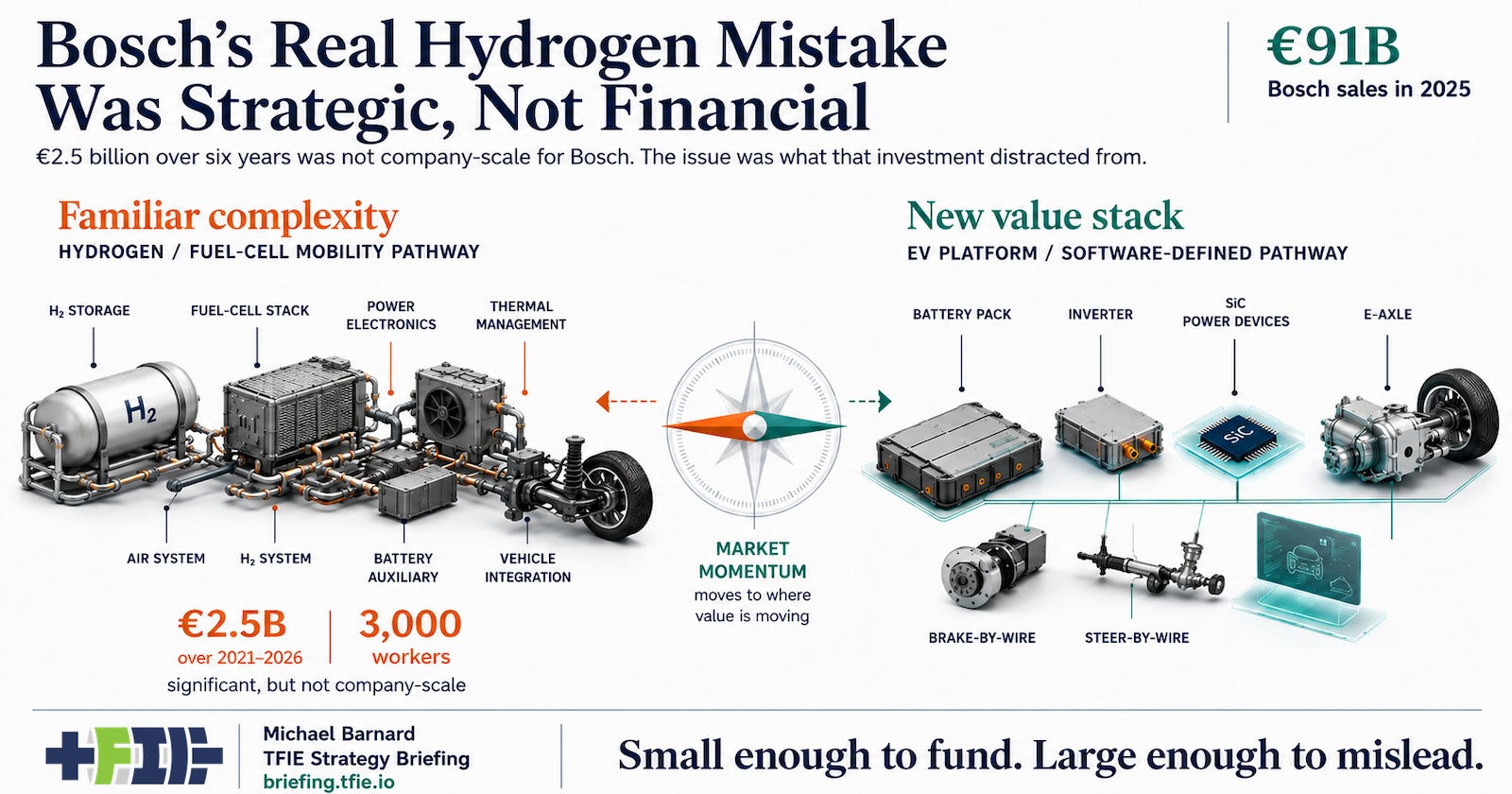
Bosch’s leadership change invites a simple story, which is usually a warning. Stefan Hartung is leaving the top job earlier than expected, Christian Fischer takes over on July 1, and the company is coming off an ugly 2025. Bosch reported €91.0 billion in sales, roughly 413,000 employees, Mobility still made up 61.4% of revenue, and the group posted a €363 million loss after tax. That is a lot of context to compress into “Bosch bet wrong on hydrogen.”
The hydrogen number sounds enormous until the denominator is put back in. Bosch said it would invest nearly €2.5 billion in hydrogen technologies between 2021 and 2026. Spread over six years, that is a little over €400 million a year. In a €91 billion company spending €7.9 billion a year on R&D and another €4.1 billion on capital expenditure, hydrogen was meaningful but not existential. It was not a bet-the-company spend.
That matters because optionality is not the problem by itself. Large industrial firms should place some bounded bets around uncertain futures. Bosch has materials expertise, precision manufacturing, controls, sensors, thermal systems, power electronics, and long experience scaling complicated vehicle components. Electrolyzer components and some industrial hydrogen equipment sit close enough to those capabilities to be worth watching. A serious company does not need perfect certainty before it explores adjacent markets.
The problem is where optionality starts to carry the weight of strategy. Bosch did not merely put a small scouting team on hydrogen. It spoke about hydrogen as a strategic growth field, expected roughly €5 billion in hydrogen-technology sales by 2030, and had more than 3,000 people working on hydrogen technologies. In its 2023 technology-day materials, Bosch said nearly two thirds of the 2021 to 2026 hydrogen investment would go into the fuel-cell powertrain. That is not a minor footnote in a transformation story.
Richard Rumelt’s useful distinction is that good strategy starts with a hard diagnosis. It identifies the real obstacle before it moves to policy and action. Bosch’s hydrogen story looks weak on that first step. The diagnosis embedded in fuel-cell mobility was not simply that road transport needed to decarbonize. That part was obvious. The deeper assumption was that a large part of combustion-era supplier value could be rebuilt around another molecule and another complex powertrain.
That assumption was comfortable for Bosch in ways that should have made it suspect. Fuel-cell trucks preserve tanks, stacks, air systems, compressors, pumps, valves, thermal management, power electronics, system integration, safety certification, service routines, and OEM dependency. Hydrogen engines were even more familiar, with Bosch arguing that more than 90% of the development and manufacturing technologies already existed. This was transition through continuity. It let a world-class automotive supplier imagine that tomorrow’s vehicle value stack might still reward many of yesterday’s strongest habits.
The market has been less accommodating. Battery-electric vehicles do remove parts of the old powertrain value pool, but they also move value into battery packs, inverters, silicon-carbide power devices, e-axles, brake-by-wire, steer-by-wire, thermal systems, software layers, vehicle operating systems, data, services, and manufacturing discipline. That is not a simpler world for suppliers. It is a different one, with different cycles, different customers, different margins, and a much faster Chinese reference class.
Bosch knows this. Its own annual report is blunt about electromobility advancing at different speeds, much more slowly in Europe and North America than in China. It also points to intensified competition and price pressure from strong Chinese suppliers. Elsewhere in the report, Bosch says it has adjusted the organization of its China business to increase autonomy, speed, and market proximity. That is the right language. The question is why the same diagnostic discipline was not applied earlier and more ruthlessly to fuel-cell mobility.
The point is not that every hydrogen activity at Bosch was foolish. Industrial hydrogen will remain a real molecule in real industries. Electrolysis equipment has a plausible role if the customers, power prices, utilization, and policy support line up. Bosch’s Hybrion PEM electrolysis stack is a more defensible adjacency than trying to make hydrogen road transport look like the next large automotive platform. The distinction matters because hydrogen is not one market. It is a label covering very different use cases with very different comparators.
Fuel-cell mobility has the weaker denominator. It needs vehicles, customers, refueling stations, high utilization, cheap low-carbon hydrogen, reliable maintenance, repeat procurement, and policy support strong enough to keep all of that moving. My prior review of hydrogen transport found that hydrogen mobility has been contained, not commercialized, and the German refueling network has already shown the same basic denominator problem in infrastructure form. Bosch’s own 2023 hydrogen remarks leaned heavily on the need for governments to solve the infrastructure and market-development problem. That should have been read less as a policy request and more as a commercial warning.
China sharpens the point. China has tested hydrogen trucks and buses, but even there hydrogen trucks remain a policy side bet, not the main vehicle transition. The main vehicle transition is battery-electric, fast, integrated, and increasingly domestic. For a global automotive supplier, that matters more than hydrogen announcements, because China is no longer just another market. It is the live reference class for product cycles, cost compression, platform speed, and supplier localization.
That is where the strategic cost becomes measurable. The direct financial cost was tolerable. The opportunity cost was scarcer and harder to see on a balance sheet: senior attention, factory planning, engineering allocation, transition narrative, and the internal comfort of working on a future that resembled the past. More than 3,000 people working on hydrogen is not just headcount. It is thousands of engineer-years inside a period when automotive value was shifting quickly toward batteries, power electronics, software-defined vehicles, by-wire systems, ADAS, and China-speed platform cycles.
The China contrast is important because it avoids the lazy conclusion that Bosch is simply an incumbent that cannot adapt. Bosch is not stupid. It remains one of the most capable industrial suppliers in the world, and parts of the company are already participating in the EV and software-defined vehicle stack. The problem is narrower and more useful: even good companies can give too much organizational weight to a familiar option because it preserves the logic of the old business.
That is the Rumelt lesson. Bad strategy does not always announce itself as fantasy. Often it arrives as a plausible adjacency, backed by real engineering, real factories, real executives, and real subsidies. It becomes bad strategy when it blurs the diagnosis. Bosch’s hydrogen mistake was not that it spent enough money to damage a €91 billion company. It was that fuel-cell mobility helped keep the old powertrain imagination alive while the competitive battlefield moved toward a different value stack.
The better guiding policy would have been more severe. Treat industrial hydrogen and electrolyzer components as bounded options. Treat fuel-cell road transport as a monitored niche until utilization, customers, fuel cost, and repeat procurement prove otherwise. Put the main weight of Mobility transformation into the parts of the vehicle stack where value is actually moving: power electronics, semiconductors, electric drive units, braking and steering systems, software, data, ADAS, thermal systems, and fast China-local integration.
That may well be where Bosch is going now. The job cuts in Germany, the pressure on Mobility, and the leadership handover all point to a company under real strain, not a company sunk by one hydrogen program. But the hydrogen story remains useful because it shows a familiar climate-tech red flag: optionality can become strategically expensive before it becomes financially dangerous. The balance sheet can absorb the option. The organization may still learn the wrong lesson from having funded it.
Free Briefing posts carry the public argument. Paid TFIE Strategy Briefing posts add the professional layer: denominator checks, evidence notes, scorecards, update triggers, and decision-grade context for people working around the transition.
https://substack.com/@michaelsura/note/p-211810267?r=253d6o&utm_source=notes-share-action&utm_medium=web