

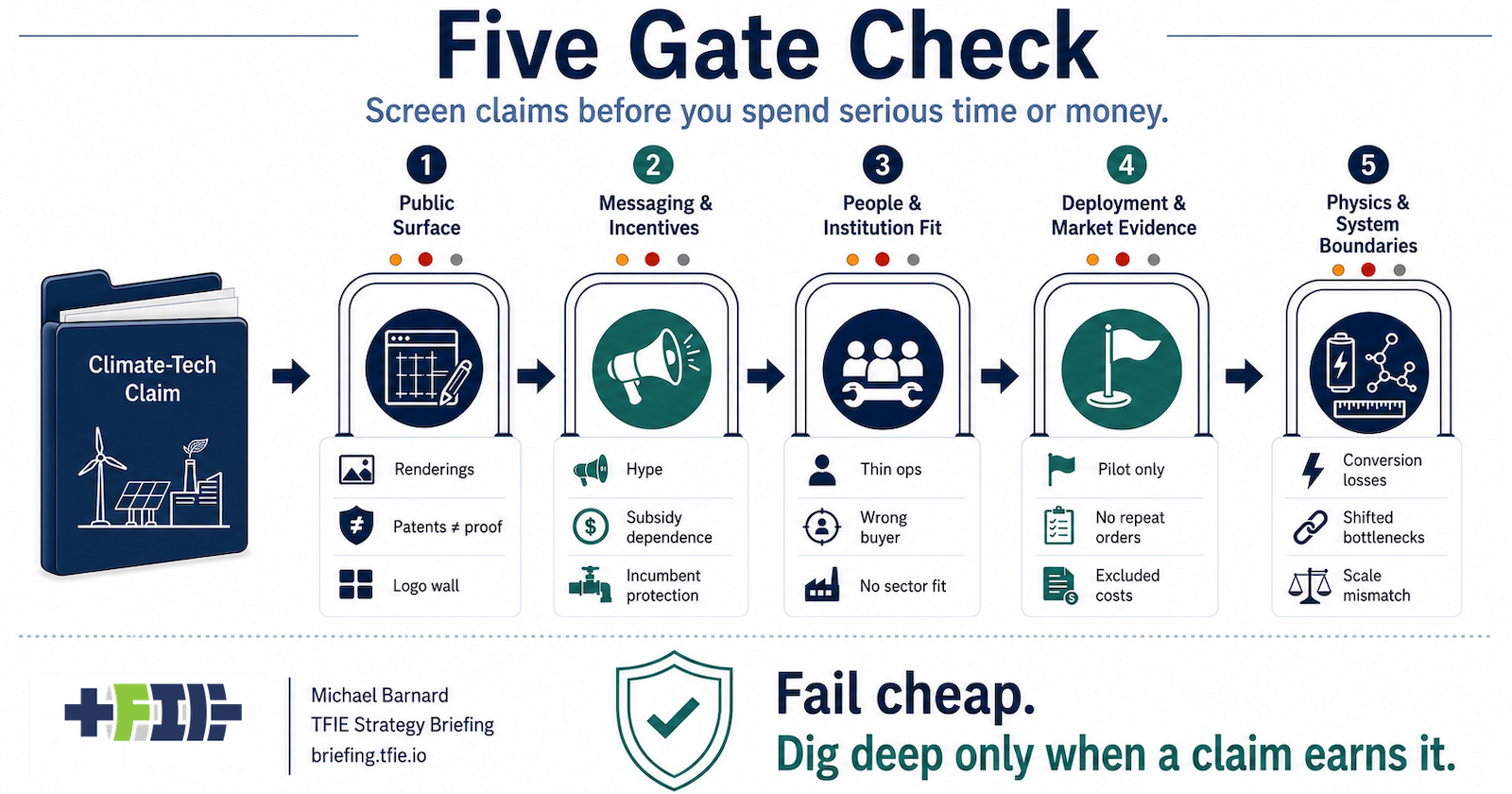
Climate-tech failures are often less mysterious than they look in hindsight. The warning signs are usually visible early: on the website, in the patent language, in the partner list, in the absence of real customers, or in the way promoters avoid ordinary operational questions until those questions become unavoidable.
After enough exposure to firms, project proposals, investor decks, procurement claims, policy submissions and press-release ecosystems, the pattern becomes familiar. Weak claims often ask for money, policy support or executive attention before they have cleared the simple tests. Red flags are how to decide whether the next step should be deeper diligence, a sharper question set, or a hard pause.
Red flags are not automatic disqualifiers. A young company can have thin evidence, a first project can be messy, and a serious industrial pathway can begin with an awkward demonstration. A useful technology can be poorly described by its marketing team, and a weak technology can be dressed up in sober language. The point of a red-flag checklist is triage. It helps decide whether a claim deserves the next hour, the next diligence call, the next procurement meeting or the next million dollars. It is also the front end of a more formal review: a way to decide whether a claim deserves deeper diligence, a hard no, or a sharper question set.
The order matters. Start with the cheap checks. Public claims, websites, press releases, team pages, partner logos, customer announcements and old history can often tell you enough to slow down before you spend time on deeper technical analysis. If the first pass already shows a stack of red flags, the right move is usually not to admire the complexity of the claim. It is to ask why the promoter has not cleared the simple tests.
Start With The Public Surface
The first pass should be simple. Look at the claim as presented to the public. The website, press releases, partner logos, team page, patents, customer announcements and funding history usually tell you a lot before you get near a data room. The question is not whether the public material proves the company is weak. It is whether the public material tells you where the burden of proof has already shifted.
Basic tests:
Is the company mostly showing renderings, animations, concept facilities or future-tense claims?
Are partner logos doing more work than customer contracts?
Are patents being treated as operating evidence?
Are grants and awards being presented as if they were market validation?
Does the claim ride the current policy wave — hydrogen, AI, carbon removal, nuclear, critical minerals or defense funding — without explaining why this specific solution survives after the wave moves on?
Does the company have a long trail of pivots, prior failures or recycled claims under new branding?
Is the technology a repeat of an approach which has been tried and failed before, and if so, what’s different?
That public-surface test is not cynicism. It is efficient. Many weak claims ask readers to accept a finished future while providing only a staged present. Renderings, pilots, memoranda, patents, awards and grants can all matter in the right context, but they do not carry the same weight as an operating plant, repeat procurement, verified performance, real customer demand or a market that persists after public support thins out. Promoters often want early-stage signals treated as if they were late-stage proof. They are not.
History matters here. Some ideas come back every decade with new language and the same denominator. Hydrogen-for-road-transport, small modular reactors, airborne urban taxis, ocean carbon removal, synthetic fuels for ordinary combustion, magical storage chemistries and fuel-saving devices all have long back catalogues. A claim may be new in execution, but if the category has been failing for decades, the promoter should be able to explain clearly what changed: materials, costs, regulation, customer demand, manufacturing, infrastructure or the physics of the system. “This time is different” is not a reason. It is a request for evidence.
Read The Messaging Before You Read The Model
Messaging is another cheap screen. Weak claims often reveal themselves in how they are sold, especially when the public material is doing more persuasion than explanation. Marketing does not prove a technology is bad, but it can tell you where to look and how much weight the promoter expects narrative to carry.
Basic tests:
Does the pitch spend more time attacking batteries, wind, solar, grids, heat pumps, rail or other working clean technologies than proving its own case?
Do fossil incumbents promote it because it preserves fuel flows, combustion assets, pipelines or delay?
Does the company lean on novelty language as evidence: breakthrough, game-changing, military-grade, AI-enabled, first-of-a-kind or all-of-the-above?
Does the narrative avoid maintenance, reliability, warranties, safety, customer adoption, permitting, insurance and unit economics?
Does the claim protect an existing business model more clearly than it solves the climate problem?
Does the pitch treat policy support as proof rather than as a reason for more scrutiny?
Incentives are rarely hidden very well. If a solution allows an incumbent to keep selling molecules, keep using existing pipelines, keep delaying electrification, keep booking reserves, keep public subsidies flowing or keep regulatory attention away from cheaper alternatives, that does not automatically make the solution wrong. It does raise the burden of proof. The more a climate claim protects the existing business model, the more it has to show that it is solving the climate problem rather than preserving the incumbent one.
There is a basic rule of thumb here: if the pitch needs three miracles and a subsidy regime, it is not yet a business. It may be research, industrial policy or something worth watching, but it should not be treated as a bankable transition pathway until the miracles have been replaced by evidence.
Test The People And The Institution They Need To Sell To
The next cheap screen is the people and institutional fit. Climate tech often fails at the boundary between technology and the institutions that have to buy, permit, operate, insure, maintain and regulate it. A team can be smart and still poorly matched to the market it is trying to enter. Outsiders can be useful, especially in sectors where incumbents have normalized bad constraints, but the team still needs contact with operating reality.
Basic tests:
Do the principals have relevant sector, engineering, regulatory, deployment or customer experience?
Is the team strong in fundraising and communications but weak in operations?
Are advisors mostly prestige names rather than people who have carried delivery risk?
Is the claimed customer the natural buyer, or merely the most sympathetic audience?
Does the pitch assume utilities, airlines, ports, mines, steelmakers, transit agencies, farmers, fleet operators or building owners will reorganize themselves around the startup’s convenience?
Does the company compare itself only with today’s fossil incumbent rather than the best available clean alternative?
Is the firm trying to sell a device into a system it does not appear to understand?
Utilities, airlines, ports, mines, steelmakers, transit agencies, farmers, fleet operators, building owners and industrial firms are not empty boxes waiting for a startup to define their problem. They have budgets, crews, safety rules, asset lives, debt covenants, regulators, unions, customers and weather. Any solution that assumes those institutions will change faster than the technology has proven itself is starting with a large unpaid bill.
This is where a lot of hydrogen, eVTOL, novel nuclear and carbon-removal claims start to wobble. They are rarely just technology claims. They are claims that maintenance shops, regulators, insurers, airport operators, grid operators, procurement teams and customers will all move in the right order at the right speed. That can happen, but it deserves evidence rather than optimism surrounded by a logo wall.
Look For Deployment Evidence Before Admiring The TAM
If the public surface, messaging and team do not already create a red-flag stack, the next question is whether the claim has moved beyond demonstration theatre. Even if a technology works, it still has to become a business, a procurement pathway or a public infrastructure program. A technology can exist, move, capture, produce or convert something and still fail as a market.
Basic tests:
Does the market exist only because of grants, mandates or demonstration funding?
Is every deployment called first-of-a-kind while repeat procurement is missing?
Do cost claims exclude maintenance, labor, permitting, downtime, safety, insurance, infrastructure, spares or decommissioning?
Does the business model need cheap clean electricity, cheap hydrogen, cheap captured CO₂, cheap capital, high carbon prices, patient customers and forgiving regulators at the same time?
Is there a real customer with operating exposure, or only a partner, host site or public funder?
Repeat procurement matters more than launch events. A transit agency buying one hydrogen bus pilot with public support tells you little. A transit agency buying hundreds of battery-electric buses after operating the first batch tells you more. A port electrifying yard equipment after learning from early chargers tells you more than a concept image of a future hydrogen terminal. A steelmaker paying for electric arc furnace capacity where scrap and power fit tells you more than another hydrogen direct-reduction announcement without ore quality, power price, gas price, capital cost or buyer willingness attached.
The comparison set matters just as much. Hydrogen for building heat should be compared with heat pumps, not just with natural gas boilers. E-fuels for passenger cars should be compared with battery-electric vehicles, not just gasoline. Direct air capture should be compared with avoided emissions, industrial point-source capture where appropriate, durable biological removal where appropriate, and the opportunity cost of the energy it consumes. Novel nuclear should be compared with the delivered cost, speed and modularity of wind, solar, storage, transmission, demand response and existing firm low-carbon options, not with a coal plant from another era.
Then Test Physics And System Boundaries
Physics and system boundaries are the deeper screen, although obvious violations can stop the process immediately. The reason to put this layer after the cheap public checks is practical. Many claims do not deserve a detailed technical teardown because they have already failed simpler tests. I lean into this part because I’m a broad-spectrum nerd, but many firms don’t deserve the attention.
Basic tests:
Does the solution claim to overcome well supported limitations like wind energy’s Betz Limit?
Does the solution fight thermodynamics, energy density, round-trip efficiency, heat losses or materials limits?
Does it use high-value electricity to make low-value energy when direct electrification exists?
Does it add conversion steps without explaining why each loss is worth it?
Does it shift the hard problem to infrastructure, logistics, permitting, water, CO₂ transport, hydrogen supply, grid interconnection, skilled labor or insurance?
Is the demonstration at grams, kilograms, kilowatts or single vehicles while the claimed market is tonnes, gigawatts, fleets or national systems?
Does the system require many independent changes to happen at once?
The conversion chain is often the clue. If electricity becomes hydrogen, hydrogen becomes a carrier, the carrier becomes another fuel, and that fuel becomes motion in a vehicle, every step needs to earn its place. If a carbon-removal claim depends on large energy inputs, clean CO₂ transport, durable storage, monitoring, liability management and cheap capital, the plant is only one piece of the problem. If a novel aircraft claim depends on certification, airport changes, new maintenance regimes, insurance comfort, weather tolerance and new route economics, the vehicle is not the whole system.
Scale is its own test because scaling is not just multiplication. It brings supply chains, siting, permitting, quality control, safety cases, working capital, maintenance, spares, trained labor and customer adoption. A kilogram-per-day technology claiming a gigaton market has not merely left some work to do. It has left almost all of the important work to do.
Patterns Repeat Across Sectors
There are sector-specific versions of these tests, but the pattern repeats. Hydrogen road transport struggles with energy losses, fuel cost, station utilization, maintenance and battery-electric comparators. Ocean carbon capture struggles with seawater chemistry, fouling, energy inputs, monitoring and ecological boundaries. Direct air capture struggles with dilute CO₂, energy demand, cost, storage and opportunity cost. Urban air mobility struggles with noise, safety, certification, utilization, weather, landing infrastructure and the fact that cities already have better high-capacity mobility tools. Small modular nuclear struggles with cost, construction time, regulatory duplication, supply chains and the loss of the very economies of scale nuclear historically depended on.
That does not mean every technology in those categories fails. It means each has to clear a higher bar because the category has already accumulated scar tissue. A strong claim should be able to say what is different now, what has been proven independently, what costs are included, what customer has bought it without theatre, what scale has been achieved, what risks remain, and which better alternatives it has beaten. If those answers are not available, the next diligence step should be slower, not faster.
Red Flags Compound
The checklist is useful because red flags compound. One red flag often means a reasonable question. Two or three may mean the company is early, the market is immature or the public material is weak. A stack of them changes the burden of proof. A weak public surface, evasive messaging, thin operating experience, missing repeat procurement, unfavorable physics, subsidy-only demand and fossil-incumbent sponsorship are not separate curiosities; they are a pattern.
Good climate-tech work survives dull questions. Who buys this, what does it replace, what is the full system boundary, what is the energy input, what breaks at scale, what standards apply, who maintains it, what happens when it is down, what does it cost without excluding inconvenient line items, what happens when the subsidy ends, and what is the best alternative it has to beat? None of those questions is glamorous. That is why they are useful.
The point is not to become reflexively negative. The transition needs new firms, tools, industrial processes, infrastructure, software, materials and some technologies that will look awkward before they look obvious. Skepticism should not become a brand identity. But scarce attention is a real constraint. Public money, private capital, procurement bandwidth, grid capacity, skilled labor and policy focus should not be wasted on claims that fail the first serious pass.
Red flags help decide where to look harder. They do not replace due diligence; they start it. Organizations looking at a specific climate-tech firm, project proposal, procurement option or investment thesis can use this as a starting point. Commission TFIE Strategy for a focused red-flags review when a specific company, proposal, procurement option or investment thesis needs fast, independent screening before the next diligence step.
Subscribe to TFIE Strategy Briefing for the deeper diligence layer: denominator checks, comparator cases, scorecards, workbooks, update triggers and decision context for climate-tech claims that want money or policy support. Many technologies already have the red-flags test.