

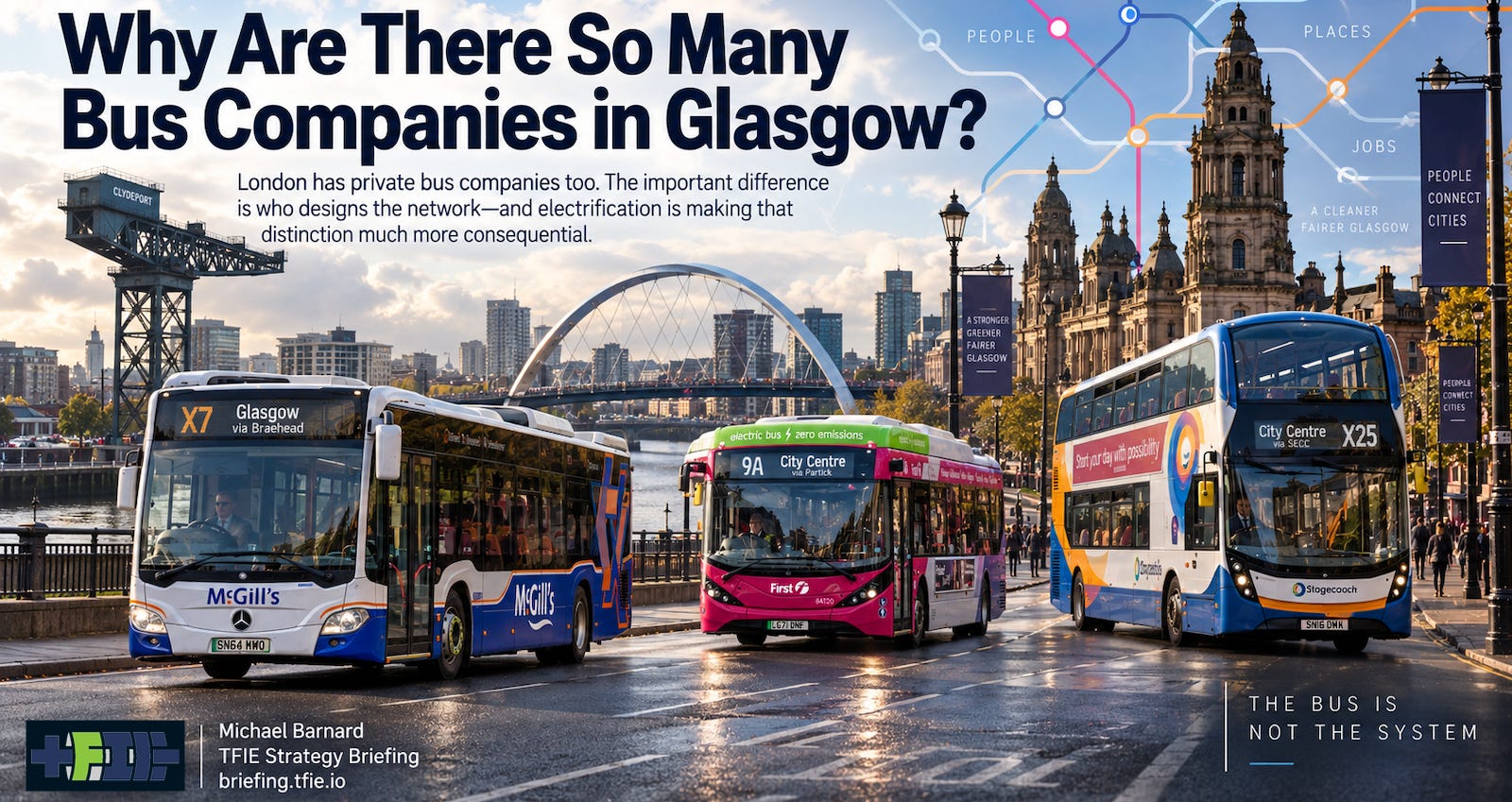
Walk around Glasgow as I did for a week this summer and the buses advertise their corporate identities. First Glasgow, McGill’s and Stagecoach have distinct liveries, and other operators serve parts of the surrounding region. It can seem an odd way to organize public transport. London has numerous private bus companies too, but passengers largely encounter one Transport for London network, with common fares, information and service standards. Glasgow’s different buses are the visible consequence of a much more consequential institutional distinction. In one city, the public authority decides what passenger network it wants and hires companies to operate it. In the other, commercial operators have historically made many of those network decisions themselves.
The explanation begins with the Transport Act 1985, which deregulated most local bus services outside London from October 1986. Until then, much of Glasgow’s bus system had been operated through the public Strathclyde transport organization. Deregulation separated the operating business from the public authority and gave companies broad freedom to register commercially viable routes and timetables. The former public operating business was subsequently privatized, while operators serving surrounding districts competed, expanded and consolidated. The companies visible today are the descendants of that restructuring, not the product of a contemporary decision to divide Glasgow into separate passenger networks.
The early results were striking. Research into the initial effects of deregulation in Strathclyde recorded 83 operators across the region, twenty more than before the reforms, and more than 2,000 notified changes to unsubsidized services in the period examined after the initial regulatory standstill. Those figures describe the wider region nearly forty years ago, not the number of operators in Glasgow today. They nevertheless capture the scale of the experiment. Bus companies could respond to commercial opportunities by adding, withdrawing or modifying services without waiting for a public authority to redesign the network as a whole. The expectation was that competition and commercial initiative would produce a better and more efficient transport service.
London pursued competition differently. Instead of allowing companies to determine much of the passenger network, its transport authority retained control over routes, frequencies, fares and service standards. Private companies compete for contracts to operate services that the authority specifies. The operators still have to manage drivers, vehicles, maintenance, depots and day-to-day reliability, and they have strong incentives to control costs. The difference is that they are competing to deliver portions of an integrated public service rather than independently choosing much of the service being sold to passengers. Both models use private-sector expertise and competition. They simply place competition at different levels of the system.
Why does that matter to the person standing at a bus stop? Consider someone travelling across Glasgow to an evening shift, perhaps using two services operated by different companies. Each operator may be running its part of the journey competently. The first bus may be frequent and reliable, but that is worth considerably less when the second runs hourly or finishes before the shift ends. An individual route can be economically rational for the company operating it while the complete journey remains inconvenient, expensive or impossible. For passengers without access to a car, the consequences can extend well beyond a longer wait. The ability to reach employment, education and healthcare depends on how the services fit together, not merely on how efficiently each bus is operated.
Glasgow has not ignored those interfaces. ZoneCard provides travel across participating buses, ScotRail and Subway within selected zones, offering a common ticket for people whose journeys cross operator or transport-mode boundaries. Strathclyde Partnership for Transport, or SPT, also supports services that the commercial market would not otherwise provide. These are useful and longstanding forms of integration. They do not mean that SPT specifies the complete commercially operated regional bus network as Transport for London does. Nor does a common ticket determine which destinations should be connected, what evening frequency is adequate or whether an important transfer should be redesigned. Fare coordination solves part of the passenger’s problem. Network planning is a larger responsibility.
Competition itself is not the villain in this story. Studies of Britain’s first decade of deregulation found substantial reductions in the real cost of operating buses. That matters because labour, maintenance, purchasing and vehicle utilization are major costs, and money spent inefficiently cannot be spent on additional service. London also achieved substantial operating-cost reductions through competitive tendering while retaining public network control. The distinction challenges a familiar claim about the British experiment: improvements in operating efficiency do not establish that private companies must also be responsible for deciding the metropolitan route network. Competition can discipline the production of bus services without requiring the passenger network itself to be the product of separate commercial decisions.
Edinburgh and Dublin provide further evidence that the choices are not simply public versus private. Edinburgh developed a comparatively coherent service around Lothian Buses, a dominant municipally owned operator working within Scotland’s deregulated framework. Dublin’s National Transport Authority specifies a common passenger network while using both the publicly owned Dublin Bus and privately operated Go-Ahead Ireland to deliver services. Neither arrangement is identical to London’s, and each has its own institutional history. What they demonstrate is that operator ownership, commercial competition and responsibility for the passenger network can be combined in several ways. A city does not have to choose between a public monopoly and a collection of independently planned private services.
For Glasgow, the practical question is what belongs under common metropolitan responsibility. Someone needs to be accountable for whether routes connect useful destinations, frequencies and operating hours support real journeys, fares work across the system and service changes improve the network rather than simply individual routes. Operators still need freedom to perform the tasks they understand best, and public authorities need enough competence and funding to exercise the responsibilities they assume. Different company names on buses need not matter very much to passengers when the services behind them form a coherent whole. They matter considerably more when corporate boundaries determine the choices available to someone trying to cross the city.
Glasgow’s regional transport authority is now examining a different allocation of those responsibilities. SPT approved the development of bus franchising in March 2024, adopted a regional bus strategy in September 2025 and commissioned a formal franchising assessment in 2026. The work concerns the wider twelve-authority Strathclyde region, not just Glasgow City. Under a potential franchise, SPT could specify the passenger network while operating companies competed to deliver services. That would not necessarily require public ownership of First Glasgow, McGill’s or the other companies. As of October 2026, however, the statutory assessment is still under way, with independent audit and statutory scrutiny ahead. The proposed reform is a live policy choice, not an improvement already delivered.
Franchising would not guarantee better service. A public authority can design poor routes, set inadequate frequencies, make expensive contracting decisions or fail to respond to passengers just as commercial operators can make mistakes. The potential benefit lies in giving one accountable institution the responsibility and means to improve the complete network, with operators competing or otherwise being engaged to deliver it. Glasgow’s debate therefore concerns much more than bus-company ownership, paint schemes or the mechanics of procurement. It is about whether decisions affecting the same passenger journey should be made independently by several companies or coordinated across the region they collectively serve.
The buses on Glasgow’s streets provide a surprisingly useful window into Britain’s forty-year transport experiment. The enduring lesson is not that public buses are necessarily better than private buses, or that competition has failed. It is that competition in operating buses and responsibility for designing a passenger network are fundamentally different things. The complete journey is what passengers need. The operating company is one of the organizations required to deliver it.
The Bus Is Not the System — Metropolitan Transit Governance examines that distinction across Britain and Ireland, including the economic evidence, passenger outcomes and the growing significance of electrification infrastructure. The full 84-page Strategy Report and supporting Evidence Book provide the detail for transport authorities, operators, policymakers and investors. For access to the Evidence Book or related advisory work, contact Michael Barnard.
This is the first of five articles examining the report’s findings. Next: how a bus network can appear more productive while providing less service.