
Open TFIE Strategy report · 83 pages · October 2026
Why are there so many bus companies in Glasgow?
It sounds like a piece of local transport trivia. It isn’t. Private companies operate buses in London too. The important difference is that London kept the passenger network itself under public specification: routes, service levels, fares and many of the rules passengers experience are designed as one system, while private operators compete to run pieces of it.
Glasgow emerged from a different experiment. Outside London, Britain’s 1980s bus reforms gave commercial operators much more discretion over where and when services ran. Edinburgh developed differently again around a dominant council-owned operator. Dublin combines public network specification with both public and private operation. Greater Manchester is now moving the boundary again through metropolitan franchising.
Those differences expose a question that has been obscured by decades of argument about public versus private buses: Who owns the problem of making the whole metropolitan network work? That question has become substantially more important with electrification.
The passenger buys a network
Passengers do not buy buses, operators or contracts. They buy the prospect that an entire journey will work.
The first bus has to arrive. The connection has to be usable. The fare and transfer rules have to make sense. Information has to survive an operator boundary. Accessibility has to work at every stage. The return service still has to exist at the end of an evening shift.
A perfectly clean, efficiently operated and punctual bus can therefore be one component of a poor passenger product.
That distinction changes the familiar debate. Competition and public network planning are not opposites. The useful question is where competition adds discipline and innovation, and where coordination across routes, operators and contracts creates more value.
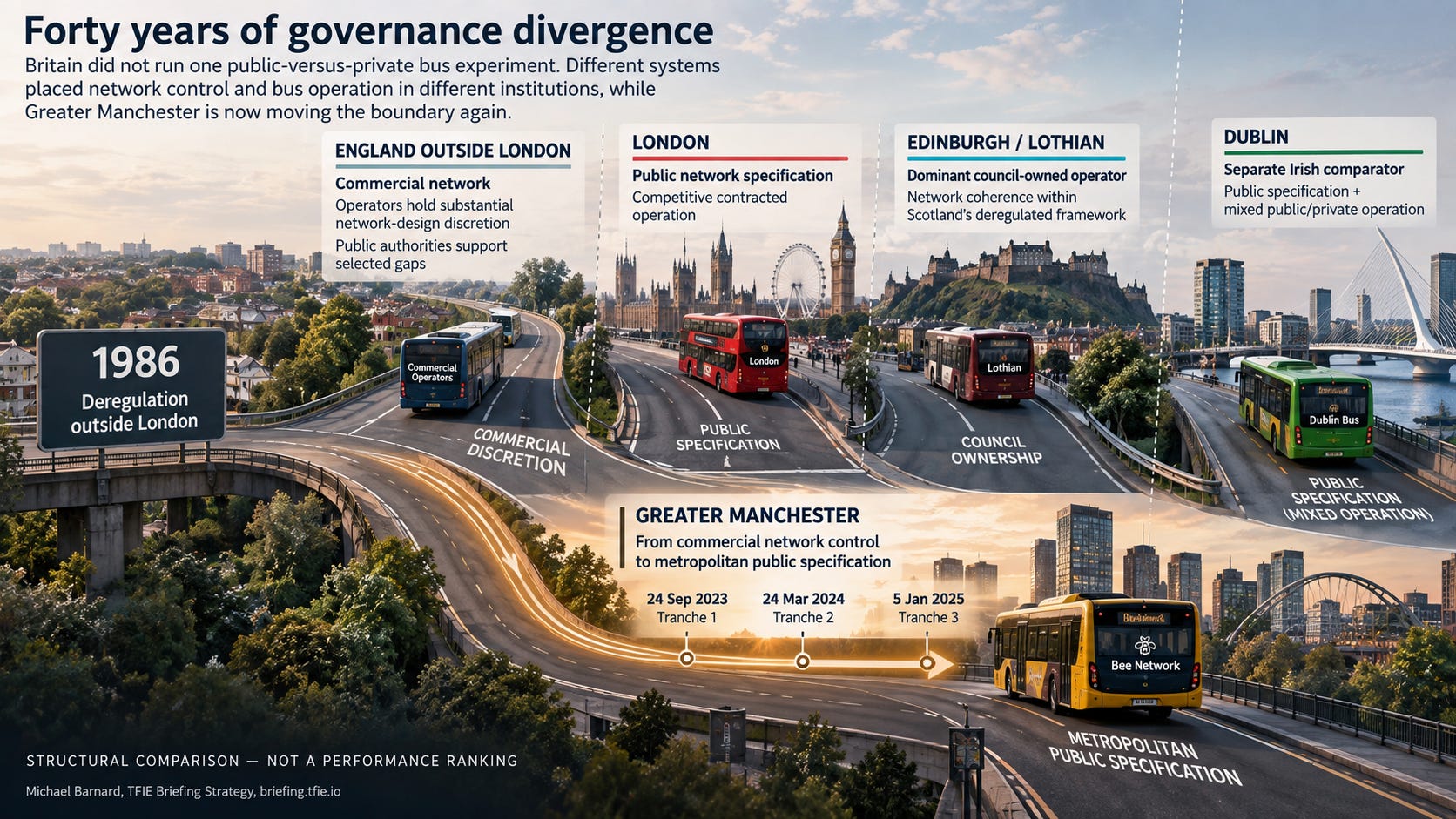
The report compares Britain and Ireland’s different institutional arrangements not as a league table, but as ways of separating the network-design problem from the bus-operating problem.
Five findings that matter beyond buses
Competition does not require commercial control of the passenger network. London demonstrates competitive private operation inside public network specification; Dublin combines public and private operation inside one authority-defined network.
A better operating ratio can conceal a worse passenger product. England outside London recovered passenger journeys faster than service mileage after COVID, making journeys per service mile look better even though less service was being supplied. Production efficiency, passenger utility and welfare are different accounts.
Electrification turns institutional boundaries into physical ones. Depots, substations, chargers and grid connections can remain in place for decades even when routes, operators and contracts change.
The first operating contract is not the decisive test. The harder question is whether a successor operator can obtain the fleet, depot access, charging capability, grid capacity, data and transition rights needed to run the next contract.
The practical starting point is the next difficult-to-reverse decision. Authorities rarely begin with a blank sheet. Fleet orders, depot leases, grid applications, contract extensions and network changes are already moving. The useful task is to identify what is becoming fixed before options disappear.
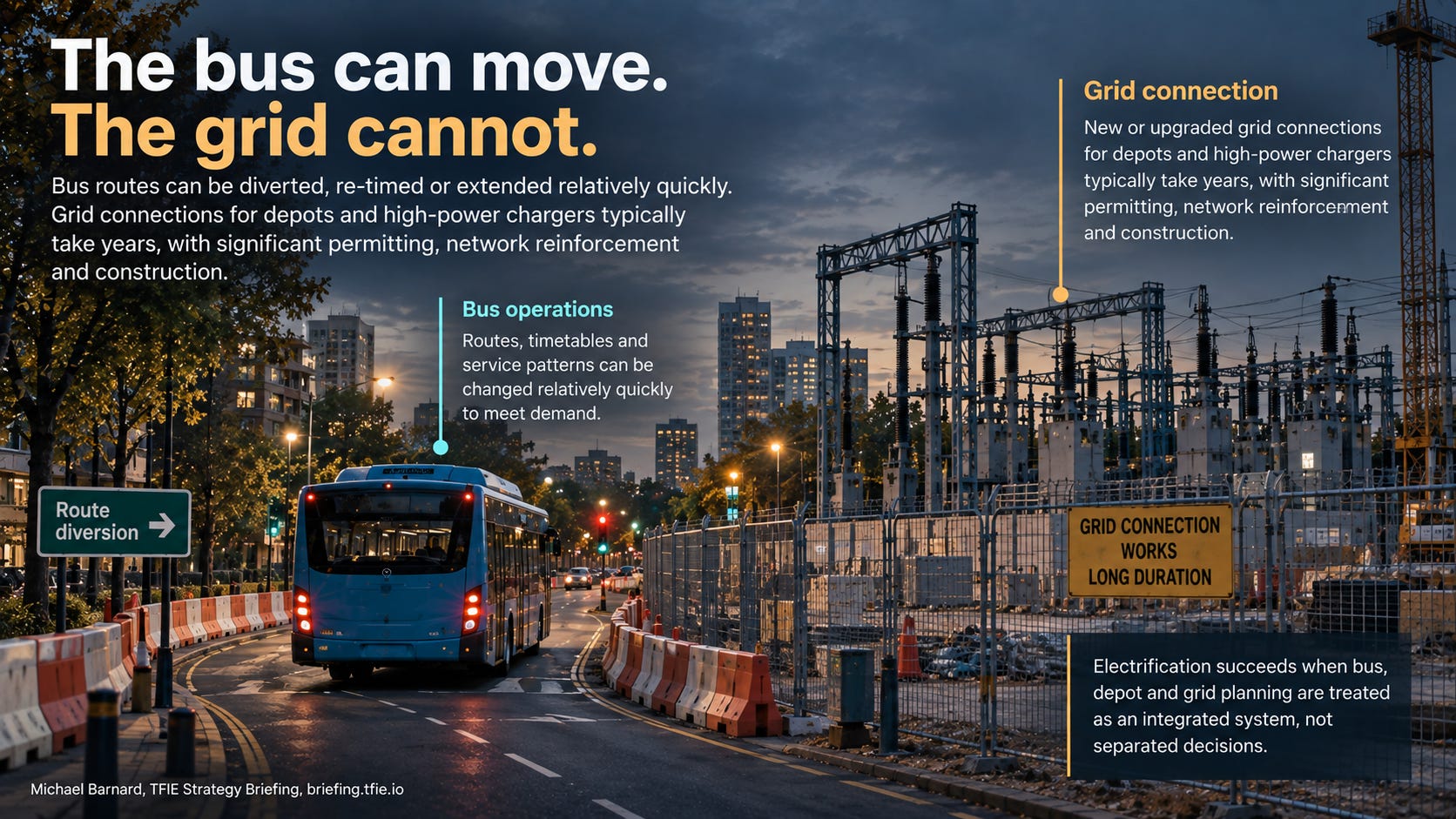
The bus can move. The grid connection cannot.
Electrification is why an old governance question has become a new infrastructure question. A route can be redesigned. An operating package can be retendered. Buses can often be reassigned. A multi-megawatt electrical connection secured at one depot cannot simply be moved across the city because the service pattern changed.
Glasgow provides particularly useful examples. First Bus has built sophisticated smart-charging capability at Caledonia and has commercialized some spare daytime charging capacity. McGill’s and Zenobē demonstrate a different model involving specialist infrastructure finance, grid-capacity procurement and smart charging across separate depots.
Those are examples of competent project and depot optimization. They also reveal the larger system question.
An operator can optimize its depot. A utility can optimize its network. A financier can price its asset risk. A transport authority can optimize its budget. Every organization can make a rational decision inside its own boundary while the metropolitan system becomes harder or more expensive to change.
The report therefore does not argue that a public authority should own every bus, depot, charger or grid connection. It argues that the authority responsible for the passenger network needs to understand the portfolio well enough to know which assets and rights must remain usable when operators, contracts or technologies change.
The second contract is where the design gets tested
Imagine that Operator A successfully electrifies a package of routes. The buses run. The chargers work. The depot has the required power. The first contract looks successful. Then Operator B wins the next contract.
Can it use the depot? Can the buses transfer? Does the charging equipment remain compatible? Who controls the grid connection? Can operating and charging data move with the service? Who carries the residual value? What happens if the authority redesigns the network?
A structure that looks inexpensive at first procurement can become very expensive if the second contract has to recreate infrastructure or compensate an incumbent for assets the network cannot operate without.
That is why the report separates ownership, financing, operational control and continuity. Public ownership is one possible mechanism, but so are access rights, assignable leases, interoperability, step-in rights, handback provisions, residual-value rules and credible replacement. The objective is a system that can change without repeatedly rebuilding the interfaces it already paid for.
Who this report is for
Mayors, ministries and transport authorities will find a framework for separating network accountability from operating delivery, and for connecting governance reform to electrification rather than treating them as independent programmes.
Bus operators and infrastructure providers will find an argument for clearer operating boundaries: operators should manage the risks and decisions they can actually control without being expected to absorb poorly specified metropolitan land, grid or policy risks.
Utilities, financiers and infrastructure investors will find the depot-and-grid portfolio, asset portability, residual-value and second-contract questions that determine whether long-lived infrastructure remains useful beyond its first operating arrangement.
Procurement teams, advisers and analysts will find evidence disciplines around counterfactuals, denominators, passenger outcomes, climate claims, data continuity and the distinction between a good project and a good system.
Read the full report
The Bus Is Not the System — Metropolitan Transit Governance
Michael Barnard · TFIE Strategy Inc.
October 2026 · 83 pages

The report includes the comparative evidence, methodology, detailed references and implementation architecture behind these findings.
The supporting Evidence Book contains the source register, calculations, lineage, crosswalks and detailed audit material. It is available on request.
Contact Michael Barnard at michael@tfie.io for Evidence Book access.
Facing a decision that is about to become expensive to reverse?
The most useful consulting entry point is often not a generic transformation programme. It is a live decision.
A fleet order is approaching approval. A depot lease is expiring. A grid offer has a deadline. An operating contract is being extended or retendered. An investor is being asked to finance infrastructure whose value extends beyond the current operator. A network redesign depends on assets and rights that were procured for yesterday’s service pattern.
TFIE Strategy works with authorities, operators, utilities, investors and advisory teams to test those decisions before assumptions become contracts and contracts become physical constraints.
A scoped engagement can establish what is already fixed, what remains reversible, which interfaces create material risk, what evidence could change the decision and which options are worth preserving.
If a fleet, depot, grid, contract or network decision is approaching a point of no return, contact Michael Barnard at michael@tfie.io.
Five Briefings will unpack the argument
This report is the starting point for a short weekly series drawing out five of its most consequential ideas.
Why Are There So Many Bus Companies in Glasgow? will look at what Britain’s forty-year experiment actually changed—and why public versus private is the wrong framing.
How Can a Bus Network Become More “Productive” by Running Less Service? will examine how an apparently improving metric can conceal declining network utility.
The Bus Can Move. The Grid Connection Cannot. will look at what electrification does to contracts, depot geography and utility planning.
The First Electric-Bus Contract Is Not the Hard One. will apply the second-contract test to fleet, depot, charging, data and residual-value decisions.
What Is the Next Bus Decision You Cannot Undo? will turn the report’s findings into a practical decision framework for authorities and investors already operating in the messy middle.
The Glasgow bus stop is only the beginning of the story. The larger issue is whether the routes, operators, depots, contracts, data and megawatts that passengers depend on are being optimized as one metropolitan system—or merely managed competently in separate pieces.
Subscribe to TFIE Strategy Briefing for evidence-led analysis of the energy transition, infrastructure, transport and the decisions that shape what actually gets built.