


Canada’s transit electrification market has reached a point where three groups need to make decisions about CUTRIC. CUTRIC itself needs to decide whether it is primarily an industry commercialization organization or a genuinely independent source of evidence, because its attempt to be both is becoming increasingly difficult to defend. Transit agencies need to decide whether CUTRIC recommendations still deserve any presumption of authority before they commit hundreds of millions of dollars to buses, depots, charging systems or hydrogen infrastructure. And CUTRIC’s member organizations — transit agencies, universities, utilities, consultants and manufacturers — need to decide whether the services and relationships they receive from membership justify the analytical credibility their participation lends the organization.
Those decisions are becoming harder to postpone because CUTRIC’s own strategic targets, its federally advantaged consulting history, its deployment database, the collapse in leading indicators for North American hydrogen buses, the procurement hangover now visible in Europe, and mature direct-electric alternatives such as in-motion charging now point in the same direction. CUTRIC has built a very effective machine for creating and sustaining technology projects, but has not demonstrated an equally effective ability to recognize when the evidence says a project, technology or previous conclusion should stop.
That is a harsh conclusion, but it is not an argument that everything CUTRIC has done is poor. Its Pan-Canadian battery-electric bus work addressed a real collective-action problem: different bus manufacturers, charger suppliers and transit agencies needed interoperable high-power charging instead of proprietary systems that could trap agencies inside individual vendor ecosystems. CUTRIC helped convene the parties around work that contributed to North American charging interoperability and SAE J3105. That is exactly the kind of bounded consortium role for which an organization such as CUTRIC can be useful: the problem was specific, competing companies benefited from solving it, success could be objectively tested, and CUTRIC did not have to determine that one member’s technology should lose for another to win.
Some transit agencies also speak positively about CUTRIC’s planning support, and those experiences should not be dismissed. Testimonials, however, do not resolve the methodological and governance questions examined here, particularly when much of CUTRIC’s planning volume was generated within a federal procurement structure that strongly favoured using CUTRIC.
Commercialization and neutral analysis require different institutional instincts
CUTRIC’s broader design is what turns individual analytical weaknesses into a strategic problem. Its formal mission is to support commercialization through industry-led collaborative research, development, demonstration and integration, while its consulting business presents sophisticated modelling as a route to scientifically neutral transit decisions. CUTRIC also develops projects, advocates to governments, provides consulting, operates proprietary analytical tools, runs professional-development programs and convenes members to align around research, funding and policy priorities. Those functions are individually legitimate, but they do not naturally point in the same direction.
A commercialization organization asks what funding, demonstration, partnership, contracting model or policy change might get a technology into the market. An independent analytical institution has to ask a harder question as well: whether the technology should reach the market at all. It has to be capable of concluding that an earlier forecast was wrong, that a pilot generated enough negative evidence, that the strongest available alternative is superior, or that a technology supported by important members no longer deserves public resources. Those are not small differences of emphasis; they require opposing organizational reflexes.
CUTRIC has demonstrated substantial ability to generate projects, assemble partnerships, obtain public support and place technologies into demonstrations. Its 2026 conference agenda still contains a session titled “From Pilot to Procurement,” using hydrogen fuel-cell projects as an example and discussing commercial structures intended to de-risk deployment. Another session asks why hydrogen and other technologies are not scaling and considers policy changes that might accelerate large-scale adoption. That is coherent behaviour for an organization whose mission includes commercialization. It is much harder to reconcile with the simultaneous proposition that CUTRIC is neutrally discovering whether those technologies should scale.
The governance reinforces the structural tension. CUTRIC says its members participate in aligning national research, funding and policy priorities, while the member forum is chaired by a senior public-sector sales and marketing executive at NFI Group, parent of New Flyer. A supplier executive chairing an industry consortium is unremarkable. A commercialization consortium asserting scientific neutrality over technologies sold by its members has a higher burden: neutrality has to be created through governance and method rather than established by assertion.
This is the central diagnosis. CUTRIC’s problem is not primarily that it has made poor technology calls; every serious analytical organization does that. The problem is that CUTRIC has not demonstrated a robust institutional mechanism for allowing evidence to kill a commercialization thesis. By the standards CUTRIC sets for itself — scientific neutrality, advanced expertise, trusted advice and evidence-based planning — I think that amounts to analytical incompetence at the institutional level. That judgment concerns the public work product and institutional method, not the intelligence or good faith of individual employees.
Becoming the default provider was not competitive validation
CUTRIC can point to dozens of Canadian transit agencies for which it has performed planning work, and at first glance that looks like powerful market validation. CUTRIC’s latest annual reporting says its ZEB consulting services served 34 transit agencies and deployed more than $10 million in feasibility funding. But much of that activity occurred inside a federal program architecture that gave CUTRIC an extraordinary advantage over competing planning providers. CUTRIC’s annual reporting describes the scale of those ZETF engagements.
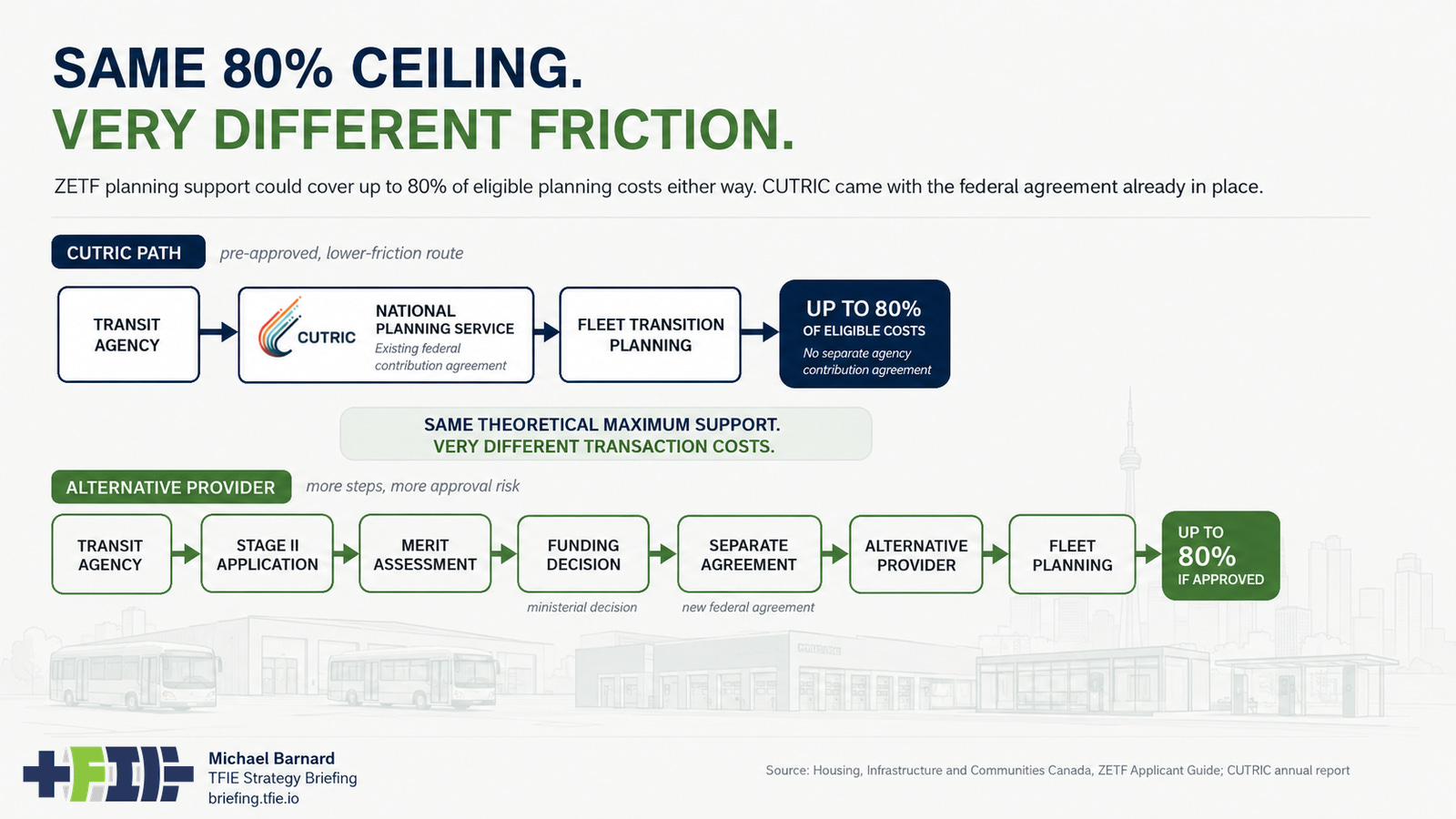
Under the federal Zero Emission Transit Fund, a transit agency using CUTRIC could receive support for up to 80% of eligible planning costs through the federal contribution agreement already established with CUTRIC. The agency did not have to obtain its own separate federal planning contribution agreement. An agency could choose another provider and theoretically obtain the same maximum federal share, but the federal applicant guide required that route to proceed through a separate Stage II planning application, assessment against federal criteria, a funding decision and, if approved, a separate federal contribution agreement.
That was a federally engineered preferred-provider channel with quasi-monopoly economics: one provider came with the subsidy mechanism and contribution agreement already wrapped around the engagement, while choosing another provider imposed additional application effort, approval risk and time on the agency. The theoretical funding ceiling was similar; the transaction costs and friction were not.
The distinction matters even more because CUTRIC’s own 2021–22 annual report says it advocated for a national neutral feasibility-planning program, subsequently became the National Planning Service and worked closely with Infrastructure Canada around ZETF. None of that implies impropriety; organizations routinely advocate for policies and then participate in their implementation.
The federal government may well have selected CUTRIC because it considered the organization qualified. What the subsequent 34 engagements cannot demonstrate is comparative market preference. Agencies were not choosing among providers under economically and administratively equivalent conditions, so that customer count cannot be used as evidence that CUTRIC’s technical work was competitively superior.
CUTRIC demonstrated exceptional success at government relations and institutional positioning. That is different from demonstrating exceptional analytical competence.
CUTRIC had explicitly set becoming the “go-to” organization for transit agencies’ technical needs as one of its strategic goals. It achieved something that looked like that objective, but federal program design makes the result a poor quality signal. The more precise conclusion is that CUTRIC became Canada’s administratively privileged planning provider. Its institutional success was becoming uniquely well positioned to be paid to perform transit-transition analysis; the public evidence does not establish that it became uniquely good at performing it.
And, of course, it’s lost that position with the new Canadian transit funding program. I suspect that’s why Enbridge and Ballard have chosen to stop paying membership dues and leave the Board.
CUTRIC also missed targets it chose for itself
CUTRIC’s 2021–22 annual report is unusually useful because it provides measurable strategic commitments rather than relying entirely on retrospective descriptions of success. Its three-year goals included tripling the number of transit agencies in membership, becoming the go-to provider for transit agencies’ technical needs and managing more than $200 million in funds. It separately targeted 260 members by 2025, while its ZEB consulting division aimed to become Canada’s most reputed, reliable and recognized fleet-electrification guidance service. CUTRIC said that expansion would be supported by growing revenues from memberships, events, consulting, program-management fees and government subsidies or offsets
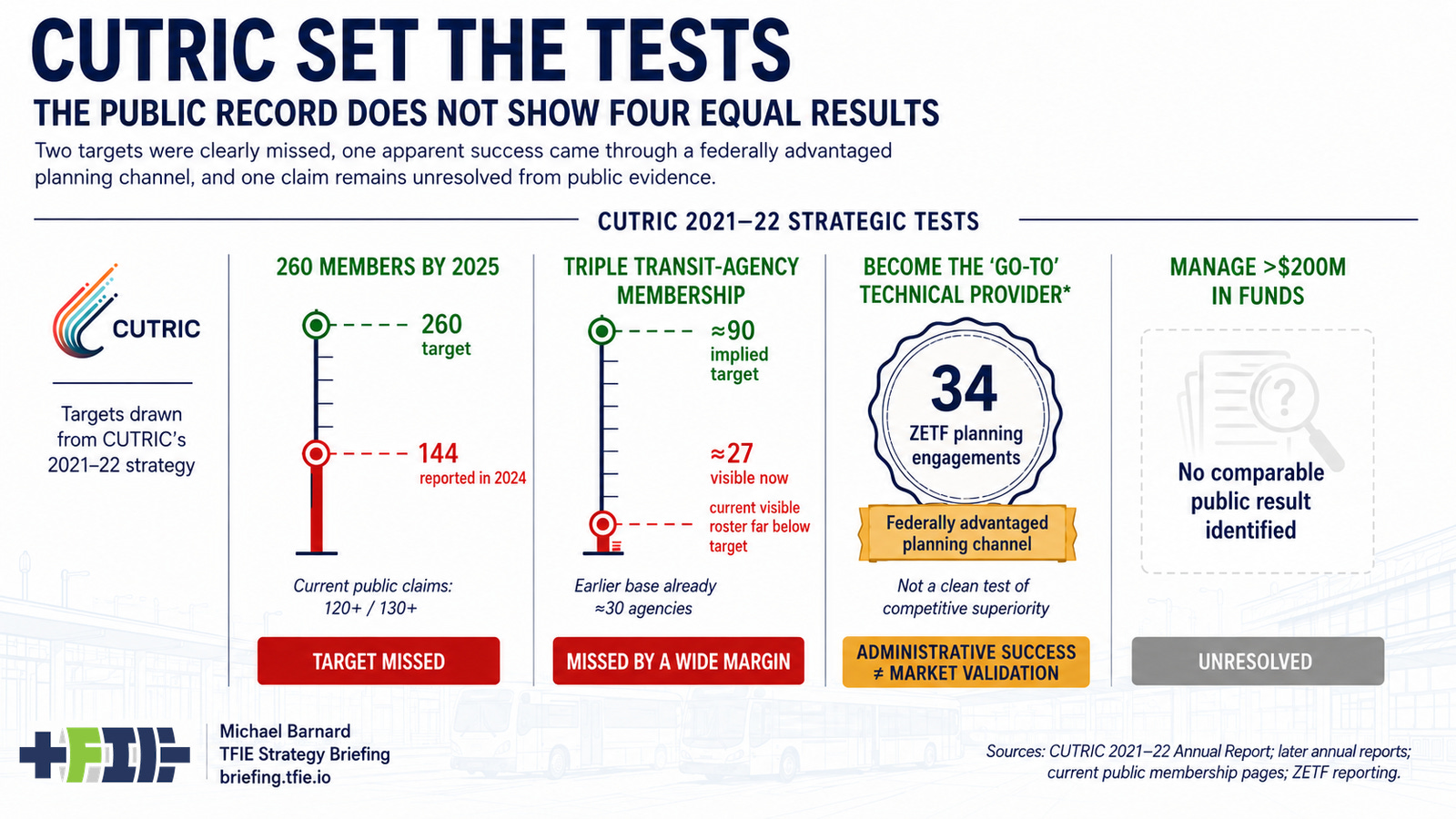
The membership-growth target clearly failed. CUTRIC reported 141 members in its 2022–23 annual report, later reported numbers in the mid-140s, and its current public materials refer variously to more than 120 or 130-plus members. Its current membership pages are inconsistent enough that it would be irresponsible to claim a definitive 2026 dues-paying count from them, but no plausible reading of the public numbers approaches 260.
The transit-agency target missed by an even greater margin. CUTRIC already had roughly 30 transit agencies in the earlier membership base, so tripling implied something around 90. The current publicly visible roster remains far below that. The more-than-$200-million managed-funds target deserves different treatment because I have not found a later public accounting that establishes whether CUTRIC achieved it under the definition intended in 2022. It should therefore be labelled unresolved rather than failed. CUTRIC chose the metric and can clarify the outcome.
The “go-to” objective is similarly not a straightforward failure. CUTRIC generated substantial work and became institutionally prominent, but did so within the ZETF structure that strongly favoured the CUTRIC route. The apparent success is therefore real in an administrative sense and weak as evidence of competitive superiority.
The larger mission is harder to evaluate because CUTRIC talks about making Canada a global leader in low-carbon smart mobility while reporting substantial activity but comparatively little portfolio-level evidence of durable commercialization. A serious strategic scorecard would ask how many CUTRIC-supported technologies generated repeat commercial purchases after operating experience, how much export revenue persisted, which demonstrations became durable markets, which failed, what employment remained after grants ended and which technologies became less dependent on public support. Projects launched, partners assembled, studies completed and pilots operated are useful intermediate outputs, but they are not automatically the outcomes the commercialization mission exists to produce.
CUTRIC’s evidence systems should have made it more sceptical, not less
The strongest evidence for CUTRIC’s analytical shortcomings is contained in its own Canadian Zero Emission Bus Database. Its database reporting distinguishes stages such as pronouncement, feasibility and modelling, funding and financing, procurement, commissioning and in-service operation. That is a sensible architecture because a politician’s announcement, a conditional grant, a signed purchase contract and a bus carrying passengers are not the same thing. In a market where bus procurement and manufacturing lags can run for years, those stages are precisely what an analyst needs to distinguish leading indicators from trailing ones.
CUTRIC nevertheless repeatedly emphasized aggregated pipeline totals across those stages. When projects stalled, changed technology or disappeared, the headline number changed. Its sixth database report described a pipeline that had fallen to 4,031 buses as procurement timelines, technology choices and agency reporting changed. That language makes the changes sound like maintenance of the database. Analytically, the changes are the interesting result. A project that remains a pronouncement for three years, a funded hydrogen project that changes technology, a procurement that disappears, or an agency that buys more battery buses after real operating experience all reveal something about the probability that particular technologies survive budgets, infrastructure constraints and service requirements.
CUTRIC can reasonably argue that a national deployment database is not supposed to contain every variable needed for route modelling or fleet-performance evaluation. That is true and is not the criticism. CUTRIC also has predictive modelling and empirical operating-analysis capabilities. The problem is that I have found no public evidence of a systematic institutional learning loop connecting these capabilities:
forecast → procurement → real operation → forecast error → revised model → revised technology recommendation.
That is what a national analytical institution claiming sophisticated predictive capability should be demonstrating.
CUTRIC has enough structure to calculate transitions from announcement to contract, compare attrition by technology, cohort procurement decisions by year, distinguish new commitments from deliveries of old commitments, record cancellations and technology switching, and examine repeat purchasing after operating experience. I have found no public CUTRIC analysis making those technology-specific longitudinal questions central to its interpretation of the market.
The obvious questions are straightforward. What fraction of hydrogen and battery announcements became contracts? What fraction of contracts became operating fleets? Which technologies had the greatest cancellation or switching rates? Which agencies bought the same technology again after several winters? What did CUTRIC predict before deployment, what actually occurred, and how were the assumptions changed afterward? CUTRIC has much of the information required to ask them.
Hydrogen buses make the consequences particularly visible because current procurement decisions and current deliveries have diverged.
Hydrogen deliveries are the hangover. Orders are the signal.
In my bounded reconstruction of identifiable public North American fuel-cell bus commitments, commitments peaked at roughly 288 buses in 2023, fell to 96 in 2024 and dropped to no more than about 45 gross visible commitments in 2025, with the evident net total lower after reversals and ambiguities. The dataset is necessarily bounded by publicly identifiable transactions, and another small order could adjust an annual total. What is much harder to change is the direction of the signal: this does not look like the procurement curve of a technology scaling steadily.
Europe demonstrates why focusing on deliveries obscures that reality. My analysis of Europe’s apparent 2025 hydrogen-bus peak found that much of the apparent strength reflected buses arriving from decisions made during the earlier subsidy and enthusiasm cycle. Germany in particular was still receiving buses resulting from earlier procurement decisions even as the forward order picture weakened. A delivery in 2025 therefore proves that somebody made a decision several years earlier. It does not prove that agencies are making the same decision today.
The denominator reinforces the point. Transport & Environment found that battery-electric buses reached 56% of new EU city-bus deliveries in 2025 while fuel cells accounted for only 4%, with most fuel-cell sales concentrated in Germany. Deliveries are real, but they are trailing indicators. Tenders, contract awards, cancellations and especially repeat purchases after years of operating experience tell us far more about the next delivery cycle.
CUTRIC has exactly the stage-based data architecture required to distinguish those things. Yet its July 2026 hydrogen programming says that while battery-electric remains dominant, FCEBs are “proving essential” for long-range and high-intensity routes. “Essential” is an extraordinarily strong word in an analytical context. It does not mean a fuel-cell bus can complete a difficult route; fuel-cell buses clearly can. It means that an important operating requirement cannot reasonably be met without them. I have found no public CUTRIC analysis demonstrating that proposition against the strongest appropriate direct-electric alternatives.
This is also not merely a legacy rhetorical problem. CUTRIC’s 2023 Five Point Plan proposed temporarily offsetting 75% of green-hydrogen fuel costs for FCEBs specifically to stimulate deployment. Its top-level messaging today is less conspicuously hydrogen-focused, which is a real change, but hydrogen market development continues through readiness programs, procurement clinics, international benchmarking and discussion of how projects can move from pilots toward procurement. Those are legitimate activities for a commercialization consortium. They are also evidence that CUTRIC continues to ask how hydrogen can be made to scale rather than making declining procurement itself a central object of analysis.
The claimed hydrogen niche has a mature electric competitor
Even if hydrogen procurement were holding up better, CUTRIC would still need to demonstrate that its claimed technical niche survives comparison against the strongest direct-electric alternatives. Transit agencies have genuinely difficult blocks: long operating days, hills, high passenger loads, large articulated vehicles, demanding heating and cooling requirements, constrained depots and routes with little time for stationary charging. Those are real operating problems. They are not automatically hydrogen problems.
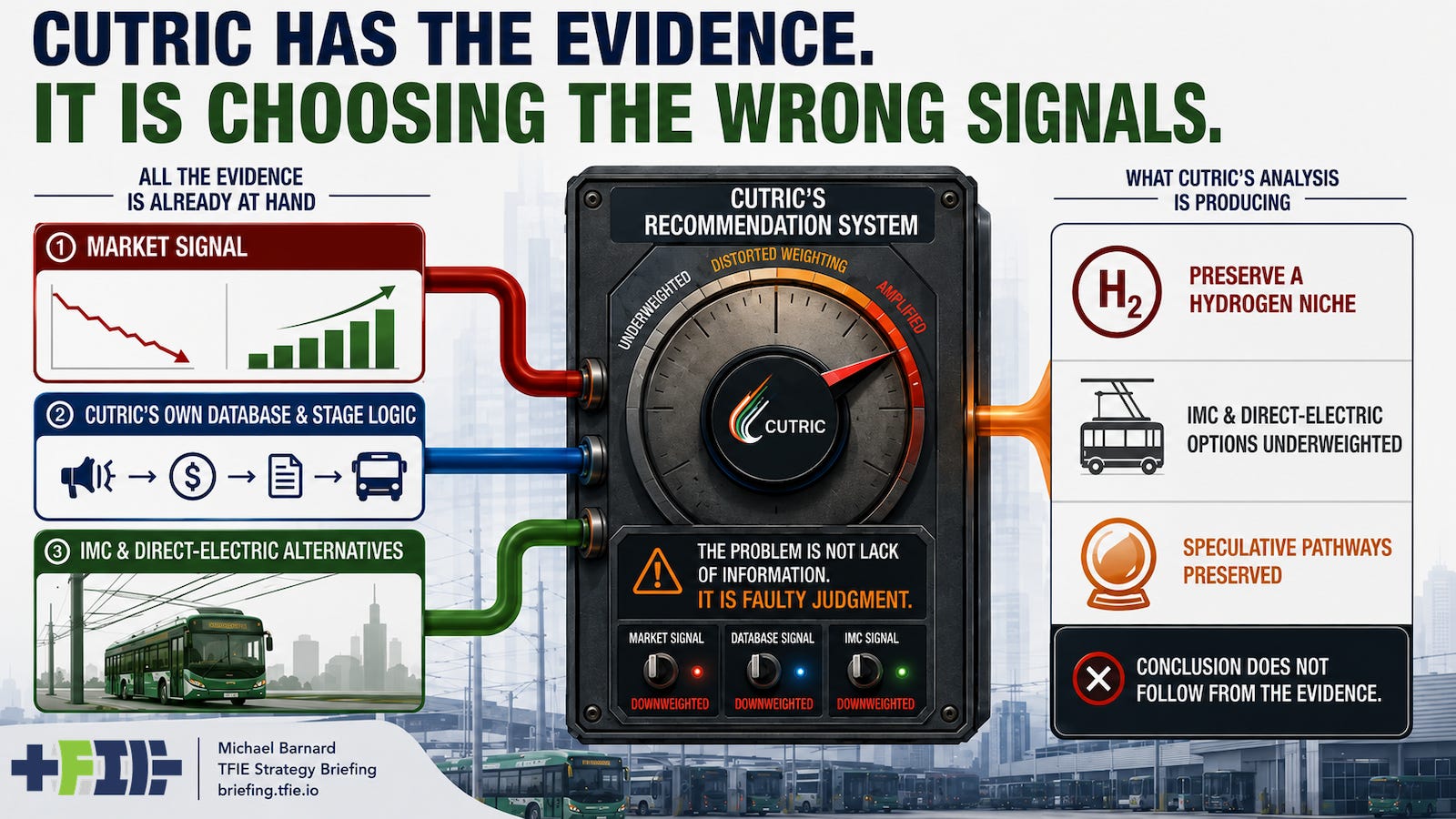
Modern conductive in-motion charging materially erodes that claimed niche. Battery trolleybuses draw electricity and recharge while travelling under selected sections of overhead wire and operate off-wire on batteries elsewhere. UITP’s work on modern in-motion charging describes a mature development of trolleybus technology that can reduce battery requirements, avoid lengthy stationary charging and enable continuous high-utilization service. The infrastructure does not have to cover every kilometre of a route; selected common corridors, hills or high-use sections can provide electricity to many vehicles.
Prague’s partial-trolleybus operating experience makes the systems argument concrete. On a demanding partial-trolleybus route, only about 40% of traction energy needs to pass through the battery. Supplying electricity directly during revenue service changes the problem from “can the battery contain a full day of energy?” to “how much storage does the network require when infrastructure and vehicles are designed together?” Range, battery throughput and charging downtime all change.
CUTRIC knows this technology family exists. Its April 2025 programming explicitly addressed wireless power and in-motion charging for bus rapid transit. Yet mature conductive IMC remains peripheral in CUTRIC’s public framing of difficult routes while hydrogen receives the much stronger characterization of being “essential.” CUTRIC is willing to devote organizational attention to comparatively novel dynamic charging approaches while I have found no public evidence that mature conductive IMC is systematically required as a comparator before CUTRIC identifies a hard route as an FCEB application.
That does not prove that IMC is optimal for every difficult route. Wires, substations and maintenance have costs; route concentration matters; and there will be networks where another architecture wins. It does establish a much more modest and difficult-to-refute proposition: CUTRIC cannot demonstrate that FCEBs are essential for difficult routes without first showing that the appropriate mature direct-electric architecture is inferior.
A rigorous technology hierarchy would begin with managed depot charging and ordinary battery buses, then test schedule and block optimization, battery and thermal optimization, terminal opportunity charging, shared corridor charging and selective conductive IMC where routes are sufficiently concentrated. Only after those increasingly capable versions of the dominant direct-electric platform fail operationally or economically should another energy carrier be introduced. Hydrogen might survive such a test in an unusual application, but “a depot-only battery bus struggles” and “hydrogen is essential” are not adjacent logical conclusions.
CUTRIC has choices. So do agencies and members.
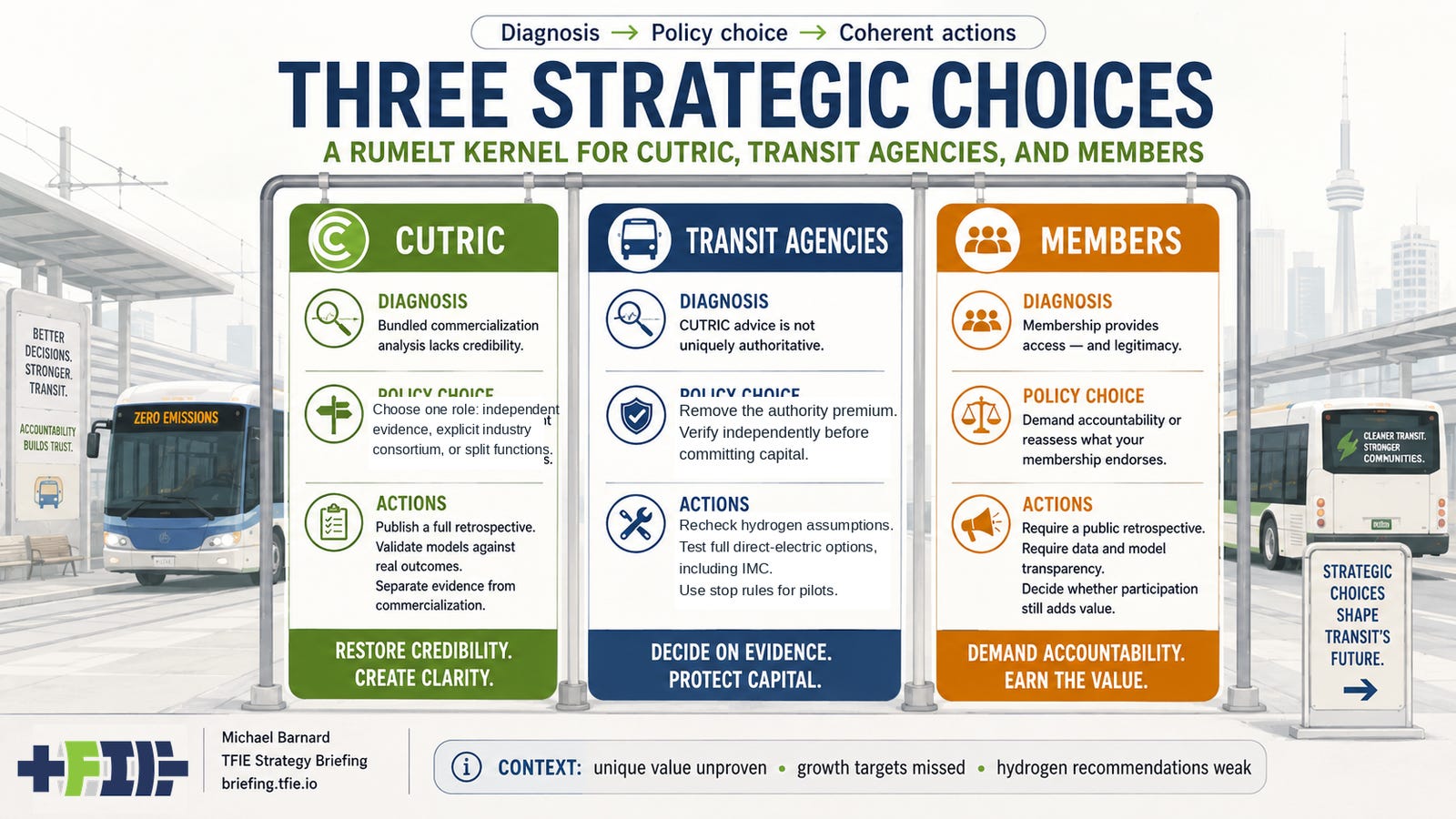
CUTRIC does not need to disappear, but it does need to choose an institutional identity. If it wants to retain the role implied by “scientifically and neutrally,” the evidence function needs genuine independence from commercialization. That means open nationally relevant project-stage data, transparent forecast performance, independent validation of models used to influence large public capital decisions, complete technology comparator sets, and explicit rules defining what evidence would cause CUTRIC to stop advocating further development of a pathway. It also means a serious retrospective that scores previous forecasts and strategic commitments rather than simply cataloguing activity.
CUTRIC could instead become an explicit industry commercialization and advocacy association. It could continue its useful standards and interoperability work, develop demonstrations, help members form consortia, lobby for transit and manufacturing policy, run conferences and professional development, and advocate particular technologies. Its analytical output would then be treated like analysis from any other interested industry organization: potentially useful, but requiring independent review rather than carrying a special presumption of neutrality.
A third option would split the functions. CUTRIC could remain the member-driven commercialization consortium it is structurally suited to be, while national evidence, model validation and technology assessment moved into a separately governed organization whose success did not depend on maintaining a portfolio of member-supported technologies. What is no longer persuasive is preserving the current bundle while treating another committee, methodology refresh or governance statement as sufficient reform.
CUTRIC could also choose to collapse itself. It’s not providing useful, unique or accurate services. At this point, it’s primary function is to provide value to its Board, executive and perhaps staff, not Canadian transit. Sunsetting an organization which isn’t delivering unique value is a very reasonable choice.
Transit agencies do not need to wait for CUTRIC to choose. They can remove CUTRIC’s authority premium now. A CUTRIC datum can be correct, its interoperability work can be valuable and a particular model can produce a sensible answer, but “CUTRIC says so” should add essentially no weight to a capital decision. Material recommendations should survive independent checks of service blocks, winter assumptions, replacement ratios, charging utilization, grid constraints, vehicle availability, lifecycle cost and the alternatives included in scenario design. Any route presented as a hydrogen case should be tested against the complete appropriate direct-electric architecture first.
Pilots should have explicit stop rules as well. Demonstrating that a hydrogen bus can travel a route is no longer a sufficient reason to build a fleet-scale hydrogen ecosystem. The procurement question is whether the entire bus, fuel and infrastructure system beats the strongest alternative on service, cost, reliability, emissions and risk. “Do not scale” must be an acceptable experimental result.
CUTRIC’s members have a different decision because membership provides both value and legitimacy. Utilities may gain useful agency relationships, universities research partners, consultants project opportunities, agencies peer exchange and manufacturers standards collaboration. Those benefits can be real. Membership also helps CUTRIC present itself as a broad national consortium whose members participate in its research, funding and policy agenda. Members therefore have reason to demand a retrospective against CUTRIC’s own forecasts and targets, open procurement-stage evidence, independent model validation and a clear institutional choice between commercialization and independent evidence.
The useful functions do not require the current bundle
Canada needs national deployment and procurement data, route and infrastructure modelling, utility coordination, empirical fleet evaluation, standards work, leading-practice transfer, commercialization support and industry advocacy. The question is whether preserving all of those functions inside CUTRIC’s current structure is necessary.
I have found no public-interest function performed by CUTRIC that appears institutionally dependent on preserving that bundle. CUTA already surveys Canadian transit agencies about procurement intentions, barriers and readiness. Engineering firms perform route, fleet, depot and utility analysis, and CUTRIC itself reported that HDR won the substantive technical work for Saskatoon’s low-carbon fleet transition plan. Universities and public laboratories can independently evaluate fleet performance. UITP disseminates leading international practice. Standards organizations manage standards. Governments can make publicly funded datasets open. CUTRIC can still perform the focused convening, interoperability and industry-commercialization work at which it has demonstrated value.
CUTRIC may indeed possess a unique combination of tools, relationships and proprietary capabilities. What has not been demonstrated is that this particular combination is indispensable to the public-interest functions it currently performs, or that combining them with commercialization and advocacy produces better analytical outcomes than separating them.
The burden of proof has moved
Hydrogen buses will continue arriving because buses ordered years ago still have to be manufactured and delivered. Existing fleets will remain in service, more ribbon cuttings will occur and more pilot results will be published. Those are real events, but they should not be mistaken for evidence that the market is expanding. The North American order trend and the European orders-versus-deliveries lag are much more useful indicators of where procurement is heading.
Battery-electric buses will also continue to encounter difficult routes and infrastructure constraints. Some agencies will need more depot power, some will need opportunity charging, some will have to restructure blocks, and some high-utilization corridors may justify conductive in-motion charging. Those difficulties are arguments for better systems engineering. They are not by themselves arguments for a second energy carrier.
That brings the assessment back to CUTRIC’s deepest strategic failure. Its problem is not merely that it has been too enthusiastic about hydrogen, nor that some forecasts or studies have been wrong. Competent institutions are wrong regularly. They become more valuable when they expose the error, explain what changed and stop doing things that no longer make sense. CUTRIC has built strong capabilities and incentives for generating projects, funding, programs and commercialization activity without demonstrating equally strong mechanisms for concluding that a technology, project, forecast or organizational activity should end.
CUTRIC has a choice at this cusp: accept the constraints that come with genuinely independent evidence, become an explicit industry-commercialization association, or separate the two functions. Transit agencies do not need to wait before independently validating CUTRIC-derived plans and requiring the strongest direct-electric alternatives to be tested. CUTRIC’s members do not need to wait before deciding what standards of evidence and governance their participation should support.
CUTRIC became uniquely well positioned to be paid for transit-transition analysis. It has not demonstrated that it became uniquely good at it and it’s lost that position. The burden of proof now belongs to CUTRIC.
If this kind of evidence-led scrutiny is useful, subscribe to TFIE Strategy Briefing for analysis of transit procurement, energy-transition institutions and the gap between announced technology momentum and what the underlying markets are actually doing.