

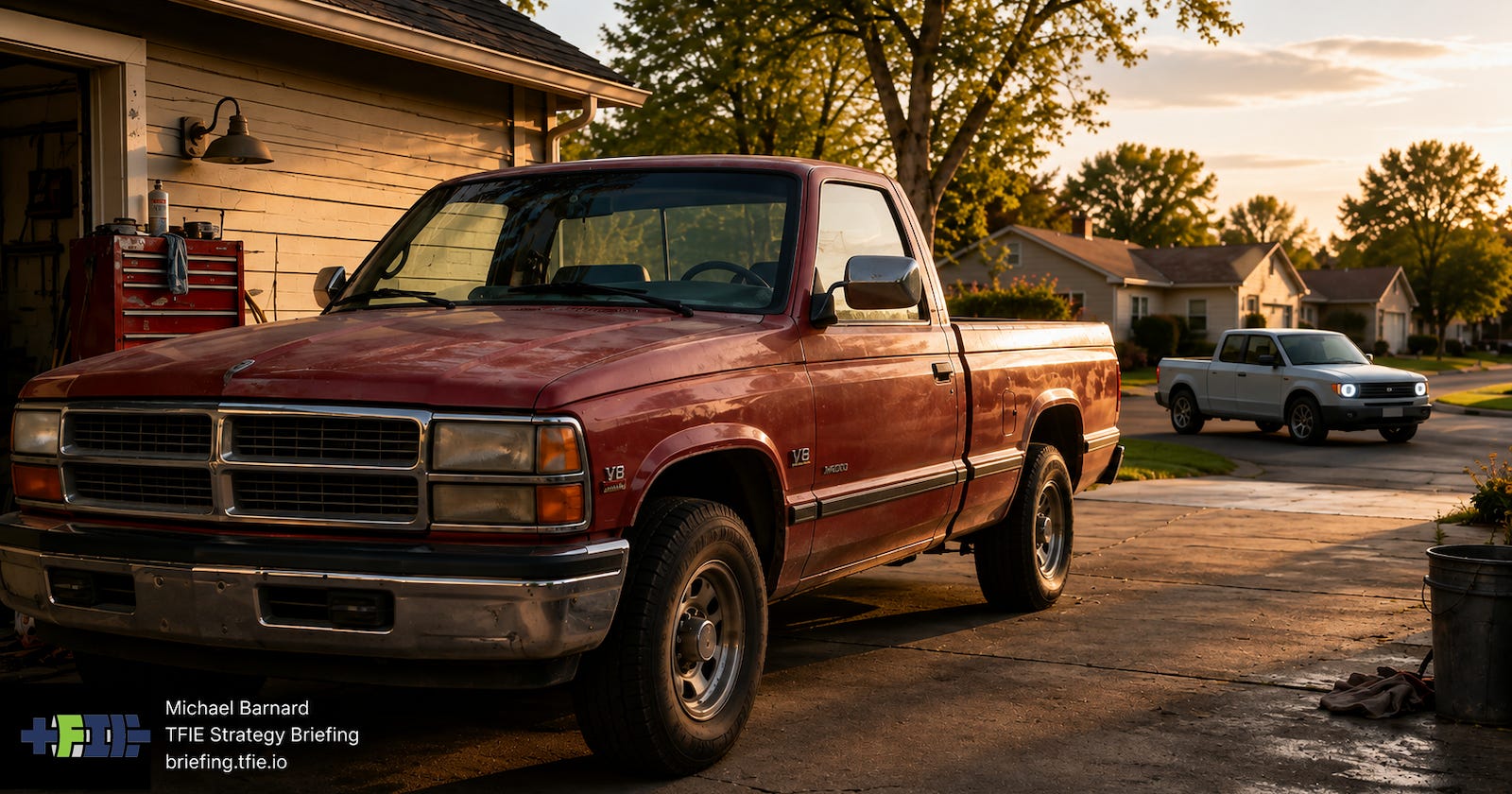
The argument in my recent Briefing article, Scrapping A Working Gas Car Can Be The Greener Choice, generated a useful counterpoint. One reader has a hand-me-down 1995 Dodge Ram from his father and intends to keep repairing it until it rusts away, someone makes him stop driving it or gasoline finally becomes unaffordable. He accepts that the climate crisis is real, but, he wrote, “we won’t be one-at-a-timing a solution to this.”
His decision makes economic sense. The Ram is paid for, he knows how to keep it running and gasoline remains affordable to him. Spending hundreds or occasionally thousands of dollars repairing a familiar truck can be much easier to justify than spending $50,000 on a new electric pickup. If the climate solution requires him to make a financially foolish decision for his household, the problem is not that he has failed to understand climate change. The available replacement and the policy around it have failed him.
The climate arithmetic points strongly the other way. Depending on engine and drivetrain, a 1995 Ram 1500 gets roughly 12 to 16 miles per gallon. Driven something like the US norm, that means around 7 to 9 tonnes of CO2 every year from gasoline combustion alone. An efficient electric pickup charged on an average US grid would be around 2 tonnes. Replacing the Ram could therefore avoid roughly 5 to 7 tonnes of CO2 every year, before counting the emissions from extracting, refining and transporting its gasoline.
The lifecycle research I examined in the previous Briefing matters because it tested the obvious objection. Manufacturing a replacement EV also causes emissions, so perhaps the environmentally responsible choice is to keep an existing combustion vehicle until it dies. Campbell and Geyer explicitly modeled that manufacturing penalty against the years of combustion emissions avoided by retiring functioning vehicles earlier, and across 92% of their modeled scenarios, early retirement reduced emissions. An old pickup getting somewhere around 14 mpg and driven regularly is close to the sort of vehicle policy should be trying hardest to retire.
But the reader’s line about not solving the problem “one at a time” is the most interesting part, because that is exactly how vehicle decarbonization works. National fleets do not turn over as fleets. Every year millions of people separately decide to repair, sell, scrap or replace individual vehicles. A mechanic decides whether another repair is worthwhile, a family decides whether its aging SUV has another few years in it, and a contractor decides what replaces a work truck. Those individual decisions aggregate into the national fleet. There is no separate fleet-level mechanism waiting somewhere above them. The policy question is whether millions of the highest-emitting vehicles remain in service for years longer because replacing them is a bad household investment.
For this Ram owner, that household calculation could look quite different in another three or four years. Today’s $50,000-plus electric pickups are not compelling replacements for someone happily maintaining a simple old truck. Slate is now offering a deliberately basic electric pickup starting at about $25,000, with a projected 205 miles of range and a strong emphasis on owner customization and repairability. Ford, meanwhile, is developing a four-door midsize electric pickup on its Universal EV Platform with a targeted starting price of about $30,000 and launch planned for 2027.
Neither should be counted as a proven mass-market product yet. Slate is still preproduction, and Ford has not released final specifications for its truck, but they signal something important. The relevant comparison is moving away from a paid-off old pickup versus a $50,000 to $80,000 electric one. In a few years it could be a paid-off old pickup approaching its fourth decade versus a new electric truck costing $25,000 to $30,000, which is a much more interesting household decision.
At those prices, operating costs start to matter. Using a roughly 14 mpg Ram, normal American annual driving, conservative gasoline and electricity prices and a reasonable efficiency assumption for a smaller electric pickup, the EV comes out about $220 a month cheaper in energy and maintenance, or around $2,600 a year. Most of the difference is simply replacing a lot of gasoline with much cheaper electricity, with lower maintenance adding to the advantage. That does not mean this owner should rush out and borrow $30,000, because a paid-off vehicle has a substantial economic advantage precisely because the capital cost is already sunk. The missing piece is bringing the upfront replacement cost down far enough that the monthly operating savings matter to the purchase decision.
That was the policy problem I explored in the earlier scrappage article. The United States currently has no federal new- or used-EV purchase credit; those incentives ended in September 2025. But Democrats have previously proposed point-of-sale cash incentives tied to surrendering an operating gasoline vehicle, with extra help for lower-income households and provisions for used clean vehicles. A future Democratic administration and Congress could reasonably return to some combination of EV incentives and vehicle scrappage, although no one should count today on a particular program or dollar amount.
A better program would target the emissions opportunity much more precisely than the old generic EV tax credit did. Someone replacing a relatively efficient five-year-old car should not receive the same public support as someone retiring a heavily driven 14 mpg pickup. Scrappage value should rise with fuel consumption, recent mileage and expected remaining life, while lower-income households should receive more help and used EVs should qualify fully. For a particularly valuable retirement case such as this Ram, a combined point-of-sale EV incentive and targeted scrappage payment in the range of $10,000 to $15,000 would be defensible. Applied to a $25,000 Slate or roughly $30,000 Ford, that could leave something like $12,000 to $20,000 to finance or pay, followed by about $220 a month in lower operating costs.
That is a very different proposition from telling someone to throw away a useful paid-off truck and spend $50,000 for the climate. Keeping this Ram running today may be the financially sensible choice. If it lasts another three or four years, the emergence of inexpensive electric pickups, combined with a sensible future scrappage program, could make replacing it the financially sensible choice instead.
And that gets back to “one-at-a-timing” the problem. The United States will not wake up one morning and replace its combustion fleet. It will do it when an old Ram in one driveway, an aging SUV in another and millions of other vehicles reach individual decision points, the electric replacement makes more sense and the aging internal combustion vehicle is scrapped instead of being sold to a lower tier of buyers. Vehicle turnover has always happened one vehicle at a time, and good climate policy makes the cleaner choice win more of those decisions.
For practical analysis of transport, energy and climate policy, subscribe to TFIE Strategy Briefing.