

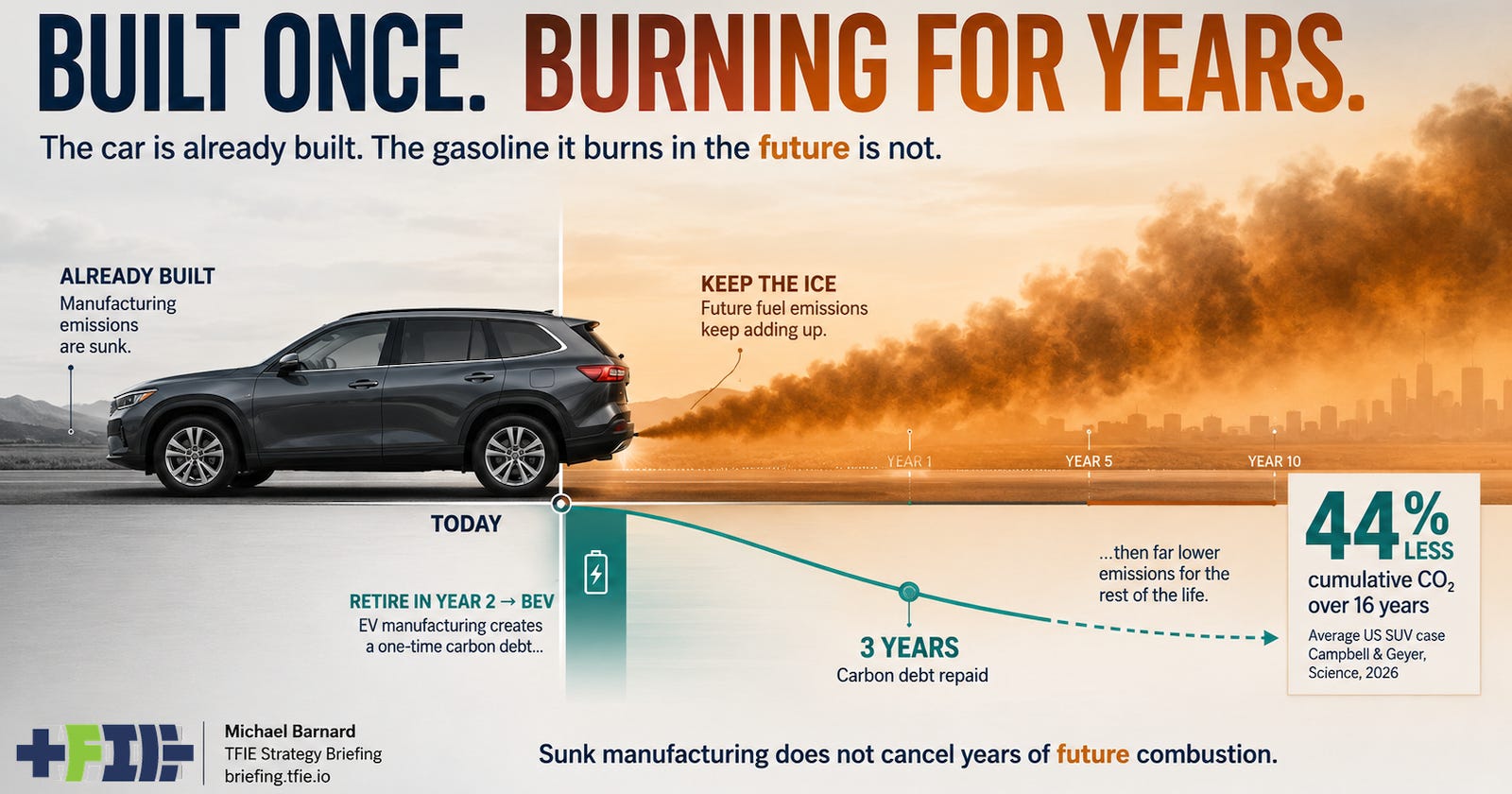
In 2024, I argued that a modern version of Cash for Clunkers should pay people to retire internal combustion cars early when they replace them with electric vehicles. I called it a strong opinion, weakly held. The uncomfortable question was the familiar one: the gasoline car has already been built, so surely driving it until the wheels fall off must be greener than manufacturing another vehicle.
J. Elliott Campbell of UC Santa Cruz and Roland Geyer of UC Santa Barbara have now done the lifecycle work that question needed. Their new study in Science compares continued operation of functional internal combustion vehicles with permanently scrapping them and replacing them with battery electric vehicles across vehicle efficiency, mileage, battery manufacturing emissions and regional electricity mixes. Their conclusion is considerably stronger than I expected. Even very early retirement usually wins.
For a representative production-weighted SUV on the average US grid, retiring the combustion vehicle in year two and replacing it with a BEV cut cumulative emissions over the 16-year analysis period by 44%. Manufacturing the BEV creates an obvious carbon spike, but the lower operating emissions repay that carbon debt in about three years. The earlier retirement scenario produces the largest cumulative benefit.
Across the much broader sensitivity analysis, 92% of modeled vehicle scenarios reduced emissions through early retirement, while fleet-average parameters produced a 58% retirement benefit. The result ranged from an 82% reduction to a 77% increase across deliberately extreme combinations of vehicle and grid assumptions, which is useful because it tells us where the policy boundaries actually are rather than pretending there are none.
The intuition error is straightforward. The emissions from manufacturing the gasoline car are already in the atmosphere. They are mathematically sunk in Campbell and Geyer’s comparison. The relevant question is whether the fixed carbon cost of manufacturing the replacement EV is smaller than the future operating emissions avoided by no longer burning gasoline, after accounting for the electricity used by the EV. That is exactly how their equations are constructed.
This is why “the greenest car is the one already built” is an unreliable slogan. A chair does not burn gasoline every time you sit on it. Keeping a combustion car in service avoids one manufacturing event, but it commits to thousands of future combustion events.
The biggest determinant in the study is not battery manufacturing. It is how much fuel the old vehicle burns. Campbell and Geyer vary battery-production emissions from 52 to 173 kg CO₂e per kWh, a very wide range, yet that changes the net retirement benefit by only about 13 percentage points. Using standard rather than the conservatively assumed extended-range batteries improves it by another 3%. Vehicle operating efficiency creates more than twice as much variability in the outcome as the manufacturing parameters.
That does not mean every functioning combustion vehicle should be fed into a crusher tomorrow. The exceptions are increasingly well defined. The annual mileage below which BEV manufacturing emissions are not recovered is about 7,054 km for cars, 6,837 km for SUVs and 10,794 km for trucks, only 35% to 54% of the roughly 20,000 km annual distance in their average case. Very lightly driven vehicles can therefore be better left alone, but the threshold is low enough that a lot of below-average drivers still benefit from switching.
Efficient hybrids, some plug-in hybrids and bad combinations of inefficient BEVs with very dirty electricity are the other obvious exclusions. In the continuous analysis, retirement can lose its climate benefit when EV energy consumption exceeds roughly 30 kWh per 100 km and grid emissions exceed 500 kg CO₂ per MWh. Their PHEV analysis is another useful warning against indiscriminate policy: replacing a PHEV car with a BEV increased emissions by 11% under the assumptions tested, while the SUV result was close to neutral.
The study is explicitly US-centric, but the principle travels better than the headline percentage. It uses US EPA vehicle efficiencies, US electricity grids and US mileage assumptions. Americans also drive unusually far, so avoided gasoline emissions accumulate particularly quickly. But the break-even mileage thresholds are well below average US use, while many countries combine lower driving distances with cleaner electricity, smaller vehicles and smaller EV batteries. The right international lesson is not “scrap every ICE car immediately.” It is to compare expected future combustion emissions with the marginal manufacturing and operating emissions of the actual replacement.
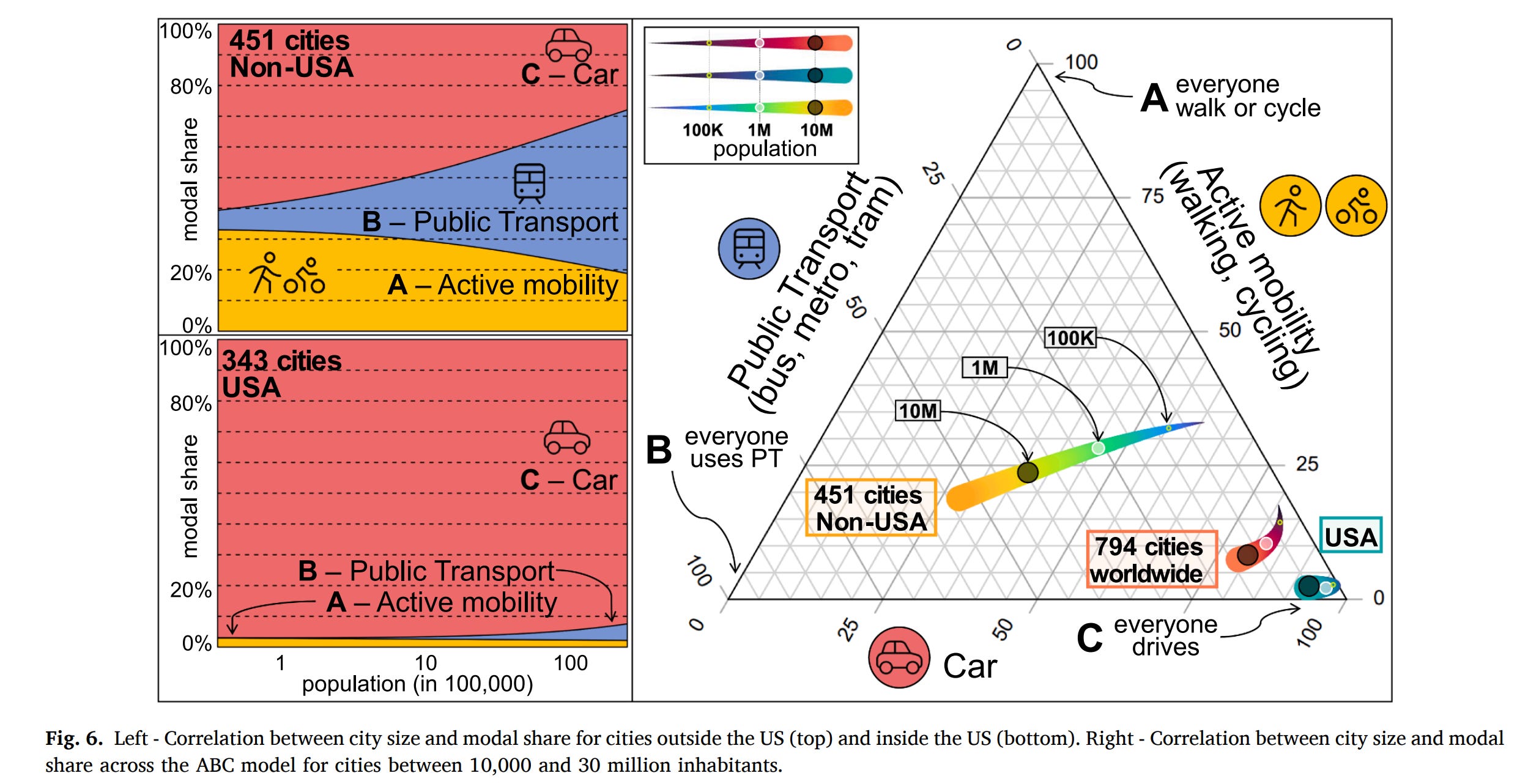
Then the peculiarly American policy problem begins. The United States has built an extraordinary dependence on private automobiles. Prieto-Curiel and Ospina’s The ABC of mobility finds that 91.9% of trips in its US and Canadian urban sample are by car, compared with 44.9% across Europe and 18.8% in East Asia. More strikingly, American car dependence barely changes with city size. Their scaling coefficient for US car journeys is 0.9949, effectively flat, while larger cities elsewhere tend to shift substantially toward public transport.
That study should not be stretched into evidence about kilometres driven because the authors explicitly say vehicle-kilometre data were unavailable for most of their cities. They measure trip shares. But the structural point is hard to miss. For much of America, a car is not a discretionary lifestyle accessory. It is effectively part of the infrastructure required to work, shop, see a doctor and participate in society.
And American vehicle ownership has a class structure. A Federal Reserve household survey found that about two-thirds of lower-income people who had recently acquired a vehicle bought used, with almost a third buying directly from a private seller. Higher-income households were much more likely to buy new or lease, while 78% of privately purchased used vehicles cost less than $10,000.
That means affluent households and commercial fleets create a large share of the vehicles that become affordable transportation years later. A six-year-old car purchased new by a high-income household becomes a ten-year-old car, then perhaps a fifteen-year-old car, moving down through progressively cheaper parts of the market. Destroying it early does not merely affect its current owner. It removes a future rung from the used-car ladder.
Campbell and Geyer recognize that vehicle resale has system effects, although they examine the opposite problem. They ask whether selling an ICE vehicle rather than scrapping it could lower used-car prices enough to entice people out of transit, walking or other lower-emission transport. Their bounding analysis finds the direct electrification benefit is eliminated only at very large displacement rates, depending on grid intensity. They also acknowledge that EV policies can instead raise used-vehicle prices, changing scrappage and fleet turnover. Their primary purpose, however, is diagnostic lifecycle analysis, not modeling who gains and loses from changes in the supply of cheap vehicles.
That is the missing American policy question. Campbell and Geyer answer whether scrapping a functioning ICE vehicle can reduce emissions. They do not answer whether the household that would have bought that vehicle eight years later can still get to work. The answer is not to preserve gasoline cars indefinitely. It is to deliberately move the used-car ladder from gasoline to electricity.
A federal Reliable Rides program should pay for expected future emissions avoided, not simply vehicle age. Fuel economy, recent mileage, remaining expected life and the local electricity mix should determine the base scrappage value. Resources for the Future has modeled targeted vehicle scrappage and found that targeting expected future emissions rather than paying a flat bounty can roughly halve the public cost per ton avoided. Campbell and Geyer reach essentially the same policy direction from the lifecycle side, arguing that limited resources today should concentrate on the least-efficient ICE vehicles.
Used EVs should qualify fully, with more assistance for households that would otherwise be unable to replace their vehicle. Government, rental, delivery and corporate fleets should electrify early because they accumulate mileage quickly and then seed the market with three- to five-year-old used EVs. Battery-health certificates, dependable charging and reasonable finance should be part of the program. Efficient, lightly driven combustion vehicles should be eligible for repair rather than scrappage. And if supplies of sub-$10,000 or sub-$15,000 vehicles tighten too sharply in a region, the retirement incentive should automatically throttle back.
That is a much better Democratic proposition than another tax credit concentrated among people buying expensive new EVs.
A candidate such as Pete Buttigieg would be an obvious owner of the plank. Transportation gives Democrats a way to discuss decarbonization through something Americans experience every week: what it costs to get to work, take children to school, buy groceries and visit family. The pitch should be about reliable mobility and household costs first, with carbon reduction, cleaner air and reduced oil dependence following closely behind.
Jonathan Haidt’s moral-foundations work is useful as a communications discipline here. Democrats naturally reach for care and equality: cleaner air, lower costs and more help for households with less money. But a well-designed program can also speak authentically to proportionality, liberty, loyalty, order and stewardship without changing the policy facts.
Lower bills. Fair rules. Your choice. Participation is voluntary rather than mandated. Luxury vehicles do not receive public windfalls. The biggest incentives go to the vehicles burning the most fuel and to households that genuinely need help replacing them. American workers build, repair, refurbish and recycle the replacement fleet. Battery condition is certified, dealers are policed and public spending is auditable. A good, efficient car is repaired rather than destroyed simply to satisfy a program target.
That language works because the policy earns it. Moral reframing cannot rescue a program that actually transfers public money to affluent new-car buyers while making transportation scarcer for everyone downstream.
Campbell and Geyer have substantially strengthened the environmental case for retiring functioning combustion vehicles early. They have also made clear that the optimal policy is not indiscriminate destruction. High-mileage pickups and inefficient SUVs are obvious early targets. A Prius doing 5,000 km a year on a dirty grid is not.
The American challenge is therefore more interesting than Cash for Clunkers. It is to accelerate the retirement of future combustion emissions while deliberately creating the affordable electric vehicles that working households will need five, ten and fifteen years from now. That is how the United States can stop treating the used-car ladder and the climate transition as competing objectives.
For more analysis like this on transport, energy and climate policy, subscribe to TFIE Strategy Briefing.
Thanks for pointing me to this analysis! It actually helps sharpen an idea I already am interested in quite a while: converting used cars to electric. If scrapping and new-built is already that beneficial, what would happen if the extra production required was only the electric drive train, which should knock off quite some emissions. I got told that the biggest issue in converting ICE to EV is making the electronics and safety systems play together. But I wonder, if vehicles on multi energy platforms should not simplify that issue, and AI might actually help with re-engineering the software in other cases. This would immediately open electrification to completely new groups of society, create work (albeit temporary) for car mechanists, and could be flanked with modest subsidies for a massive impact on emissions and welfare...
Does the study account for the fact that as more EVs are made, the more CO2 efficient they are made?