

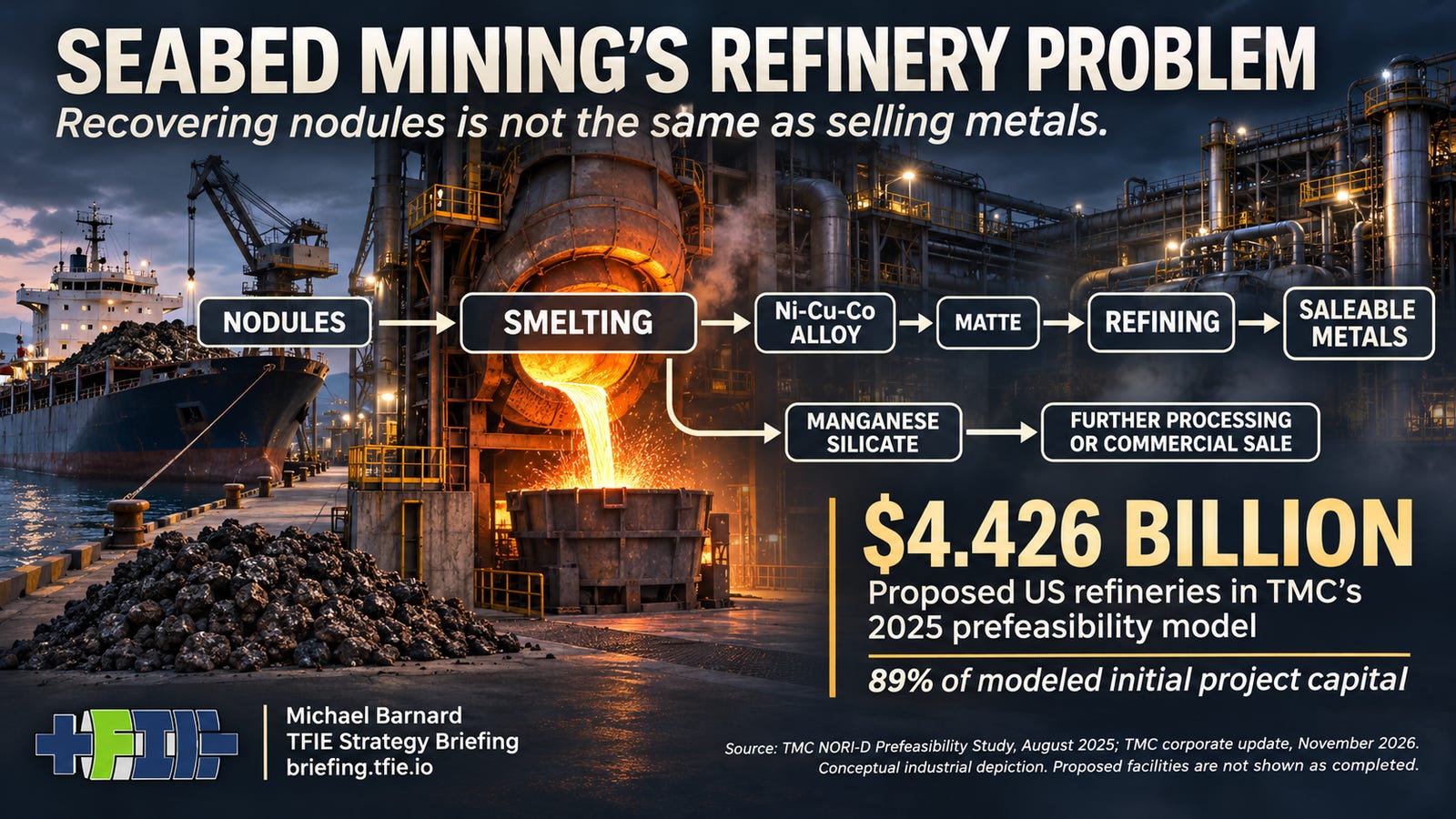
In November 2026, The Metals Company acknowledged that having its proposed Brownsville, Texas, processing and refining facility ready for the first commercial nodules would be difficult. TMC may instead rely initially on Pacific Metals, or PAMCO, in Japan, where an existing smelter would need modifications before accepting commercial quantities of seabed nodules. The company has demonstrated that nodules can be processed there. Making that arrangement work at commercial scale is another matter.
The capital requirements explain why this is important. TMC’s 2025 prefeasibility study estimated $4.426 billion for two proposed US hydrometallurgical refineries. That was approximately 89% of the $4.971 billion of project capital presented in the study, although the comparison needs care. The offshore figure includes only the first production system, after an Allseas capital credit. Subsequent offshore systems would be provided through contracting arrangements, with their costs recovered through operating payments. The $4.426 billion is also not a complete estimate for TMC’s newer Brownsville concept, which would have a different industrial scope.
In our August 2025 techno-economic assessment of seabed mining, metallurgist Lyle Trytten and I identified processing as another fundamental weakness in the proposed business models of TMC and Impossible Metals. Both companies want to capture the economic value of refined nickel, cobalt, copper and manganese products. Neither has demonstrated a complete, commercially operating processing chain that delivers those products at its intended scale and modeled cost. Recovering nodules from the ocean does not establish how much revenue their metals will generate.
Who receives the value of the metals in a seabed nodule? What might a processor pay for the raw material, and what must the mining company finance to retain more of the finished-metal revenue? Subscribe for the processing economics and financial comparisons behind our assessment.