

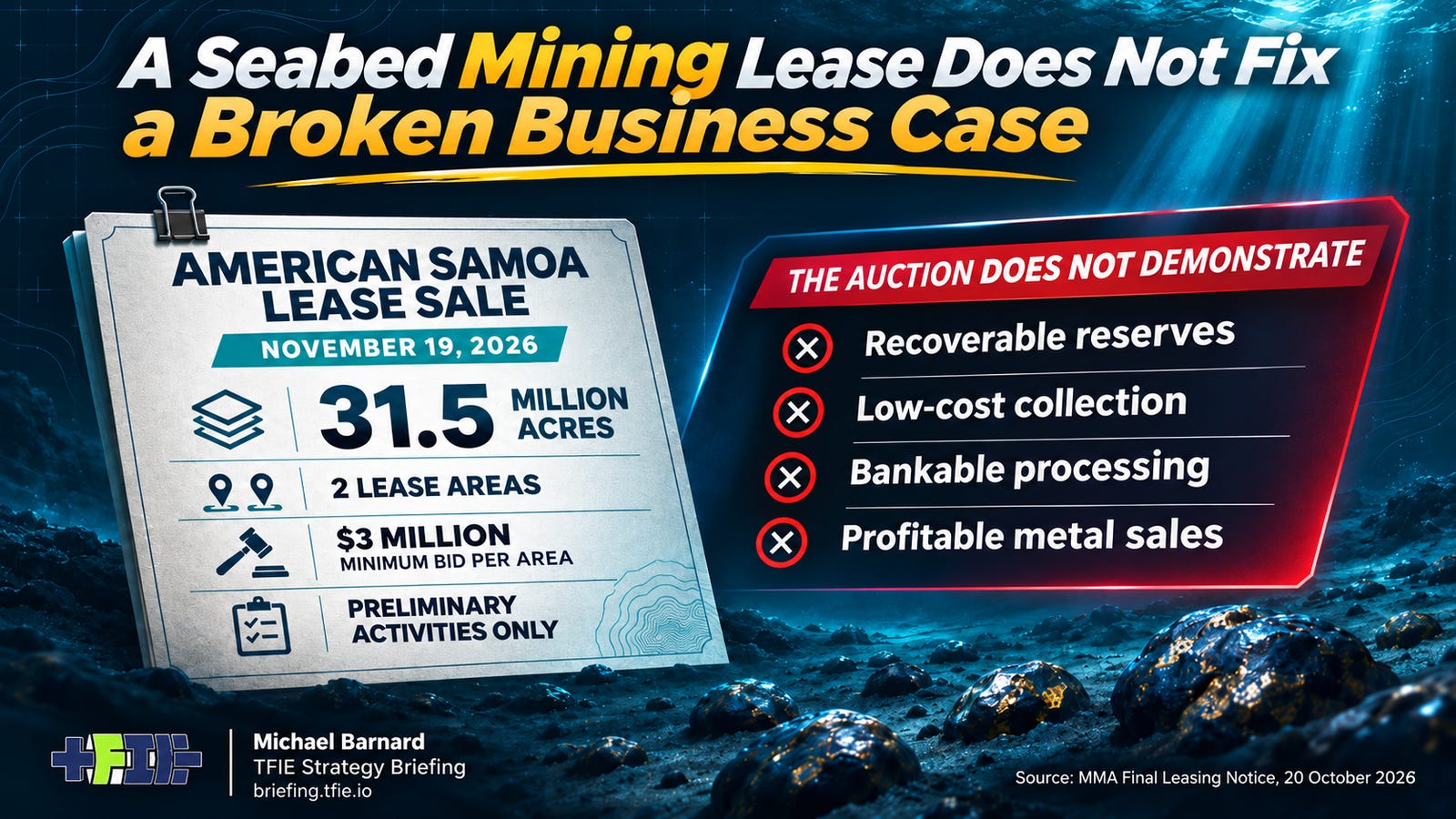
On November 19, the United States is scheduled to auction 31.5 million acres of seabed near American Samoa. Two lease areas will be offered, each with a minimum bid of $3 million. Washington presents the sale as progress toward securing critical minerals for American industry and national security. It is certainly progress in a government leasing process. Whether it represents progress toward a viable mining industry is a very different question.
The auction gives a speculative industry something valuable: an official milestone. Mineral rights acquire formal boundaries, government notices establish a development process, and successful bidders can point to a federal lease award. These developments create an appearance of industrial momentum without demonstrating that the underlying projects are commercially sound. Government agencies allocate mineral rights. They do not establish that the resulting businesses will be profitable.
In August 2025, metallurgical specialist Lyle Trytten and I completed a techno-economic assessment of seabed mining, commissioned by the National Ocean Protection Coalition. We examined the proposed extraction systems, offshore operating requirements, processing arrangements, metals markets and financial sensitivities. Our conclusion was that commercial viability within the following 15 years was highly unlikely. The fundamental problems were technical and economic. Permitting was one obstacle among many, not the principal reason for our negative assessment.
Impossible Metals’ proposed autonomous underwater fleet was exceptionally speculative from an integrated engineering perspective. The Metals Company had demonstrated somewhat more mature collection technology, but its proposed industrial operation still faced substantial commercial problems. Neither business emerged from our assessment as a promising new mining industry waiting for government to open the door. The November auction opens that door without materially changing the evidence behind our conclusions.