

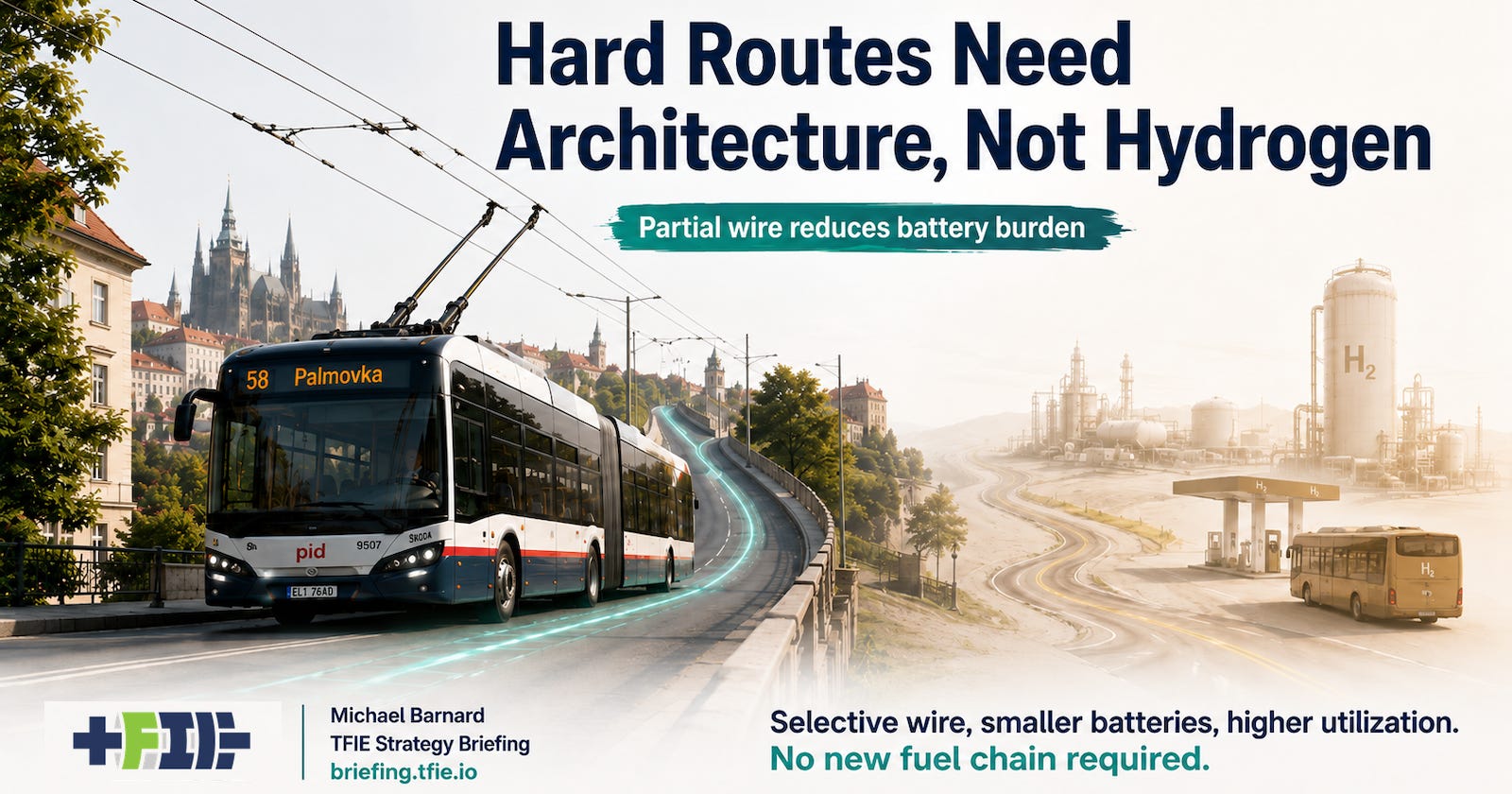
Prague has put useful numbers behind an argument transit agencies should already have been testing: hard bus routes do not automatically require new fuels. They require the right electric architecture.
The first operating-cost data from DPP, Prague’s public transport company, are early and route-specific, but they are much more useful than another brochure comparison between vehicle types. Zdopravy reported that DPP compared electric buses and partial trolleybuses against diesel buses while including vehicle depreciation, infrastructure construction, infrastructure maintenance, and related costs. On line 58, DPP’s transport director Jan Barchánek said the full per-kilometer cost came in only about 10% above comparable diesel operation without subsidies, and slightly below diesel once grants for vehicles and infrastructure were counted.
That is not a universal verdict for every city, route, or procurement. It is more interesting than that. It shows that a direct-electric bus system can get close to diesel economics on selected difficult routes when the design question is asked properly. Not “can a battery bus replace a diesel bus one for one?” Not “can a trolleybus return as a nostalgic historical mode?” The better question is what mix of batteries, wires, chargers, substations, route geometry, layover windows, passenger load, and annual kilometers actually delivers the service.
That is the context for modern in-motion charging trolleybuses. Earlier this year, I wrote that the current trolleybus revival is not about reviving a fixed-wire relic. Modern IMC trolleybuses are battery-equipped electric buses that charge while moving under wires and run off-wire where continuous wiring is unnecessary, visually sensitive, operationally awkward, or simply not worth the cost. Prague was already a useful case in that assessment because line 59 to the airport combined steep grades, heavy passenger loads, high frequency, and large double-articulated vehicles.
The new data are focused on line 58, not the airport line, which strengthens the point. The airport corridor was always an obvious high-capacity candidate. Line 58 makes the strategy look less like a showcase and more like network planning. Magyarbusz’s useful framing is that Prague is not just restarting trolleybus service, but building a deliberate electrification strategy for hilly, high-load bus corridors where diesel consumption is high and battery-only operation can become operationally constrained.
The most important technical detail is not the wire. It is the battery burden. DPP says that in a partial trolleybus, only about 40% of the vehicle’s energy flows through the battery, while in a pure battery-electric bus effectively 100% does. That is a lifecycle-cost statement hiding inside an energy-flow statement. Batteries are not just purchased once in a procurement spreadsheet. They are cycled, heated, cooled, replaced, oversized, constrained by charging windows, and judged by whether they let the vehicle do enough useful work every year.
Selective wire changes that equation. Put direct power on the hilly or high-load segments, let the vehicle charge while doing revenue service, and use the battery where flexibility is valuable. The battery becomes part of the system rather than the whole system. That is the missing middle between depot-only battery buses and old-style continuous-wire trolleybuses.
Prague’s battery-bus results point in the same direction rather than the opposite one. DPP says its older Škoda electric buses with Temsa bodies come in at about 104 to 105% of diesel costs before subsidies, and slightly below diesel after subsidies, on the right services. The explanation is not that batteries have escaped operational constraints. It is that Prague can connect electric buses to an existing electric transit ecosystem: tram infrastructure, substations, regenerative braking energy, and terminal charging.
Utilization is the denominator that keeps getting lost. DPP says the average diesel bus in Prague runs about 50,000 kilometers per year, while its electric buses reached 67,000 kilometers last year. Barchánek said the economics start to work around 65,000 to 70,000 kilometers per year, which is harder for buses that only charge overnight in garages. Capital cost looks different when the vehicle can do more annual service. So does battery sizing, charger count, depot space, maintenance planning, and spare ratio.
This is where the hydrogen bus procurement argument becomes much weaker. Hydrogen is usually pulled into the bus conversation through edge cases: hills, cold weather, long duties, limited depot charging, high passenger loads, and the desire to keep vehicles in service. Prague is showing that those are not necessarily hydrogen requirements. They are route-design and charging-architecture requirements.
That distinction matters. A hydrogen bus is not just a bus with a different tank. It brings a fuel chain: electricity or gas into hydrogen production, compression or liquefaction, storage, distribution or on-site production, refueling equipment, safety systems, specialized maintenance, and fuel-price exposure. A direct-electric transit system brings wires, chargers, substations, batteries, vehicles, and power-system integration. Both require infrastructure. Only one keeps inventing a fuel to avoid using electricity directly.
Subsidies still need honest treatment. Prague’s line 58 result is slightly below diesel on DPP’s books after grants, but subsidies do not make physical costs vanish. They change who pays. The more defensible policy argument is that grants for trolley wires, substations, chargers, and electric buses buy durable public infrastructure for a direct-electric transit system. Grants for hydrogen buses too often buy participation in a fragile fuel ecosystem that still has to prove delivered fuel cost, station reliability, vehicle availability, and repeat procurement after pilot funding fades.
The Prague lesson is not that trolleybuses beat battery buses. It is that electric transit architecture beats fuel substitution. Battery buses work where routes, chargers, layovers, and annual kilometers fit. Opportunity-charged buses work where existing electrical infrastructure can be used intelligently. IMC trolleybuses work where hills, passenger loads, and utilization make battery-only operation less attractive. The categories overlap, and a serious transit agency should be sorting routes into them rather than treating one vehicle type as the universal answer.
That leaves hydrogen with the burden it should have had all along. It has to beat the actual direct-electric alternatives, not a caricature of them. It has to beat depot-charged buses on routes where depot charging works. It has to beat opportunity-charged buses where terminals and substations fit. It has to beat IMC trolleybuses where selective wire reduces battery size, battery cycling, and charging downtime.
Many routes described as too hard for batteries are not hydrogen routes. They are routes where the battery should not be left alone. Prague is now putting early cost evidence behind that distinction, and it is a distinction transit agencies, policymakers, and investors should take seriously before funding another molecule-shaped detour around electricity.
Free posts carry the public argument. Paid TFIE Strategy Briefing posts provide the professional layer: evidence notes, denominator checks, update triggers, and decision-grade context for people working around the transition.