


The leading Western “small” modular nuclear reactor project has reached physical construction without completing the engineering needed to support its original cost and schedule. On November 10, Ontario Power Generation acknowledged that its first GE Vernova Hitachi BWRX-300 reactor at Darlington will exceed its C$7.7 billion budget and miss its October 2030 commercial operation date. OPG cannot yet say how much more it will cost or when it will enter service. A comprehensive reassessment is expected to be substantially complete by mid-2027. The most important part of the announcement is OPG’s explanation: unfinished first-of-a-kind engineering is affecting construction execution and supply-chain performance.
This is the second major schedule retreat. When OPG selected the reactor design in 2021, it suggested completion as early as 2028. The approved project planning subsequently moved commercial operation to October 2030, and now that date is gone as well. The utility is continuing construction while assessing engineering maturity, outstanding design work, construction deliverables, procurement assumptions and first-of-a-kind complexity. Those are precisely the uncertainties that need to be brought under control before the construction activities dependent on them begin.
Bent Flyvbjerg, the Oxford megaproject researcher and co-author with Dan Gardner of How Big Things Get Done—which contains some of my research at their request—, has a memorable rule for successful projects: think slow, act fast. Spend enough time planning, designing, testing assumptions and learning from comparable projects before committing to expensive physical execution. The slow part is where options remain open and changes are relatively inexpensive. The fast part comes when engineering is sufficiently mature, suppliers know what to deliver, construction teams have stable instructions and the project can advance without repeatedly revisiting earlier decisions.
Flyvbjerg and Gardner explained the principle in 2021, warning that pressure to get construction underway can reverse the sequence. Projects think fast, commit early and then act slowly because unresolved problems emerge during delivery. Darlington is demonstrating that failure pattern. Large construction programs can legitimately overlap engineering and physical work when the relevant work packages are sufficiently mature and their interfaces are controlled. The problem is proceeding with activities whose engineering is not ready. OPG’s acknowledgment that incomplete engineering is disrupting execution establishes that this boundary has been crossed.
The reactor’s 2.1-million-pound basemat was installed in April. The first turbine-building concrete pour has been completed, and the cooling-water tunnel boring machine has been assembled. These are genuine construction milestones, but physical progress is not the same as progress toward a predictable completion date. When engineering changes during construction, specifications can change, suppliers may need revised instructions, fabrication and installation sequences can be disrupted, and completed or partially completed work may require modification. OPG has not disclosed how much rework has occurred or what share of the expected overrun arises from each cause. Inflation, market conditions and geopolitical risks are also being assessed. But engineering immaturity is no longer an outside analyst’s hypothetical concern. OPG has identified it as a contributor to the emerging problems.
This was foreseeable. In my 2021 assessment of small modular reactors, subsequently republished in a peer-reviewed journal and text book, I argued that the economic proposition behind SMRs was much weaker than its advocates suggested. Smaller reactors sacrifice some of the economies of scale available to larger units. To compensate, they must capture substantial savings through standardized designs, factory manufacturing and repeated construction. That requires convergence on a small number of proven designs, stable supply chains, committed order books and institutions capable of sustaining production over many years. My assessment found 57 designs and concepts across 18 broad types, without the standardization needed to support the claimed manufacturing economics.
In May 2026, I revisited the evidence on SMR scaling. The global technology landscape had become more crowded rather than converging around a handful of proven products. The projects making tangible progress were those with the strongest traditional nuclear foundations: established sites, experienced operators, public financing, regulatory capacity and major industrial organizations. Darlington stood out as one of the strongest Western candidates because OPG already operates nuclear plants, has the necessary infrastructure and can draw on Ontario’s nuclear workforce. If SMRs were going to demonstrate easier construction and lower institutional costs, this was a favourable place to do it.
Yet an experienced nuclear institution does not eliminate the risks of an unfinished first-of-a-kind design. Ontario’s experience with CANDU reactors does not give it construction or operating experience with the BWRX-300, an American-designed boiling-water reactor using different fuel, equipment and operating systems. GE Vernova Hitachi has considerable experience with boiling-water reactor technology, but this specific reactor has not been completed and operated commercially. That distinction matters when construction schedules, costs and projected learning curves are used to justify billions of dollars of public investment.
I was more quantitative in my October 2025 Darlington assessment. Applying reference-class forecasting derived from historical nuclear construction projects, I used cost uplifts of approximately 67% at P50 and 202% at P80, with schedule uplifts of 40% and 104%, respectively. Rather than accepting the project’s internal estimates as the most reliable basis for planning, this method starts with what comparable projects have actually cost and how long they have taken. It corrects for the optimism that repeatedly accompanies large infrastructure commitments.
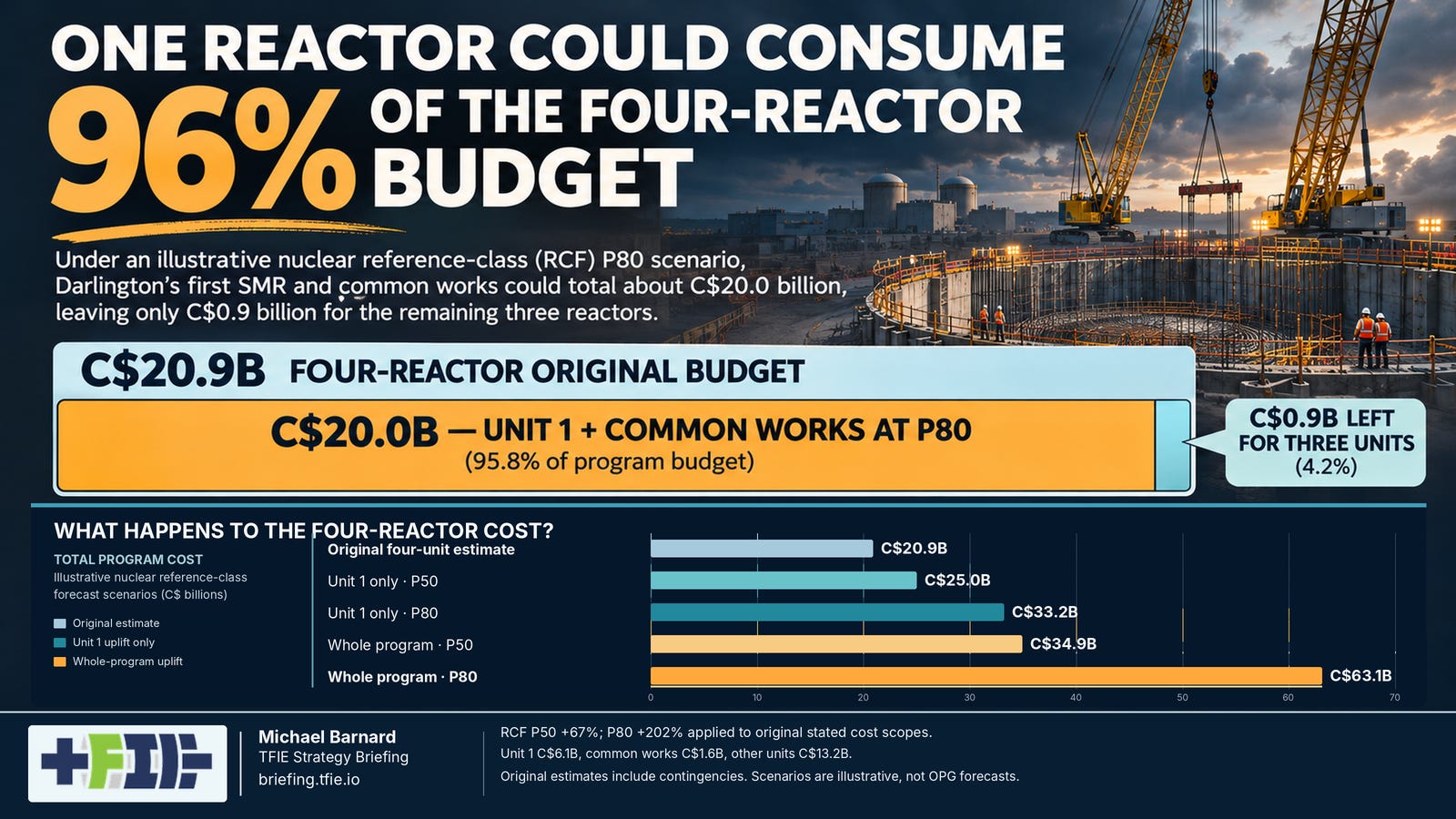
OPG’s original estimate was C$6.1 billion for the first reactor, with another C$1.6 billion for common infrastructure serving the planned four-unit site. Applying the historical nuclear reference-class uplifts to the first-reactor component, while leaving shared infrastructure unchanged, produces approximately C$11.8 billion at P50 and C$20.0 billion at P80, including common infrastructure.
That last figure deserves attention. Ontario’s original budget for all four BWRX-300 reactors was C$20.9 billion. At the illustrative nuclear reference-class P80 uplift, the first reactor plus common infrastructure alone would consume approximately 96% of the original four-reactor budget. Only C$900 million would remain against the C$13.2 billion originally allocated for the other three reactors.
This is not a new OPG forecast, and the historical P80 uplift does not establish an 80% probability of that outcome for Darlington. OPG’s original estimates included financing, escalation and contingency, and reference-class adjustments require care about what those budgets already cover. OPG has confirmed that its approved cost and schedule will be exceeded, but has not yet provided revised figures. The significance is that a severe historical nuclear construction outcome would not merely make Unit 1 more expensive. It would undermine the financial assumptions behind the entire program.
The cost exposure extends beyond Unit 1. The original program allowed C$13.2 billion for Units 2–4, averaging C$4.4 billion each, compared with C$6.1 billion for the first reactor before common infrastructure. Those savings were expected to come from learning, standardization and repeated construction. But repetition delivers the anticipated benefits only when the design being repeated is sufficiently stable. Unresolved engineering can propagate through supplier contracts, fabrication methods, construction sequences and subsequent-unit requirements. The first reactor may still produce valuable learning, but Ontario should require evidence of those savings rather than accepting projections derived from a production system that has yet to stabilize.
The full historical reference-class range is sobering. If only the first unit experiences a substantial overrun while Units 2–4 meet their original budgets, the four-reactor program reaches approximately C$25.0 billion at P50 and C$33.2 billion at P80. Applying the historical uplifts to the entire original program produces illustrative totals of C$34.9 billion and C$63.1 billion, respectively. These are distinct stress scenarios, not additive costs or official forecasts. They show why Ontario should not treat the original C$20.9 billion estimate as a reliable basis for further commitments.
There is also a near-term electricity planning problem. In its November 10 filing with the Ontario Energy Board, OPG removed previously forecast production from the first SMR for the entire 2027–2031 regulatory period. Its original application included approximately 0.5 TWh in 2030 and 1.9 TWh in 2031. Both are now zero, along with the associated forecast capital additions and rate-base assumptions. This does not mean OPG has formally forecast commissioning after 2031. It means the previous schedule is no longer sufficiently reliable to support the regulatory application. The consequences of engineering immaturity are now visible in electricity and financial planning, not just on the construction site.
Ontario needs additional electricity, and the distinction between annual energy and dependable capacity matters. In my August 2026 assessment of Ontario’s electricity requirements, I examined the Independent Electricity System Operator’s outlook and the role of generation, storage and system flexibility. The 2026 Annual Planning Outlook identifies more than 8 TWh of additional annual energy need emerging in 2032 and more than 12 TWh by 2035, after accounting for actions already underway. The outlook includes planned nuclear additions. If those additions arrive late, Ontario needs other resources to meet demand, preserve reliability and avoid greater reliance on natural gas generation.
Ontario has already demonstrated that it can procure substantial quantities of clean electricity through competition. Its final May 2026 Long-Term 2 energy procurement awarded contracts for 1,115 MW of wind and solar, expected to generate approximately 2.37 TWh annually. The weighted average fixed price was C$88.84/MWh, representing approximately C$211 million annually at the contracted production estimate and initial price. These are 20-year contracts with market-revenue settlement and indexing provisions, so the fixed price is a procurement benchmark rather than a forecast of every year’s actual net payments.
One 300 MW BWRX-300 operating at a 90% capacity factor would also generate approximately 2.37 TWh annually. Ontario has contracted essentially that annual quantity of renewable electricity without relying on a single first-of-a-kind construction project. Wind and solar do not have the same hourly output or dependable capacity as a nuclear reactor. But the comparison establishes the scale of new energy Ontario can procure competitively.
Ontario’s June 2026 capacity procurement adds another part of the portfolio. IESO selected 640 MW of battery storage, with a weighted average fixed capacity payment of C$563.48 per MW-business day. Using approximately 250 payable business days annually, that represents about C$90 million in annual fixed capacity payments. Combined with the renewable energy procurement, the two separately contracted resource groups represent approximately C$301 million annually, equivalent to C$127/MWh when battery capacity payments are allocated across the expected renewable generation.
That C$127/MWh is not the price of continuous firm electricity. The battery contracts are separate from the renewable contracts, and the calculation does not include every integration, transmission, charging and additional reliability cost. It is, however, a useful Ontario-specific procurement benchmark. Using a 6% real financing rate, a 60-year operating life, a 90% capacity factor and an illustrative C$35/MWh allowance for nuclear operating and fuel costs, the original first-reactor budget produces approximately C$237/MWh. The original four-reactor budget produces approximately C$172/MWh. Both are modelled figures, not regulated electricity prices, and both use nuclear budgets OPG has now acknowledged are insufficient at least for Unit 1.
The remaining question is how much additional expenditure Ontario needs to make renewable electricity useful and dependable in its actual grid. Nuclear provides substantial continuous low-carbon generation but requires the system to manage planned and unplanned outages. Wind and solar produce electricity according to weather and time of day. Batteries shift energy and deliver operating services for limited periods. An hourly portfolio comparison must account for these differences, along with seasonal requirements, charging losses, transmission constraints and resources needed during prolonged periods of low renewable production.
There is no reason to assume that every solar farm must behave like a nuclear reactor. Ontario already has substantial nuclear and hydroelectric generation, interconnections with neighbouring electricity systems, an expanding battery fleet and considerable opportunities to make electricity demand more flexible. These resources have constraints and competing uses, but their existence changes the incremental cost of integrating new renewable generation. The proper comparison is between complete portfolios providing equivalent energy, capacity, reliability and emissions outcomes, including the financing and construction risks of each pathway.
Ontario should expand competitive procurement of wind and solar, continue building batteries, and invest in transmission, interconnections, efficiency and demand flexibility wherever these provide demonstrated system value. Its existing nuclear fleet remains a major low-carbon asset and should be maintained and refurbished where economically justified. New nuclear investment should compete against alternatives on realistic cost and schedule assumptions, with historical reference-class evidence included rather than set aside.
Ontario also needs to obtain much greater value from the electricity infrastructure it already owns. A substantial share of transmission and distribution investment is driven by what networks must deliver during a few difficult hours or at specific locations, rather than their average annual utilization. A constrained transformer, congested transmission corridor or brief winter peak can create a requirement for expensive reinforcement even when capacity is available elsewhere or at other times. Batteries, managed EV charging, thermal storage, industrial demand flexibility and grid-enhancing technologies can reduce some of those requirements. Where constraints persist, physical reinforcement remains necessary. The objective is to use infrastructure and flexibility together, not to pretend that better software can eliminate the need for wires.
This is the problem addressed in my October 2026 Flexibility Mesh report, a whole-system architecture for reliable and affordable electrification. The report starts with the electricity-system service required, then identifies which physical resources can deliver it at the necessary location and duration. It also examines the permissions, coordination, procurement, measurement and settlement arrangements needed to turn technical potential into usable system value.
A battery located on the correct side of a constrained distribution feeder may help defer an upgrade, while an identical battery elsewhere may offer no value for that particular problem. Managed EV charging can reduce local peaks without compromising mobility requirements. Industrial demand and building thermal storage can shift consumption within acceptable operating boundaries. Those services depend on coordination among resource owners, aggregators, distribution utilities and the system operator. A technically capable resource that lacks permission to participate, cannot be coordinated or cannot demonstrate delivered performance is not yet a dependable source of grid flexibility.
Flexibility exists throughout the electricity system, but its value depends on the service required, the location and duration, permissions, coordinated delivery and who ultimately benefits.
The implications for Ontarians’ electricity bills are practical. Competitive generation procurement can reduce the cost of obtaining additional clean electricity. Storage and flexible demand can reduce expensive peak requirements and make renewable generation more useful. Better network utilization can defer or reduce some infrastructure investments. Efficiency permanently reduces consumption and the need for new assets. These benefits are not automatic, and the same avoided cost cannot be claimed several times. Savings must be assessed against credible alternatives, after accounting for the cost of delivering flexibility, and passed through to consumers by procurement, regulatory and tariff arrangements.
This is also why the Flexibility Mesh distinguishes the value created for the system from revenue received by a service provider and savings reaching electricity customers. A flexibility market can pay participants without reducing total system costs. The goal should be measurable reductions in required infrastructure, generation, fuel and system operating expenditure, subject to reliability and customer-service requirements. Ontario should use those measures to determine which flexibility investments to procure, which network upgrades to defer and which permanent reinforcements remain necessary.
There is a common principle connecting Flyvbjerg’s megaproject discipline and the Flexibility Mesh. Both require decision-makers to understand the problem before committing resources. Both distinguish demonstrated performance from expectations and emphasize learning while choices remain open. Darlington’s failure was to advance physical construction without adequate engineering maturity. Ontario would compound that mistake if it committed to three more reactors on the assumption that the first would establish an economical, repeatable design before the evidence supports that conclusion.
The first Darlington SMR may eventually operate successfully and provide valuable construction experience for subsequent units. The other three reactors may achieve genuine learning-curve savings. But Ontario’s original cost and schedule assumptions are already broken, and historical nuclear reference-class outcomes illustrate how much greater the resulting financial exposure could become. Until OPG completes its engineering assessment and establishes a credible revised budget and delivery schedule, the remaining reactors should not be treated as committed low-cost future supply.
Ontario does not need to wait for Darlington’s next cost estimate to act on its electricity needs. It can accelerate competitive renewable generation and battery procurement, improve use of existing generation and networks, coordinate flexible demand and measure the resulting savings. Those investments can reduce exposure to gas generation, provide new energy when it is needed and help contain electricity costs while preserving the option to build additional nuclear generation where the evidence justifies it.
Darlington’s lesson is not that Ontario should build nuclear reactors faster. It is that Ontario should complete the difficult thinking before making expensive commitments, build the competitive clean electricity it can deliver now, and get much more value from the grid it already owns.
How much could the first SMR’s cost overrun increase the price of Ontario’s planned four-reactor fleet? What do historical nuclear P50 and P80 outcomes imply for electricity costs, and how sensitive are those estimates to financing? What evidence should Ontario require before approving Units 2–4? The paid analysis below works through the calculations, assumptions and investment decision gates.
