

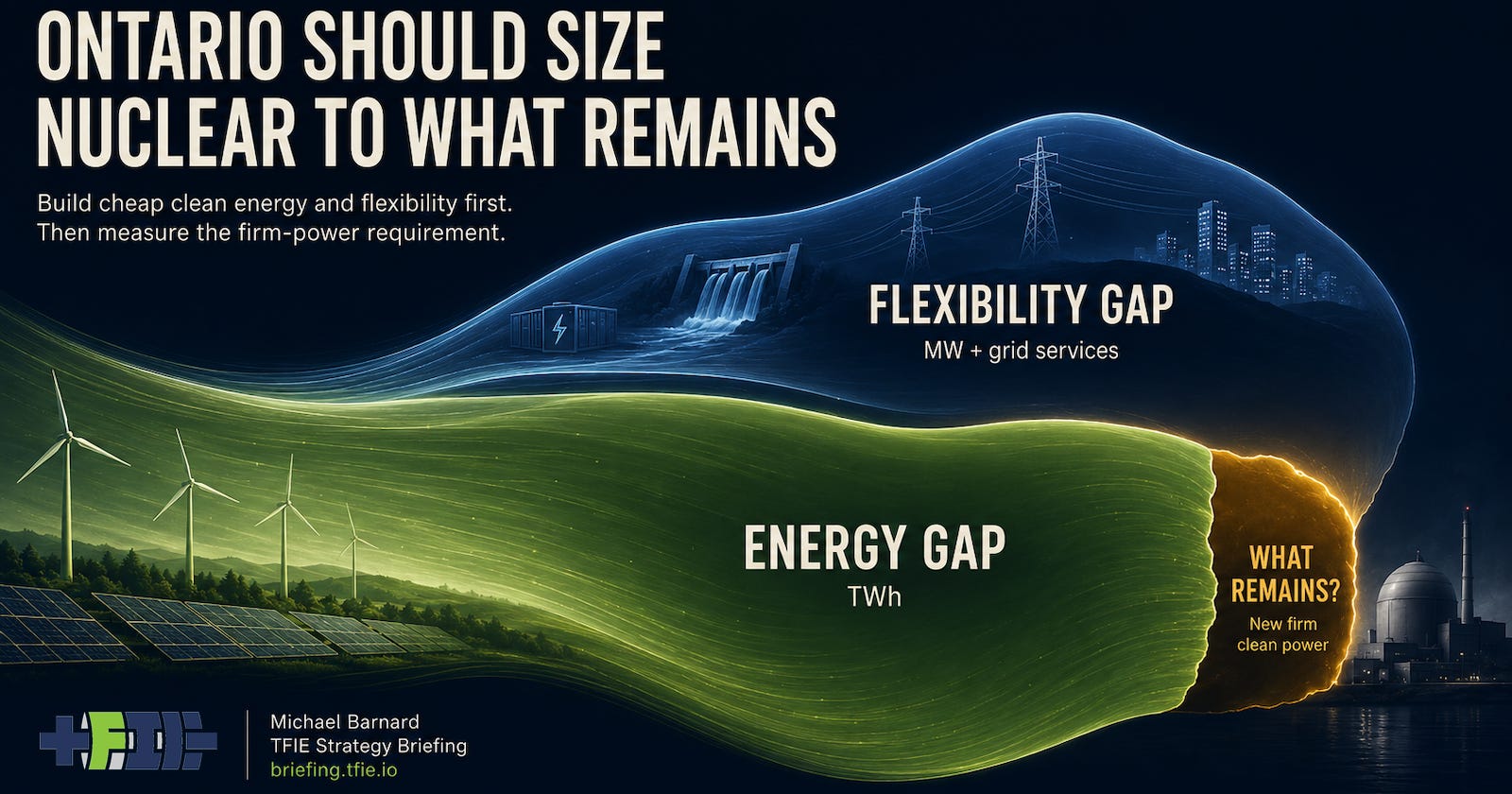
Ontario undoubtedly needs more electricity. Demand reached 145.6 TWh in 2025, up 4.4% in a single year, and IESO’s 2026 Annual Planning Outlook has reference-case net demand reaching 250 TWh in 2050. The uncertainty around that number is enormous: its low-demand case is 207 TWh and its high case 297 TWh. That range alone should make planners wary of behaving as though the 2050 generation mix is already known. More importantly, IESO now distinguishes clearly between energy and capacity requirements. After accounting for actions already under way, it sees more than 8 TWh of additional annual energy need emerging in 2032 and more than 12 TWh by 2035, while the remaining incremental summer capacity requirement does not appear until 2035 and is initially about 950 MW.
Those numbers point toward two overlapping but different jobs. Ontario needs generators that produce additional annual TWh, and it needs a portfolio capable of ensuring that enough electricity is available at difficult hours while continuously maintaining frequency, reserves, ramps and other operating requirements. A reactor can provide enormous quantities of low-carbon electricity and dependable capacity over long periods. A wind or solar farm supplies energy with a very different hourly profile. A battery supplies almost no net annual energy but can shift it through time and respond extremely quickly. Hydroelectric reservoirs can provide both energy and flexibility. Transmission can make generation that is plentiful in one part of the system useful somewhere else. Demand response can eliminate a requirement to generate at a particular hour without producing a single electron itself. Treating all of these resources as competitors for one vaguely defined product called “power” is how bad capacity planning starts. IESO itself says an adequate and operable grid must simultaneously provide energy, capacity and essential reliability services.
Ontario’s recent gas trajectory is a useful demonstration of what happens when those products are not separated clearly enough. Transmission-connected gas and oil generation increased from 9.7 TWh in 2020 to 31.4 TWh in 2025, more than tripling in five years, while nuclear output declined from 87.8 TWh to 78.3 TWh as major refurbishment programs and outages worked through the fleet. Gas consequently rose from 7% to 19.3% of transmission-connected generation. That increase cannot reasonably be blamed on nuclear alone: demand increased, weather varied, exports and imports changed and market conditions matter. But IESO specifically says planned shutdowns of multiple nuclear units tightened 2025 supply conditions and that natural gas was increasingly relied upon to maintain reliability. Its March 2026 near-term outlook likewise says Ontario can absorb Pickering going offline for refurbishment partly because gas-plant upgrades and new battery projects are entering service.
Gas is doing more than filling an energy hole left by unavailable reactors. It is also doing jobs that baseload nuclear generally does not. IESO’s operability work says large hydro and gas generators provide both inertia and primary frequency response, whereas baseload nuclear supplies inertia but normally cannot provide primary frequency response because it operates at full output rather than changing output to counter frequency deviations. Hydro and gas currently provide most operating reserve, while hydro, gas and interchange do much of the system’s load following. IESO explicitly anticipates that battery storage and other technologies can take over increasing portions of these services as Ontario reduces its reliance on gas.
This distinction is central to the nuclear discussion because a nuclear-heavy grid is not a grid consisting only of nuclear plants. Very large reactors create very large contingencies when they trip, disappear for long planned outages during refurbishment and maintenance, and are economically happiest running at high output most of the time. None of that makes nuclear bad technology. It means that the hydro, gas, storage, transmission and controllable demand surrounding the reactors are part of the system architecture that makes nuclear useful. Ontario’s current architecture has allowed gas to play too much of that complementary role, and reducing electricity-sector emissions requires replacing much of it with non-emitting flexibility rather than simply adding more low-carbon baseload generation.
At the same time, flexibility cannot manufacture the 8 TWh IESO says Ontario starts needing in 2032. Batteries can move wind, solar, hydro or nuclear electricity from one hour to another. Demand response can move or eliminate load. Efficiency can genuinely reduce the amount of energy required, and IESO says expanded efficiency programs materially reduce its 2050 demand forecast and save $12.2 billion in system costs. But after those savings there is still an annual energy gap, and somebody has to generate those TWh. IESO lists on-time nuclear refurbishments and new nuclear, additional dispatch from the existing gas fleet, further efficiency and cost-effective new renewables among the options for meeting it.
That puts wind and solar much closer to the centre of the Ontario electricity discussion than provincial politics has allowed for most of the past decade. IESO has now returned to buying them after more than ten years without a major new-build renewable procurement. The first LT2 energy window ultimately executed contracts for 1,115 MW of projects with expected annual production of 2.37 TWh, and IESO has more procurement windows planned. When the projects were initially selected, the agency said competitive bidding had produced pricing 21% below the previous large-scale Ontario renewable procurement. The selected projects also required municipal support and substantial Indigenous equity participation, addressing two of the major political defects of the earlier Green Energy Act model.
Ontario’s long renewables hiatus was not the result of wind and solar losing a neutral economic competition. The province’s first renewables boom certainly had real policy problems. Early feed-in tariffs bought solar when the technology was much more expensive, siting policy alienated municipalities, demand stopped growing as expected and Ontario sometimes had surplus baseload electricity that forced wind curtailment. Those mistakes provided ideal raw material for populist politics. Doug Ford’s Progressive Conservatives turned wind turbines and electricity bills into wedges, cancelled 758 renewable contracts after taking office and even terminated projects that had already been materially developed. The cancellations also increased political risk for anyone signing a long-term infrastructure contract with the province.
The cost narrative attached to that political campaign was badly distorted. Ontario electricity prices had been held down by previous political interventions and eventually had to recover toward more economically realistic levels, while large legacy costs from the province’s nuclear build remained embedded in the system. I have written before that roughly half of the consumer price increase being blamed politically on renewables was associated with servicing nuclear debt, with much of the remainder associated with restoring rates after earlier suppression and repairing the grid. Ontario Hydro entered its 1999 restructuring with tens of billions of dollars of debt, much of it associated with nuclear investment and overruns. Wind and solar were visible and politically convenient targets; stranded nuclear liabilities and years of artificially low prices were much less useful on a campaign sign.
That episode deserves remembering, but not dwelling on, because the more important point is what Ontario should build now. The system that produced surplus electricity fifteen years ago is disappearing. Annual demand in 2025 was already 10.5 TWh higher than in 2020, IESO expects substantial further growth, and its 2026 outlook says surplus baseload generation is no longer the planning problem. Ontario is moving from an era in which it sometimes had too much inflexible electricity into one in which it expects to need additional TWh before it needs a large increment of new peak capacity. Wind and solar are particularly well suited to that first problem because they can be procured in repeatable increments and built on timelines measured in a small number of years rather than committing the province today to the exact generating fleet it will require in the 2040s.
Their limitations are real and should be accounted for rather than waved away. Wind production varies and is generally stronger in Ontario’s winter; solar is strongly daytime and seasonal. More variable generation increases regulation and load-following requirements because forecast output never perfectly matches actual output and because solar sunset or wind ramps change net load. IESO explicitly models those operability effects. Existing Ontario wind and solar also do not currently provide primary frequency response, although inverter-based resources can increasingly be designed to provide fast frequency services. None of this means Ontario gets to add arbitrary amounts of wind and solar with no balancing cost. It means that their very inexpensive energy has to be evaluated together with the incremental cost of the flexibility and transmission required to make it useful.
Ontario is now procuring that complementary system at meaningful scale. The latest LT2 capacity window contracted another 640 MW of new battery storage, bringing contracted battery capacity to more than 3.5 GW by 2030. More interesting than the quantity is the procurement curve: IESO says those batteries came in 36% cheaper than its expedited first long-term battery procurement and 16% below its first regular long-term procurement. Repeated procurements are doing exactly what modular technology markets are supposed to do: revealing current prices, creating supplier competition and allowing the province to update the next decision instead of forecasting one technology cost decades ahead.
Batteries do not eliminate the need for hydro, transmission or longer-duration resources. IESO notes specifically that batteries providing operating reserve or load following eventually have to recharge and can run into duration limits during sustained high-demand or low-renewable periods. Ontario therefore also has a Long Lead-Time procurement for resources including long-duration storage and hydro, is maintaining more than 1,000 MW of Northern Ontario hydro through new contracts, and has more than 1,800 kilometres of transmission planned or under development. Interties with neighbouring systems add another source of diversity and frequency support. The useful grid is a portfolio, not a battery monoculture attached to a wind farm.
Demand itself is becoming part of that portfolio. At Ontario’s 2025 annual peak, Capacity Auction resources reduced demand by 316 MW, Peak Perks delivered about 200 MW and the Industrial Conservation Initiative reduced demand by roughly 1,600 MW. IESO now has more than 320,000 homes and small businesses participating in Peak Perks, capable of providing more than 200 MW of demand reduction, while a similar program is being introduced for commercial and institutional buildings. Those numbers are still modest beside a provincial grid with peaks approaching 25 GW, but they precede most of the electrification that creates the really large flexible resource: millions of EV chargers, heat pumps, water heaters and other digitally controlled loads.
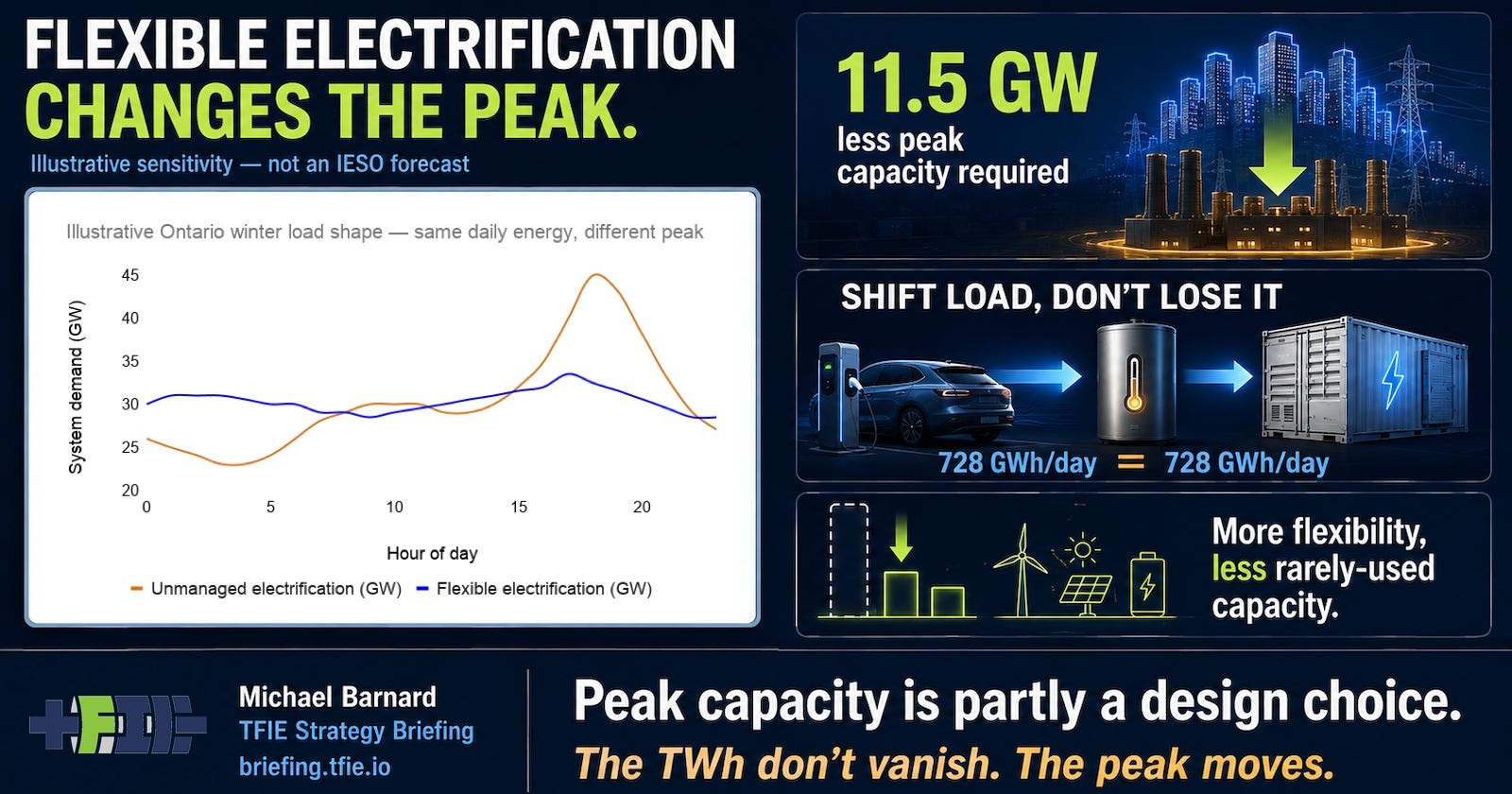
The emerging architecture is therefore reasonably clear. Wind and solar can provide substantial amounts of the incremental clean energy. Hydro supplies both energy and valuable flexibility. Batteries increasingly handle fast response, reserves and shorter-duration shifting. Demand response and smart electrification reduce the amount of physical capacity required for infrequent peaks. Transmission and interties increase the value of all of them by broadening the geographical resource pool. Gas currently fills gaps across both energy and operability, but its role should shrink as the non-emitting portfolio becomes deeper. None of these statements requires believing that an Ontario grid can or should become 100% wind, solar and batteries.
Nor does this architecture imply abandoning nuclear. Ontario’s existing reactor fleet is a major low-carbon asset, and recent refurbishment performance deserves recognition rather than being forced into an anti-nuclear narrative. Darlington’s refurbishment was completed ahead of the overall schedule and below budget, while Bruce Unit 3 returned seven months early and under its refurbishment budget. Extending productive reactors on existing sites with existing transmission, workforces and operating organizations is a very different proposition from choosing how much entirely new nuclear generation to build.
The Darlington SMR program belongs somewhere between those categories. Ontario is already physically constructing the first unit, including installation of the first reactor foundation, and plans four units totalling about 1,200 MW. Whatever one thinks about the economics, those projects are now sufficiently advanced that Ontario should learn from what they actually cost, how quickly subsequent units can be delivered and how they operate in the provincial system. Real construction data from Darlington will be more valuable for sizing the next nuclear program than another decade of vendor forecasts.
The much larger future nuclear options are where sequencing becomes critical. Ontario is advancing Wesleyville near Port Hope as a site that could hold as much as 10,000 MW of generation, while Bruce C has entered a roughly $300 million pre-development phase. Preserving sites, conducting environmental work and maintaining a nuclear development option can be sensible given the range in IESO’s long-term demand outlook. It is not the same thing as concluding that every prospective reactor should be constructed. At Wesleyville alone, the potential capacity is roughly ten times the residual 2035 capacity requirement IESO currently identifies after accounting for actions already in flight. Those numbers refer to different years and the system requirement grows beyond 2035, so the comparison is not a claim that Wesleyville is ten times too large. It demonstrates how much uncertainty remains between preserving the option and knowing the required fleet size.
Ontario consequently has a sequencing opportunity that is much more valuable than choosing an ideological winner between nuclear and renewables. The first step is efficiency because avoided electricity requires neither generation nor flexibility. The second is to procure large amounts of the fastest competitive clean generation available, which in present Ontario procurement means wind and solar will have a substantial role. In parallel, batteries, hydro, demand response, transmission and interties should be expanded so that more variable energy displaces gas rather than simply adding variability to it. Existing nuclear should be refurbished when justified, and the Darlington SMRs should be allowed to generate real evidence about the newest nuclear technology Ontario has chosen.
After several procurement cycles, the province will know much more than it does now. It will know whether the 2050 demand trajectory is bending toward 207, 250 or 297 TWh. It will know actual Ontario wind and solar prices rather than arguments about fifteen-year-old feed-in tariffs. It will know how much battery costs fall, how many hours of storage are economically useful, how much EV and building load can be controlled, where transmission remains constrained and how much gas has actually been displaced. It will also know whether the first Darlington SMR and its successors are meeting their own cost and schedule promises. IESO itself says the heightened uncertainty around demand supports an iterative planning and procurement approach.
There will almost certainly still be a requirement for dependable low-carbon generation. The scale is what is uncertain. If Ontario moves toward the high-demand case, variable generation reaches practical economic limits, gas must be driven close to zero and a large persistent energy deficit survives after efficiency, storage, hydro, transmission and demand flexibility are counted, additional large nuclear may be an entirely rational investment. If demand lands nearer the reference or low cases while repeated renewable and storage procurements continue to get cheaper, the economically justified new nuclear fleet could be substantially smaller.
The mistake would be to reverse that order and make the slowest, largest and least reversible investment the starting assumption. Ontario does need generation, and flexibility alone will not produce the missing TWh. It also needs far more flexibility, and new nuclear alone will not provide it. Wind and solar address much of the first problem quickly; storage, hydro, transmission and controllable demand address much of the second; the combination can push gas back toward the margins. Nuclear should then compete for the large, durable clean-energy requirement that remains.
Ontario’s Conservative government deserves criticism for spending years turning renewables into a political wedge and helping destroy the development pipeline it now needs to rebuild. But that is history, not the organizing principle for the next thirty years of electricity investment. The stronger indictment would be to repeat the error in another form by allowing political enthusiasm for nuclear to determine the generation mix before the system requirement has been discovered. Ontario has enough time to build the fast things first, learn from them, preserve its nuclear options and make the very large capital decisions with better information.
That is not hesitation. It is competent infrastructure planning.
For more analysis of electricity-system planning, nuclear economics, renewables, storage and grid flexibility, subscribe to TFIE Strategy Briefing.