

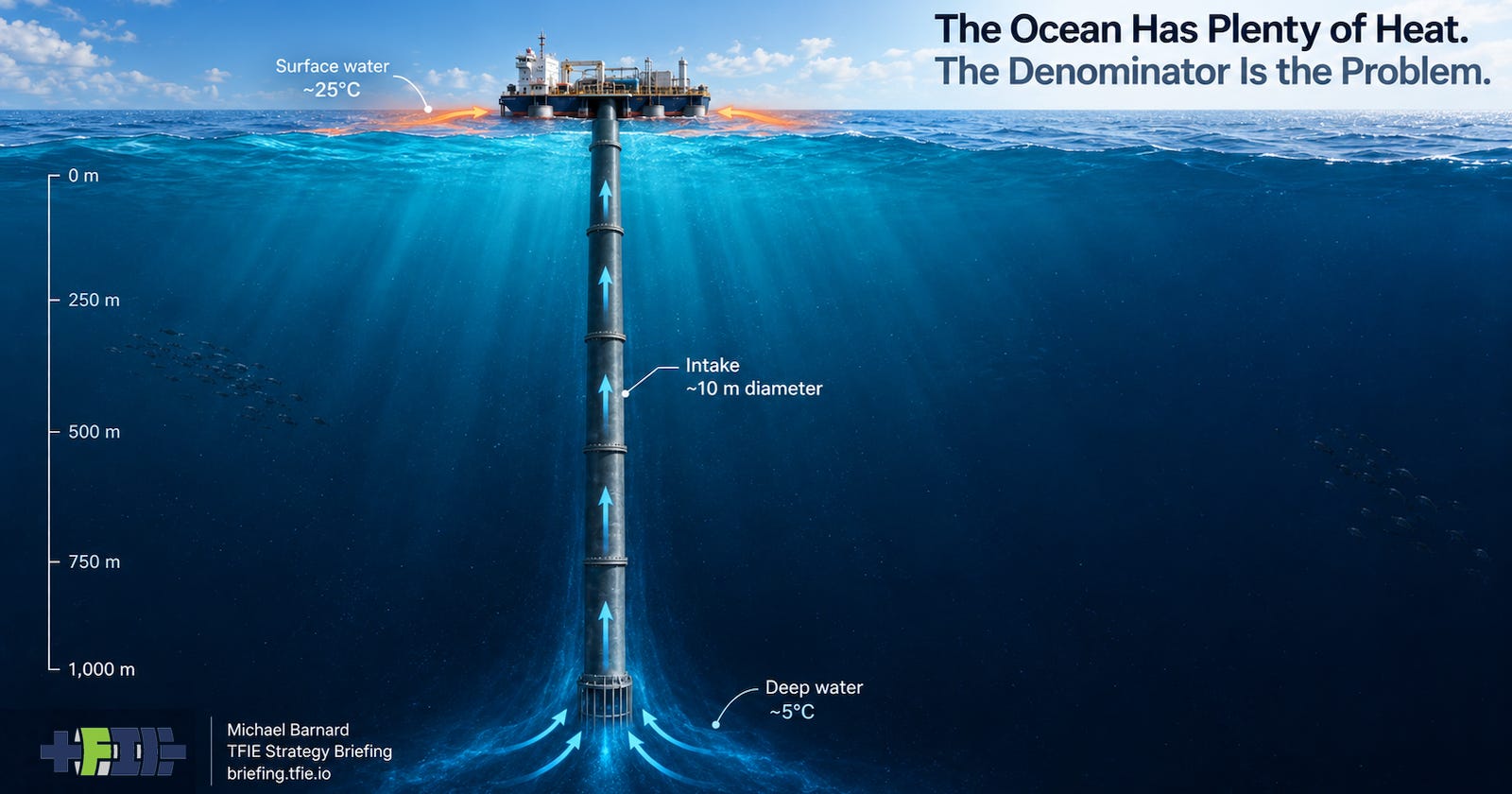
Ocean thermal energy conversion, usually shortened to OTEC, is one of those energy technologies that never entirely goes away. The proposition is appealing. Tropical oceans have warm water at the surface, typically around 25°C or more, while water roughly a kilometer down can be around 4°C to 5°C. Put a heat engine between the two reservoirs, vaporize a working fluid such as ammonia with the warm water, run the vapour through a turbine, condense it with the cold water and repeat. The fuel is free, the temperature difference is available day and night, and the underlying thermodynamics are entirely legitimate. The basic process generally needs a temperature difference of roughly 20°C or more to become useful.
The interesting question is not whether OTEC works. It does. The question is why a technology first demonstrated as a net electricity source almost half a century ago still has no utility-scale commercial fleet. Makai Ocean Engineering has spent decades developing OTEC and deep-water systems, and its Hawaiian research installation has operated with a 105 kW turbine-generator. Yet Makai still describes a multi-megawatt offshore demonstration operating for several years as an important step before very large commercial systems become readily financeable. That is a revealing deployment record for a technology whose fundamental physics have been understood for generations.
The answer starts with the quality of the energy resource. A heat engine operating between 25°C water and 5°C water has a theoretical Carnot ceiling of only about 6.7% between those seawater temperatures. Real equipment has to maintain temperature differences across heat exchangers, operate turbines and generators, and run pumps, so practical cycle efficiencies are only a few percent. A detailed 100 MW net OTEC design study for Indonesia places conventional Rankine-cycle efficiency in the 3% to 5% range and assumes substantial internal electricity consumption. Low efficiency by itself is not the indictment. The heat differential in the ocean is free. The problem is what low efficiency means physically: a modest amount of useful electricity requires processing several gigawatts of heat and moving enormous quantities of seawater.
That Indonesian design makes the denominator tangible. To deliver 100 MW net, it requires 235 cubic metres of cold deep water every second and another 470 cubic metres of warm surface water every second. Together that is 705 m³/s, or 705,000 liters every second. An Olympic-size competition pool holds about 2.5 million liters, so the plant circulates the equivalent of one Olympic pool every 3.5 seconds, about 17 every minute and more than 24,000 every day. The pool comparison uses the 2.5-million-liter competition pool at Montreal’s Olympic complex as the reference.
The plant is not consuming all of that water. It returns most of it to the ocean after passing through the system. But “not consumed” is very different from “does not require infrastructure.” Every liter has to enter through an intake, pass through pipes and heat exchangers with low enough pressure losses that pumping does not consume the plant’s output, and then be discharged again. On an electricity basis, the reference design moves roughly 25 cubic metres, or about 25 tonnes, of seawater for every net kilowatt-hour it produces. That is a much more useful denominator than the total amount of thermal energy stored in tropical oceans.
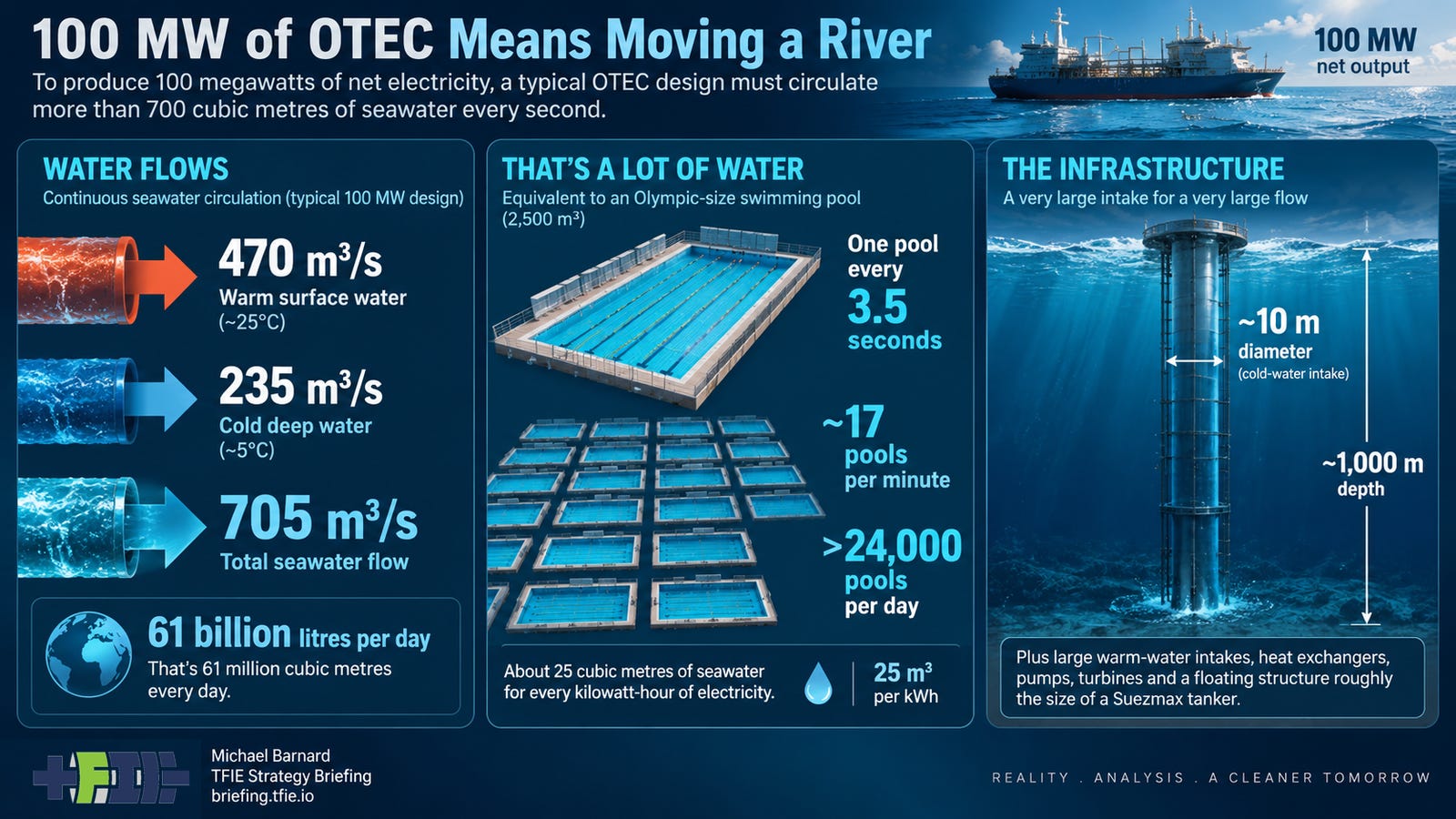
The cold-water intake is where the abstraction becomes civil infrastructure. An IRENA engineering review put a 100 MW-class cold-water pipe at roughly 10 m in diameter and about a kilometer long, while Makai gives a similar scale for a future 100 MW plant. A 10 m diameter is an enormous pipe, extending downward for roughly a kilometer and remaining connected to a plant that must continuously move hundreds of tonnes of cold seawater every second.
The heat exchangers are similarly dominated by scale because several gigawatts of thermal energy must cross them to produce only 100 MW of net electricity. Makai describes the heat-exchanger installation for a 100 MW plant as roughly 6 m high and occupying about 930 m². Better working fluids, heat-exchanger designs and materials can reduce costs and parasitic loads, but they do not alter the basic requirement to move enormous quantities of heat across a temperature difference of only about 20°C.
The kilometer depth itself is not equivalent to pumping water vertically one kilometer from a mine. Hydrostatic pressure inside and outside the intake largely balances. Pumping loads come mainly from friction, screens, bends, heat exchangers and other pressure losses. But when hundreds of cubic metres per second are moving continuously, even small increases in pressure loss translate into large electrical loads. Large pipes and relatively low velocities are necessary precisely because parasitic pumping can otherwise consume a material fraction of gross generation.
Putting OTEC offshore trades one form of civil infrastructure for another rather than eliminating it. A vertical intake can be shorter than running a pipe from shore down a sloping seabed, but then a kilometer-scale riser hangs beneath a floating structure and has to tolerate currents, vessel motion, corrosion, fatigue, storms and stationkeeping loads. In that Indonesian 100 MW design, accommodating the machinery and seawater systems drove the platform toward Suezmax tanker scale— roughly 275 m long and 48 m wide, nearly three soccer pitches from bow to stern. Offshore engineering can certainly build systems at that scale, but the ability to engineer complex subsea infrastructure does not make it cheap.
The deployment history is the other hard denominator. Mini-OTEC in Hawaii produced net electricity in 1979. Later demonstrations in Hawaii, Japan and elsewhere proved additional components and integrated systems, and Makai’s 105 kW plant became the first closed-cycle OTEC system to send electricity to a US utility grid. Those are legitimate engineering achievements. What has not followed is the pattern seen with technologies that found strong economic niches: increasingly large commercial plants, repeated orders, standardized equipment, competitive suppliers and a growing base of operating data. Solar, wind and batteries have moved into deployment measured in hundreds of gigawatts per year. Utility-scale commercial OTEC deployment remains absent.
There is another denominator that matters just as much as seawater flow. The relevant resource is not the total area of tropical ocean with a 20°C temperature gradient. It is the much smaller subset of coastlines where kilometer-deep water lies close enough to substantial electricity, cooling or water demand to justify the intake, export and shore infrastructure. A vast theoretical resource can shrink quickly once distance to depth, grid connection, landfall, maintenance access and actual customers are included.
OTEC still has a plausible niche. The strongest case is a steep-sided tropical island where deep cold water lies close to shore, land is constrained, electricity is expensive because imported fuels dominate, and several valuable services might share deep-water infrastructure. The thermal gradient is available day and night, which is a genuine advantage over variable generation considered in isolation. If commercial OTEC is going to establish itself anywhere, those unusually favourable locations are the obvious places to do it.
Even in Hawaiʻi, which is close to a textbook best-case geography for OTEC, the competition is formidable. My 2026 assessment, The Clean Energy Future Hawaiʻi Can Actually Build, found that a fully electrified civilian Oʻahu economy would require roughly 6,000 GWh of electricity a year, while the island’s screened solar resource is large enough to exceed that demand substantially, with batteries, flexible demand, modest wind and small amounts of firm reserve addressing the timing and reliability problem. And Hawaiʻi Island already has firm geothermal generation at Puna, further narrowing OTEC’s prospective niche there. OTEC therefore is not competing with imported diesel in isolation. In one of the places where its physical resource and demand match is most attractive, it has to beat a portfolio of cheap modular solar, batteries, demand flexibility, selective wind, direct seawater cooling and, on the Big Island, geothermal—technologies that are already commercial and can be deployed incrementally rather than as a single enormous piece of marine infrastructure.
But the coproduct argument needs the same denominator discipline as the electricity claim. Cold deep water is genuinely valuable for cooling. If cooling is the service required, using cold water directly avoids first converting a few percent of a small thermal gradient into electricity. In 2014, when I assessed the broader family of ocean-energy technologies, I concluded that deep-water cooling was probably the most useful ocean-energy application.
Freshwater can also be a useful coproduct in some OTEC configurations, especially on water-stressed islands, but desalination does not inherently require OTEC. Reverse osmosis is already a mature technology that produces freshwater using electricity without first requiring a kilometer-deep intake and a thermal power cycle. Cooling, electricity and freshwater therefore need to be tested against their simplest mature alternatives before integration is assumed to create value. Shared infrastructure is useful only when the savings from sharing it exceed the additional complexity.
The strongest OTEC proposition I can imagine therefore remains a steep tropical island with very deep water immediately offshore, unusually expensive electricity, significant cooling or desalination demand, constrained land and favourable financing. The empirical test is straightforward. Build a multi-megawatt plant there, meter the net electricity after every pump and auxiliary load, operate it for several years, publish the complete installed cost, maintenance record and availability, then build another one commercially without heroic bespoke engineering or subsidies. That would materially change the evidence.
Until then, OTEC belongs in the category of technologies that are physically real and potentially useful in narrow circumstances without being serious candidates for broad energy-system deployment. The oceans contain an extraordinary amount of thermal energy, but that is the wrong denominator. The relevant denominator is how much seawater, machinery, heat-exchanger area and deep-ocean infrastructure are required for every useful MWh delivered.
The ocean has plenty of thermal energy. The denominator is why OTEC remains a niche.
OTEC is real engineering, but that does not make it a major energy solution. Subscribe to TFIE Strategy Briefing for more denominator-first assessments of which technologies scale, which stay niche, and why.