

A while ago, I published a sexy-practical quadrant chart for maritime shipping decarbonization. Sharp-eyed readers noted an omission from it: nuclear power for commercial ships. While I make no claims to be encyclopedic, I do try to be relatively thorough, and it honestly did not occur to me to include it.
Imagine my surprise, then, when Giulio Gennaro, CTO of Core Power Energy, was on a panel with me at Stena Sphere’s technical summit in Glasgow. Core Power’s pitch is nuclear propulsion for commercial shipping, using small molten-salt reactors.
The panel of four included me with my projections of maritime shipping megatonnes by mode and category. Bulk shipping will decline sharply as demand for the oil, gas and coal that make up a large share of it falls. The raw iron ore portion of bulk shipping will also drop as more steel is produced from scrap and more primary processing happens closer to mines using renewable electricity and, in some cases, green hydrogen. Container shipping will rise, but not enough to offset the decline in bulk. Global population growth will slow and likely stop between 2050 and 2070 as well, reducing one of the background assumptions often used to inflate long-range shipping demand.
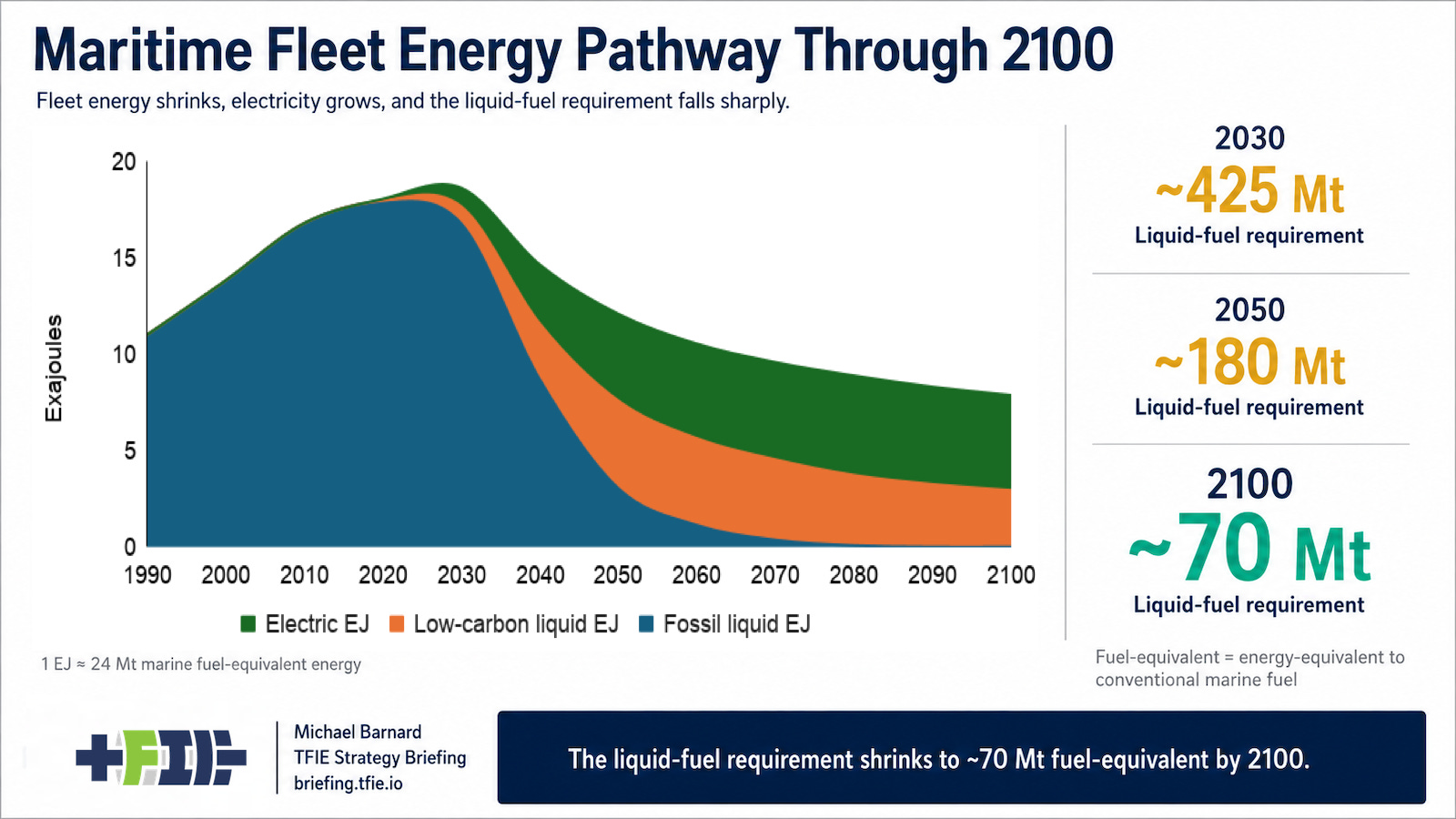
My view, laid out in my maintained Briefing work on shipping’s fuel transition, is that inland shipping and a large share of short-sea shipping shift to batteries. Hybrid solutions extend the transition as battery replacements increase pure-electric range and reduce fuel consumption. Scarce liquid biofuels and other residual fuels serve the smaller pool of long-distance shipping that still needs energy-dense molecules.
But this article is about the case Gennaro made for nuclear.
He was right that the biggest ships on the longest routes produce a large share of shipping emissions. That is an obvious point, but still worth stating. My solution is not to put enormous batteries on ultra-large crude carriers. Residual liquid fuels are fit for purpose in some of those segments, but it is reasonable to ask what else might work for the largest problem areas.
Core Power’s argument, as I understood it, is that only the biggest ships, traveling the longest routes, with well-known endpoints and guaranteed requirements for long ocean crossings, would make sense for nuclear propulsion. That narrows the addressable market quickly.
Those characteristics mostly describe the biggest bulk carriers for oil, coal and iron ore. Those are also the segments facing structural decline. Coal demand peaked years ago. Oil demand is approaching a peak. Iron ore flows are exposed to scrap growth, alternative steel routes, rising bulk shipping costs and more local processing near mines. Building a few very large nuclear-powered ships for a radically declining market does not slip smoothly through the waters of economic decision-making.
As one indicator of that niche going away, there were over 900 ultra-large crude carriers in service when I wrote the original CleanTechnica article, but only one of that class on order earlier that year. That was not a typo. Smaller carriers were still being ordered, but the very large ships most suitable for nuclear were not. Everyone in the market could see the stranded-asset risk.
Core Power’s preferred technology is small molten-salt nuclear reactors. That adds another layer of risk. Molten-salt reactor ideas have been around since the 1960s, but they have not become commercial products at scale. There were tiny prototype MSRs in China when I last checked, but a prototype is not a bankable marine product. A nuclear commercial shipping pathway based on a reactor class that has not been deployed commercially is a first-of-a-kind risk stack inside an already conservative, capital-intensive industry.
Claims that it will be safer or cheaper do not stand up to much scrutiny when the product has not been deployed in earnest. The safety claim is especially interesting because the sales pitch includes proactively dealing with port, government, shipping-industry and civilian concerns about nuclear safety. In my opinion, nuclear reactors are generally very safe, and radiation from reactor accidents, even Chernobyl and Fukushima, is not remotely comparable as a global risk to climate change.
It is not fear of radiation that makes me question nuclear energy in commercial shipping.
The problem is that my informed opinion is not shared by every government, port authority, insurer, regulator, cargo owner or member of the public. The last time commercial nuclear-powered freight was tried was in the 1950s and 1960s. New Zealand passed a law banning nuclear ships in its ports, and it remains on the books. Turkey and Spain said no. The UK demanded extra liability insurance. Commercial nuclear-powered ships disappeared as a commercial category.
Since then, Chernobyl and Fukushima have occurred. Nuclear safety concerns still exist, although they have changed form. Governments are much more aware of exclusion zones, emergency planning and long-tailed economic liability. There is more interest in new nuclear again in some countries, especially as Europe works to escape the consequences of Russian gas dependency, but that does not translate cleanly into enthusiasm for nuclear ships entering commercial ports.
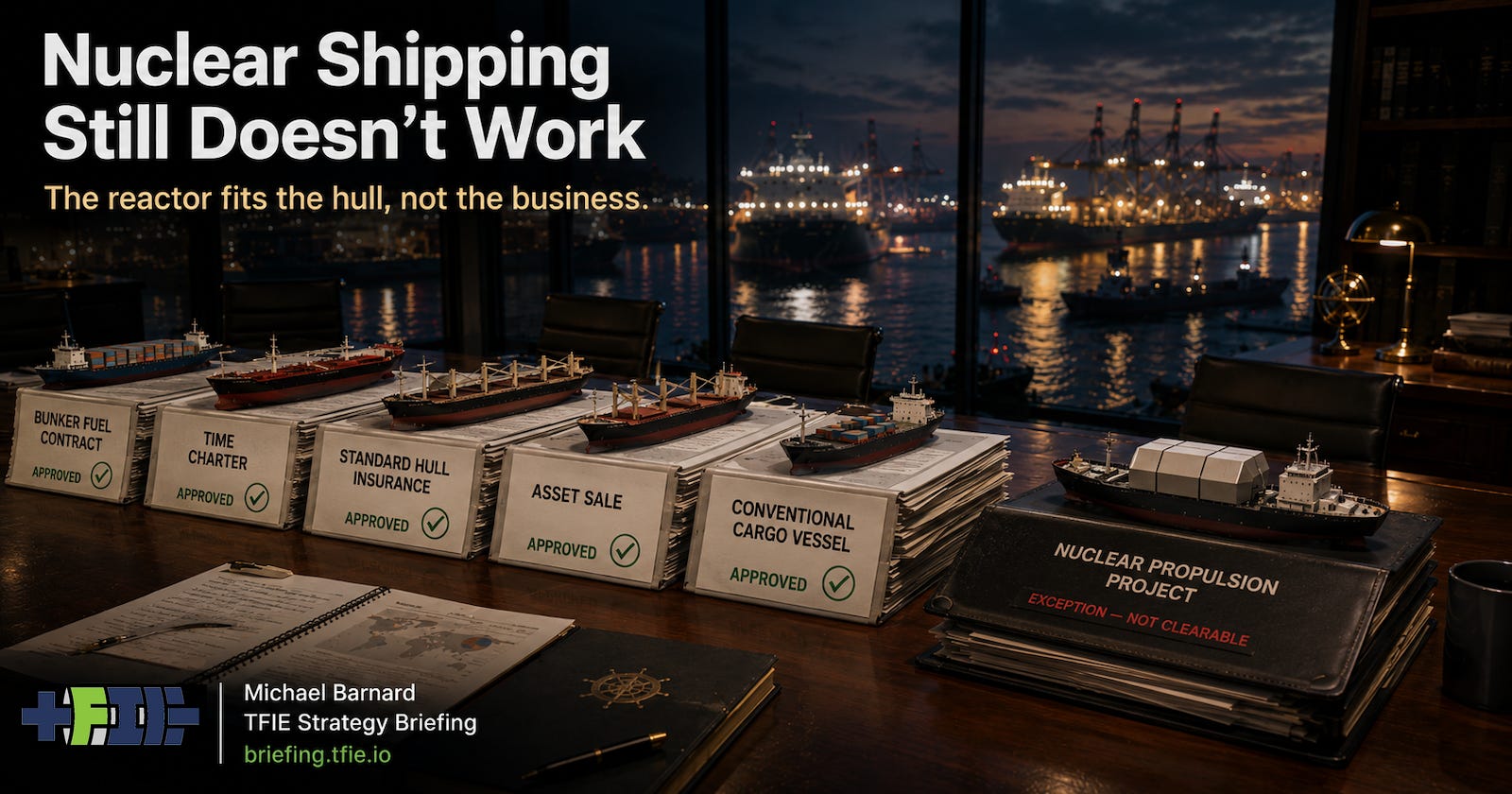
Among other things, security and regulatory requirements for ports go up. That is not a side detail. Commercial shipping is a port-dependent system. If a ship requires exceptional handling, exceptional liability arrangements, exceptional security treatment, exceptional inspection regimes or exclusion from some ports, the ship becomes less commercially liquid. The reactor may fit the hull, but the business has to fit ports, insurers, customers, charters and regulators as well.
Having published extensively on small modular reactor economics and why manufacturing learning curves do not rescue SMRs, I know that any marine SMR system would likely cost several times the value of the basic ship. A $100 million bulk carrier could become a $400 million vessel once the reactor system and associated requirements are included. Only ship owner-operators would find the use case even potentially viable, because ship owners who lease vessels would carry the capital cost without necessarily receiving all operational benefits.
A novel business model would be required. That is another limitation on the market, because many ships are owned by one party and leased, chartered or operated by another. Maritime markets rely on tradable assets, financeable hulls, insurance norms, resale pathways and standardized commercial treatment. Nuclear propulsion interrupts that machinery.
Gennaro was asked about regulatory compliance for commercial nuclear and argued that shipbuilders and owners would be isolated from it because Core Power would build, install and lease the reactors, while owning liability, maintenance and decommissioning. He compared it to engine manufacturers providing warranties and maintenance for engines.
That analogy is weak. A leased reactor is not a marine engine warranty with a different fuel. It does not remove regulatory, liability and operational burden from ports, ship owners, ship leasers, cargo owners and insurers. The exceptional technology still enters the commercial system.
It is like an industrial plant powered by a dedicated coal plant across the fence and operated by a third party claiming that the coal plant’s emissions should not be counted in the industrial process. I heard that example from Laurent Segalen, who spotted it while running Scope 1, 2 and 3 deployment examples, a framework he was integral to developing. Moving an obligation outside the fence does not make it disappear.
Then there is the lifetime mismatch. SMRs are usually discussed as long-lived assets. Nuclear reactors are often forty-year solutions. Big commercial hulls typically have target lifetimes closer to twenty-five or thirty years. One can imagine pulling a reactor out of a decommissioned ship and putting it into another hull, but pulling a major marine power plant is already non-trivial before nuclear security, regulation, inspection and recertification are added. The timeframes do not line up cleanly.
The fuel expectation adds another problem. Most SMR designs expect high-assay, low-enriched uranium, or HALEU. That should make the fuel topic ordinary, but it does not. Russia has historically dominated HALEU processing. The United States and others are trying to create non-Russian HALEU supply chains, but establishing that kind of fuel chain is not trivial. A commercial shipping pathway dependent on a constrained nuclear fuel supply adds geopolitical and supply-chain risk to a market that already has simpler alternatives.
Nuclear works in military ships and extreme-condition icebreakers, which are effectively state missions. In those cases, refueling difficulty, strategic mobility, endurance and mission assurance justify extraordinary cost and institutional burden. Commercial shipping is a different reference class. It is cost-sensitive, port-dependent, leased, financed, insured and exposed to cargo shifts.
Core Power’s pitch faces a declining addressable market, a non-commercial reactor product, higher port and regulatory burden, a likely high capital-cost premium, an awkward ownership model, a lifetime mismatch and a fuel supply chain exposed to geopolitical risk.
The question of nuclear for commercial ships is so flawed from a business perspective that I did not include it in my original sexy-versus-impractical maritime decarbonization chart. Perhaps that was an oversight. Core Power managed to raise enough money to keep pitching the idea and put executives on stages, but that is not the same thing as delivering a working, financeable, insurable, port-accepted nuclear propulsion system for commercial shipping.
The maintained Briefing view is simple. Nuclear propulsion can move ships. It has already done so. But commercial shipping does not buy propulsion systems in isolation. It buys vessels that can move through ports, contracts, insurers, fuel chains, owners, operators, charterers and asset markets. Nuclear commercial shipping still does not fit that system.
Subscribe to TFIE Strategy Briefing for the professional layer behind the public argument: evidence notes, comparator checks, transition-pathway scorecards, update triggers and decision context for people working around shipping decarbonization, nuclear claims, firm-power options, first-of-a-kind risk and climate-tech diligence.
This article is archived and lightly updated from an earlier CleanTechnica analysis.
Another issue is insurance. Given conflict over the Straight of Hormuz, and potential for conflict elsewhere, I suspect the insurance costs for nuclear shipping would be exorbitant.