

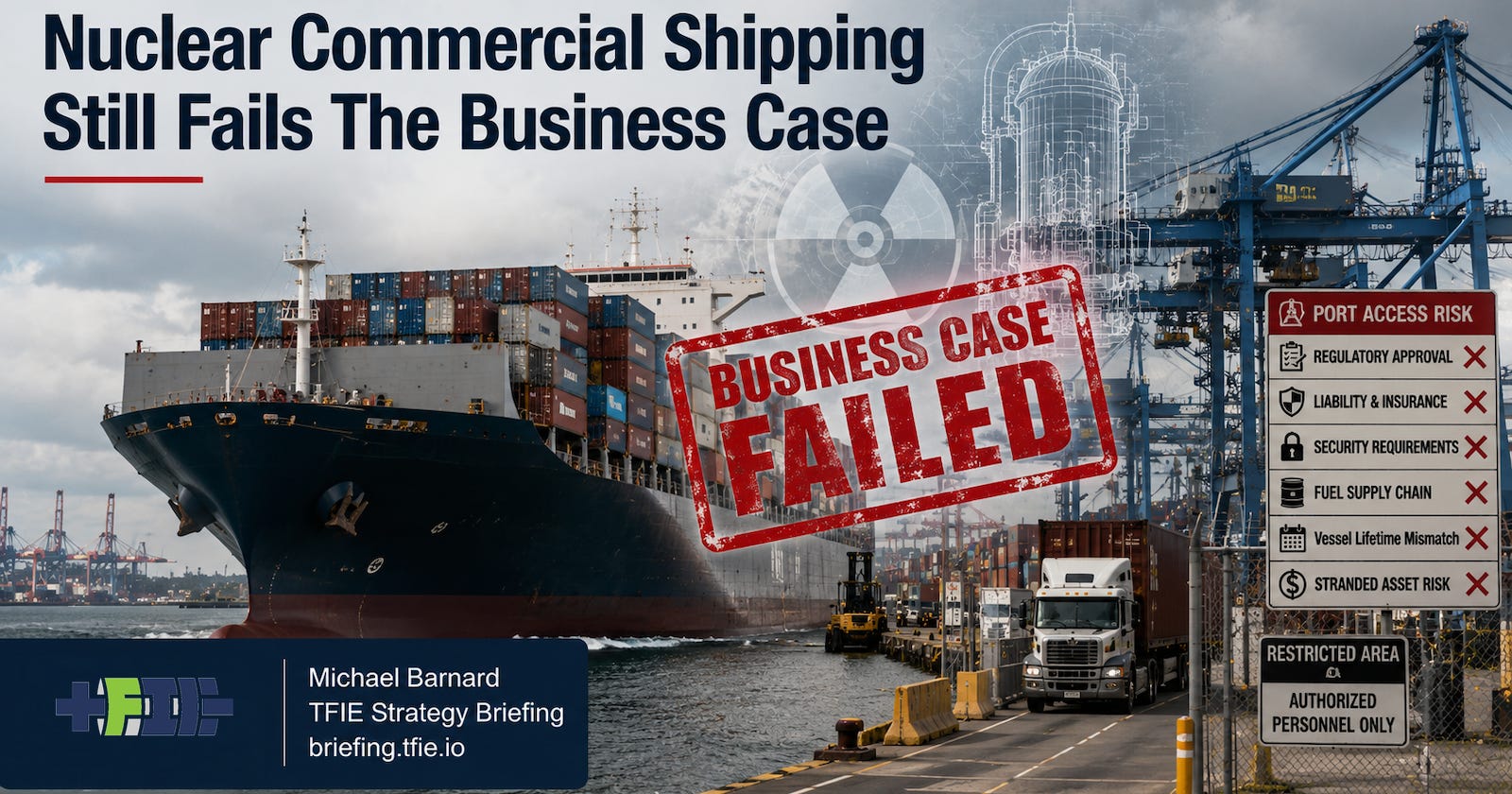
A while ago, I published a sexy-versus-practical quadrant chart for maritime shipping decarbonization. Sharp-eyed readers pointed out that nuclear propulsion for commercial shipping was missing. I make no claim that every chart I produce is encyclopedic, but I do try to be reasonably thorough, and the omission was not because I was trying to dodge the subject. It did not occur to me to include it because nuclear commercial shipping is so far outside the useful center of the transition that it sits closer to historical recurrence than to a likely commercial pathway.
That changed briefly when I found myself on a panel at Stena Sphere’s technical summit in Glasgow with Giulio Gennaro, CTO of Core Power, a firm promoting nuclear propulsion for commercial shipping. That was a useful forcing function. It made me think through the argument in a more structured way, not as a generic anti-nuclear reaction but as a shipping business case, route case, vessel case, port case and technology-readiness case.
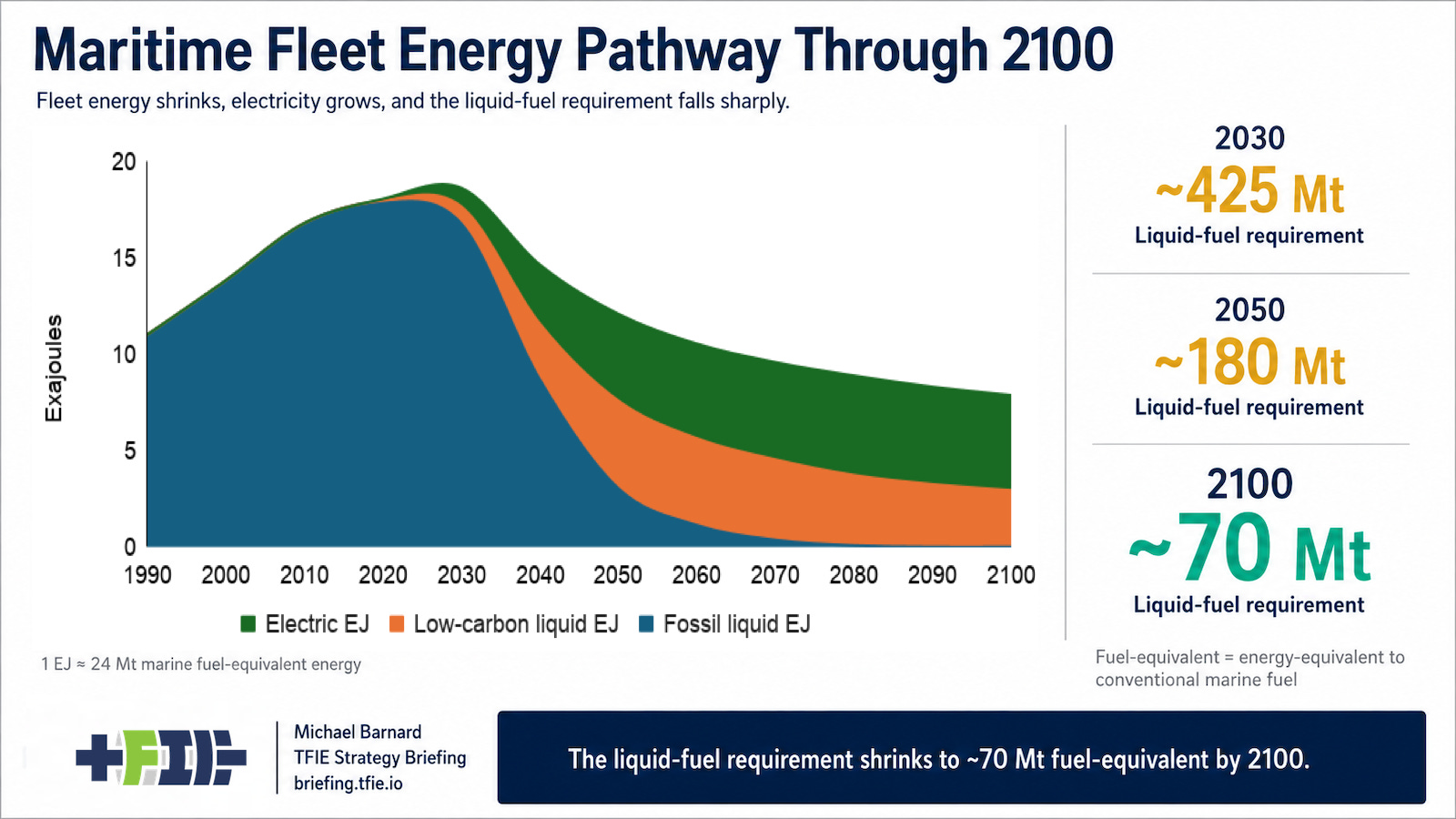
The starting point is the maritime denominator. My current Briefing maritime shipping projection is not built around replacing today’s fuel demand one-for-one with alternative molecules. It starts by shrinking the fuel pool. Fossil-fuel cargoes are a very large part of bulk shipping, and coal, oil and gas volumes decline in a serious transition. Iron ore volumes are also exposed as more scrap is used, more processing moves closer to mines and more clean electricity is used in industrial production. Container shipping grows, but not enough to offset the decline in the bulk categories that were built around moving fossil fuels and raw materials through the 20th-century industrial system.
That matters for nuclear because the strongest pitch for nuclear merchant ships depends on a subset of very large vessels on very long routes with high, steady energy demand and known endpoints. That points first toward the biggest bulk carriers and crude carriers. But those are precisely the ship classes most exposed to decline in a decarbonizing world. Building expensive nuclear-powered ships for a shrinking segment is not an obvious commercial strategy. It is especially weak when the vessels most naturally suited to nuclear propulsion are linked to cargo categories that are likely to contract.
The Briefing maritime shipping projection and graphics make this clearer than a fuel-comparison table does. The transition is not “today’s ship fuel, but green.” It is a changing freight system. Inland shipping and much of short-sea shipping are increasingly battery candidates. Some ships will become hybrid, and every battery replacement cycle will tend to extend electric range and reduce liquid-fuel burn. Operational changes, efficiency and route-specific electrification reduce the amount of fuel the sector needs before the residual molecule question is even asked. The hard blue-water segments remain, but they are a smaller and more filtered problem than the usual alternative-fuels debate implies.
That is the context in which nuclear has to compete. It is not competing against every tonne of today’s bunker fuel. It is competing against a future in which a lot of shipping demand disappears with fossil cargoes, a lot of shorter shipping electrifies, and the remaining fuel pool is served by cheaper, simpler and less institutionally awkward options. Nuclear has to win after the denominator changes, not before.
Core Power’s argument, as I understood it, was that the biggest ships on the longest routes are where the emissions problem is largest. That is true in the narrow sense. I am not proposing that ultra-large crude carriers or very large ore carriers should cross oceans on batteries. The question is not whether the largest ships use a lot of energy. They do. The question is whether nuclear is the practical commercial answer for those ships, their routes, their owners, their ports, their insurers, their regulators and their replacement cycles.
Only the biggest ships on the longest routes, with predictable endpoints and repeated long ocean crossings, look even superficially suitable. That narrows the market immediately. It narrows it toward the very large bulk and tanker segments. Those are not the growth center of future shipping. Coal demand peaked years ago. Oil demand is much closer to peak than to another long growth phase. Iron ore shipping is exposed to changes in steel production, scrap availability, regional processing and carbon pricing. The addressable market for the most nuclear-suitable merchant ships is not expanding into a grand new blue-ocean category. It is likely to be a shrinking niche inside a changing cargo system.
There is also the awkward matter of actual ship orders. The most nuclear-suitable large crude carriers have been weak as an order category because serious market actors can see stranded-asset risk. Shipowners are not naïve. They understand cargo trends, regulatory pressure, finance, utilization risk and residual value. If the base hull is already struggling as a long-term capital bet, adding a nuclear reactor does not make it a lower-risk asset.
The reactor technology is another filter. The pitch commonly turns on small modular reactors, often molten-salt or advanced designs, adapted for marine use. That is several layers of novelty stacked together. Small modular reactors remain mostly a promise, not a mass-produced industrial product. Molten-salt reactors have been around as a concept for decades, but they are not a commercial technology deployed at scale. In recent years, “small” has meant 300 MW and even bigger, multiples of the energy demand of the biggest ship. Marine deployment adds another layer of engineering, regulation, safety case, security case, liability and operations.
This is not an argument that nuclear reactors are generally unsafe. I have written often enough that the real-world health and safety risks of nuclear power are much smaller than the public imagination tends to assume, and far smaller than the damage from fossil-fuel combustion and climate change. Radiation is not the reason I doubt nuclear merchant shipping. The problem is that public perception, port acceptance, national regulation, liability, security and insurance are not optional parts of commercial shipping. They are part of the business case.
The history is not encouraging. Commercial nuclear-powered freight ships were tried decades ago. They did not become a normal shipping category. Some countries rejected port access. New Zealand’s nuclear-ship restrictions remain famous. Other countries created political and regulatory barriers. The world has also lived through Chernobyl and Fukushima since those early commercial experiments. Whether those accidents should rationally dominate thinking about nuclear safety is a separate question. The practical point is that governments, port authorities, insurers, unions, communities and cargo owners do not treat nuclear infrastructure as just another engine room.
Every port touched by a nuclear merchant-ship route inherits new burdens. Security requirements rise. Emergency planning changes. Liability questions sharpen. Regulators need new rules. Civilian and political concerns become part of port operations. A conventional ship can be denied, delayed, redirected, repaired, scrapped, sold or chartered with relative flexibility. A nuclear merchant ship carries a much more complex institutional tail. That tail is not a rounding error in a sector that relies on global port access and operational flexibility.
The cost case is just as difficult. A large bulk carrier or tanker is expensive, but a nuclear propulsion system would be a very large capital addition relative to the hull. SMRs are often discussed as though modularity automatically makes them cheap. In practice, the evidence for cheap SMRs at scale is absent. Nuclear projects are capital-intensive, regulatory-intensive and slow. Marine nuclear would be a small, specialized market layered onto a technology category that has not demonstrated cost reduction at volume.
That creates a mismatch with how shipping often works. Many vessels are owned by one party and operated or chartered by another. If the shipowner bears the capital cost of a nuclear propulsion system but the operator captures the fuel savings, the incentives are misaligned. A new business model can be proposed, of course. Core Power has argued that the reactor could be built, owned, maintained, leased and decommissioned separately from the ship in a way that isolates the shipowner from parts of the nuclear burden. That is a clever answer to an obvious objection, but it does not make the burden disappear. It moves it around and adds contractual, regulatory and liability complexity to an already narrow use case.
There is also a lifetime mismatch. Nuclear reactors are typically discussed as long-lived assets. Large merchant hulls have shorter commercial lives. If the reactor is supposed to last longer than the ship, then the business case has to include removing it, managing it, reinstalling it or otherwise carrying the value across hulls. That is not impossible in principle, but it is not how ordinary shipping wants to create operational simplicity. Pulling large machinery out of ships is already non-trivial. Pulling out nuclear machinery, with all of the associated security and regulatory issues, is a different level of complexity.
Fuel supply adds another problem. Many advanced reactor designs point toward high-assay low-enriched uranium, HALEU. That supply chain is not trivial. Russia has been central to HALEU processing. The United States and others are trying to build alternative supply chains, but that is not an overnight exercise. For a sector that already has to think carefully about fuel availability, port infrastructure and global route flexibility, adding a specialized nuclear fuel-chain dependency is not a minor footnote.
Nuclear propulsion works in military vessels and in some icebreakers because those are unusual mission cases. Navies value endurance, power density and strategic independence in ways that are not comparable to merchant shipping. Icebreakers operate in extreme conditions where refueling logistics can be uniquely difficult and where governments are often the owner, customer, regulator and strategic beneficiary at the same time. Those are not normal commercial shipping conditions. They are exceptions that prove how special the institutional setting has to be.
Merchant shipping is different. It is a cost-sensitive, globally mobile, port-dependent, finance-constrained and charter-driven sector. The solution has to pass through ordinary commercial tests. Can the vessel get into ports without extraordinary friction? Can the owner finance it? Can the operator use it flexibly? Can the insurer price it? Can regulators standardize it? Can the fuel chain support it? Can the asset retain value if cargo patterns shift? Can the business model survive outside subsidies, announcements and a handful of flagship routes?
On those tests, nuclear commercial shipping still fails. It begins with a narrow subset of ships, many of them tied to declining bulk flows. It depends on reactor products that do not yet exist as commercial marine systems. It adds port, security, liability and regulatory burdens. It complicates ownership and operating models. It has an awkward asset-lifetime mismatch. It adds fuel-chain risk. It competes against a maritime transition pathway that is already reducing the residual fuel problem through demand shifts, electrification, hybridization, efficiency and better route-specific choices.
This is why the Briefing maritime shipping projection starts with less fuel first. The important graphics in that work separate routes and cargoes before they compare fuels. They show inland and short-sea electrification as a large practical wedge, fossil-fuel cargo decline as a structural demand shift, iron ore exposure as another material-flow change, and residual blue-water fuels as a smaller and harder problem rather than the whole sector. Nuclear does not become more attractive when that framing is applied. It becomes more obviously misaligned with the actual transition pathway.
The question is not whether a nuclear-powered merchant ship can be imagined. It can. The question is whether it is a useful transition pathway for commercial shipping. That requires more than a reactor concept and a decarbonization need. It requires a growing addressable fleet, a commercial reactor product, port acceptance, viable finance, aligned ownership incentives, workable insurance, flexible operations, a secure fuel chain and a clear advantage over simpler alternatives. That stack is not present.
Nuclear commercial shipping will keep returning because it has some attractive narrative features. It is high-density. It is technically serious. It has military precedents. It sounds like a way to avoid the awkward fuel-volume problem in long-distance shipping. But the energy transition is not short of technically imaginable options. It is short of options that survive the full chain of physics, economics, operations, institutions and timing.
For ordinary merchant fleets, nuclear remains outside that useful set. Batteries, hybrid systems, shore power, port electrification, operational efficiency, wind assistance in some cases, constrained biofuels and a smaller residual fuel pool are less dramatic. They are also much closer to the actual structure of the shipping transition.
Subscribe to TFIE Strategy Briefing for the professional diligence layer behind maritime, aviation, industrial and climate-tech claims: denominators, route tests, evidence quality, cost stacks, pathway reviews, update triggers and the difference between a technically imaginable option and a commercially useful transition pathway.
Update note: This article was originally published at CleanTechnica and has been lightly updated.