

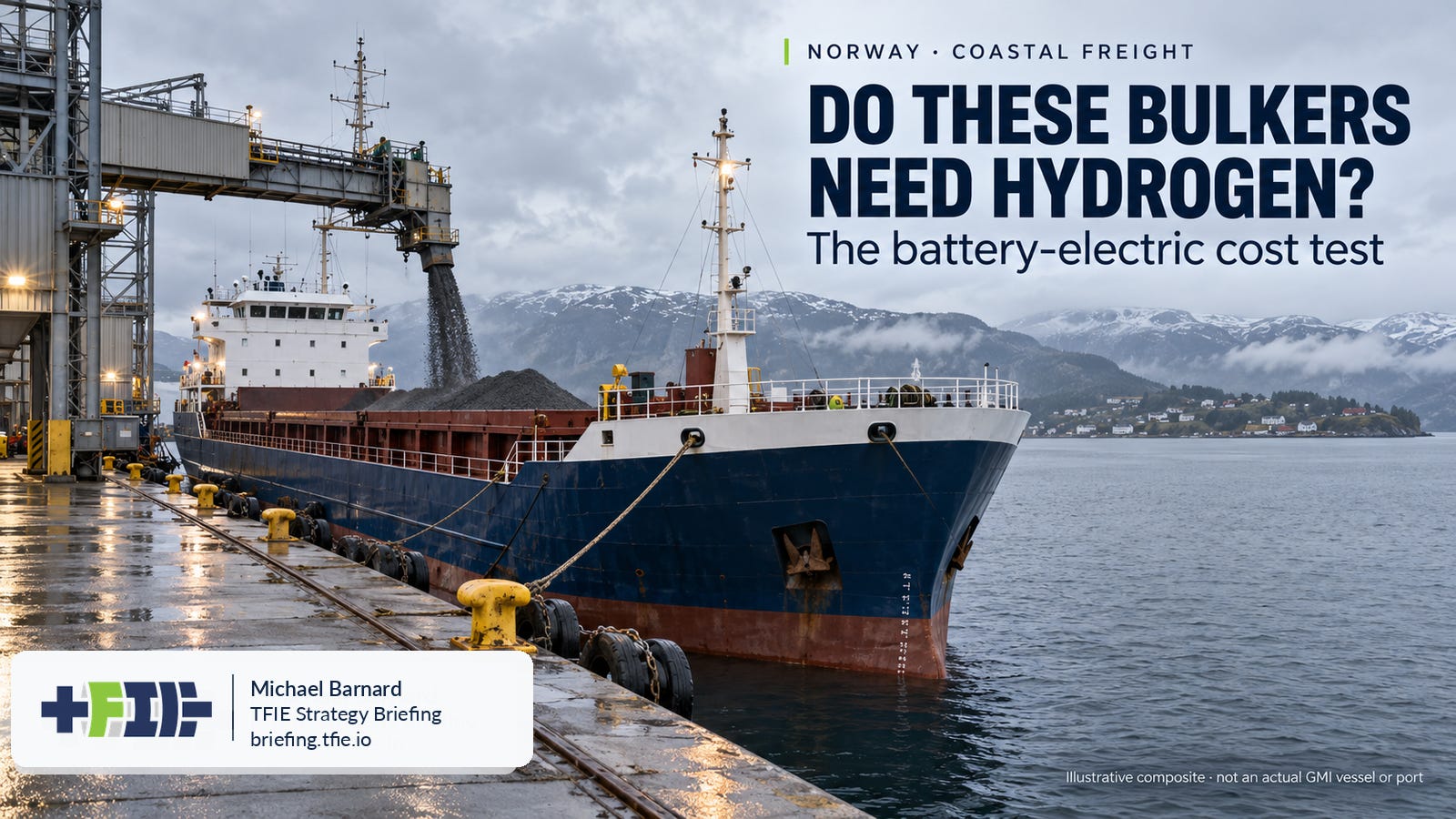
GMI says its planned compressed-hydrogen bulk carriers can cost 9–10% less over their lifetimes than conventional ships. The available evidence does not establish that saving. In my 15-year model of two shorter coastal services, hydrogen costs 50–58% more than diesel even after assuming the full vessel grant of approximately €13.1 million is received upfront. Battery-electric propulsion is €11.64–14.13 million cheaper than the subsidized hydrogen alternative. These are modeled services, not GMI’s unpublished routes or contracts, and the exact differences depend on uncertain shipbuilding prices. Still, the modeled fuel and equipment economics offer little support for hydrogen being the cheaper default.
In October, PowerCell confirmed another order for GMI Group, bringing the proposed fleet to four compressed-hydrogen bulk carriers with 24 Marine System 225 fuel-cell units totaling 5.4 MW. The first two vessels are rated at 4,000 deadweight tonnes and planned for 2027; the two later 3,000-dwt ships are being built in India for 2029. These are serious shipbuilding and equipment commitments, but none of the four has established a commercial operating record. A choice of marine fuel is also a commitment to how that fuel will be produced, stored and delivered.
GMI’s website attributes its claimed lifetime advantage to a combined design: batteries, fuel cells, an efficient hull and sails said to save roughly 200 kW of propulsion power on average. Hull efficiency, batteries and sails do not confer a special advantage on hydrogen. Diesel or fully battery-electric vessels can use comparable hulls and wind assistance. GMI has published no like-for-like battery-electric cost estimate to explain why its additional hydrogen production, compression, storage and onboard fuel-cell equipment should cost less over the vessel’s life.
Norway has committed public funds to this choice. Norsk Hydrogenforum reports Enova awards of approximately €13.1 million for each of the later ships and roughly €42.9 million across the four-ship program. GreenH separately received approximately €37.4 million in support for hydrogen production projects at Bodø, Kristiansund and Slagentangen. These are announced awards, not evidence that all the money has been paid. Supporting an emerging shipping technology may have industrial value, but financial support cannot establish that the underlying transport service is cheaper than its alternatives.
My Lofoten ferry analysis applied the same test to another Norwegian hydrogen decision: compare full vessel and delivered-energy costs against batteries, not just the characteristics of the fuel cell. I have also reported on Yangtze electric bulk freight and China’s growing electric-shipping infrastructure. Those examples do not prove that GMI’s undisclosed routes can be electrified. They demonstrate that a battery alternative warrants an engineered, forward-priced bid. For GMI’s cheaper-than-diesel claim to stand up, the fuel price, the vessel cost and the expected cargo service have to overcome the model’s large disadvantage. Hydrogen suppliers also need other customers, while battery vessels need practical charging windows. The economics of those competing infrastructures—and which costs public money shifts to taxpayers—determine the result.
