

People have been asking for my view on another addition to hydrogen’s increasingly elaborate color chart: white hydrogen. I am color-blind, which makes the entire exercise look even sillier than it already does. Hydrogen does not need dozens of colors. For climate purposes, there are only two useful categories: hydrogen with sufficiently low lifecycle emissions and hydrogen with high lifecycle emissions. Green and black would cover the distinction.
The Hydrogen Science Coalition proposed a threshold of no more than one kilogram of CO₂e emitted for every kilogram of hydrogen produced. That is a demanding but defensible line. The process, feedstock and marketing label matter much less than the full lifecycle carbon intensity of the resulting gas. A kilogram below the threshold can reasonably be described as low-carbon. Everything above it remains part of the climate problem, regardless of whether someone has assigned it an attractive color.
Electrolysis requires roughly 55 to 60 kWh of electricity for every kilogram of hydrogen after balance-of-plant loads are included. That requirement will improve around the margins, but it is already constrained by physics. Electrolyzer manufacturing can become cheaper and industrial plants can gain economies of scale, yet the electricity requirement will not collapse in the way solar-module or battery prices did.
At a lifecycle ceiling of one kilogram of CO₂e per kilogram of hydrogen, the electricity used for electrolysis can carry only about 18 grams of CO₂e per kWh. British Columbia’s grid can meet that standard, as can a few other exceptionally clean grids. Many European grids and most North American ones still cannot, although they are gradually decarbonizing.
Even grid-connected hydrogen produced in a moderately clean electricity system is preferable to hydrogen made from natural gas without carbon capture. Conventional natural-gas hydrogen is responsible for roughly 10 kilograms of CO₂e per kilogram of hydrogen once upstream methane leakage and steam methane reforming are included. Blue hydrogen might reduce that to somewhere around two to four kilograms under favourable assumptions, with the lower end dependent on unusually effective methane management and high capture rates. The European Union’s renewable-hydrogen rules have allowed substantially more than one kilogram of CO₂e per kilogram of hydrogen, illustrating how political definitions of “green” can become looser than climate-aligned ones.
Why focus so heavily on grid electricity? The first reason is that most hydrogen is already produced where it is consumed because moving hydrogen is difficult and expensive. Hydrogen made from cheap US natural gas may cost around $1/kg at the plant, yet delivery by truck can push the cost toward $10/kg before dispensing. Retail hydrogen for vehicles has often cost $15 to $25/kg.
A tube trailer carries only a fraction of the useful energy moved by a tanker truck full of gasoline or diesel. Delivering the same energy therefore requires many more truck trips, drivers, vehicle hours and maintenance. Compressed hydrogen consumes energy before delivery, liquid hydrogen consumes even more, and the dispensing station must compress the gas again to as much as 700 bar for passenger vehicles. Hydrogen is not impossible to distribute, but it is inherently awkward and costly compared with conventional liquid fuels.
That is why industry generally avoids distributing hydrogen unless it has no practical alternative. Diesel and gasoline are liquids under normal conditions, and natural gas can carry useful amounts of energy without anything approaching hydrogen’s compression requirements. The logistics advantage of those fossil fuels is one reason they became dominant.
The second reason is cost. Electrolysis economics involve a trade-off between capital expenditure and operating expenditure. An expensive plant must operate for enough hours each year to spread its capital cost across a large amount of hydrogen. That generally requires electricity available well over half the year, not the output of a single wind or solar farm.
A dedicated renewable-hydrogen facility therefore needs some combination of excess generation, storage, transmission and multiple complementary generation sources. Each addition increases capital costs and operational complexity. The industrial electrolyzer stack is only one part of a much larger plant containing power electronics, water treatment, gas processing, compression, cooling, controls and other mature industrial components. Mass manufacturing may make stacks cheaper, but it will not eliminate most of the system cost.
There is already a widely available source of firm electricity with experienced operators, transmission, balancing and administrative systems: the grid. Connecting an industrial load to the grid requires planning and infrastructure, but it is normally much less capital-intensive than building a complete renewable-generation and storage system in an isolated location.
Grid power carries utility charges and potentially higher operating costs, but it can avoid the immense cost of transporting hydrogen from a remote production site. Replacing the steam methane reformer at an existing ammonia facility with appropriately sized electrolysis, while reusing the existing water, industrial site and product-handling infrastructure, will often make more sense than manufacturing hydrogen hundreds of kilometres away and transporting it to the plant.
The same logic applies to other persistent demand. An electrolyzer at a nuclear facility can supply the relatively small quantity of hydrogen used for turbine-generator cooling or lubrication more sensibly than regular deliveries of fossil-derived hydrogen. The durable hydrogen market is concentrated in ammonia, refining, methanol and a limited number of other industrial processes. Most replacement hydrogen production should therefore be located close to those consumers and connected to increasingly clean grids.
This is also why additionality, locality and temporal matching matter when governments subsidize renewable hydrogen. A supported electrolyzer should be associated with new clean generation located reasonably close on the grid and producing electricity on a schedule that broadly matches the electrolyzer’s demand. Otherwise, the facility can increase fossil generation elsewhere while claiming renewable credentials through accounting.
Carbon pricing makes some of these distinctions easier to manage, provided lifecycle emissions are measured honestly. Canada’s carbon-pricing system covers methane in relevant sectors, while the European Union adopted dedicated energy-sector methane rules in 2024 requiring measurement, reporting, leak detection and reductions in venting and flaring. Methane also entered the EU ETS for covered maritime transport in 2026.
The basic conclusion remains straightforward. Hydrogen will usually make more sense when produced near the point of use, and low-carbon hydrogen will not be cheap.
That brings us to white hydrogen, more usefully called natural or geologic hydrogen. Biological and geological processes can create hydrogen underground, sometimes leaving accumulations that might be accessible in roughly the same sense that natural gas, oil and coal occur in geological formations.
The headlines have been predictably breathless, with references to vast or even limitless clean-energy supplies. Hydrogen advocates confronting the poor economics of manufacturing, storing and distributing hydrogen as an energy carrier have started treating natural hydrogen as a possible escape from those constraints.
The enthusiasm is far ahead of the evidence. One prominent announcement came from France’s Lorraine region, which is better known for wine but also has a coal-mining history. Researchers provisionally estimated that a prospective formation might contain 46 million tons of hydrogen. That sounds enormous until it is compared with global hydrogen consumption, which was already around 120 million tons annually when the original article was written. The prospective Lorraine quantity represented less than five months of existing demand, even before considering recovery losses or economics.
Another prospective resource was identified in Spain. Even if its gas had been entirely hydrogen, the estimated quantity would have represented only about 1% of one year’s global demand, and the actual gas was mixed with other substances. Other reported accumulations have been smaller still.
Nor can the gas simply be pumped out and used without further work. In Lorraine, the hydrogen was reported dissolved in underground fluids, with concentrations increasing at greater depth. That immediately raises questions about the composition of the fluid, the mechanism concentrating hydrogen, the process needed to separate the gas, the energy required, and the other gases or contaminants that might be produced alongside it.
Those are not minor details. There was no established commercial industry extracting hydrogen from geological formations in 2023. Developers must determine how hydrogen behaves in wells and reservoirs, how much escapes through equipment and geological pathways, and what the climate implications of leakage would be. Hydrogen is a smaller molecule than methane and has an indirect warming effect when released into the atmosphere.
The Lorraine researchers were careful to describe their estimates as preliminary. Exploration was still needed to confirm the size, concentration and nature of the resource. The field was also distant from most major hydrogen demand. Yara’s French ammonia operations were hundreds of kilometres away, and even its Dutch facilities were not close. A large refinery was nearer, but using scarce low-carbon hydrogen to prolong the refining of road-transport fuels would be an odd long-term strategy as road transport electrifies.
The location problem remains even if extraction proves inexpensive. Hydrogen stations will not be able to drill local wells and supply themselves. A viable resource might support a plant built directly above it and operated for several decades, or it might not. That depends on flow rates, purity, production decline, processing costs and the availability of a customer close enough to avoid expensive distribution.
Mali provides the best-known operating example. A well near Bourakebougou produces gas that is roughly 98% hydrogen and has supplied a small local electricity generator. That is useful for the community and scientifically significant, but it is not the foundation of a global energy system. Mali is also far from the major ammonia, steel, refining and chemical centres that account for most hydrogen demand.
The evidence available in 2023 therefore supported a bounded conclusion. More hydrogen exists underground than was widely recognized, and favourable deposits might help decarbonize some existing hydrogen consumption. The known and estimated accumulations were much smaller than the limitless-fuel headlines suggested, frequently remote from demand, and commercially uncertain. Distribution would remain expensive even if extraction at the wellhead proved cheap.
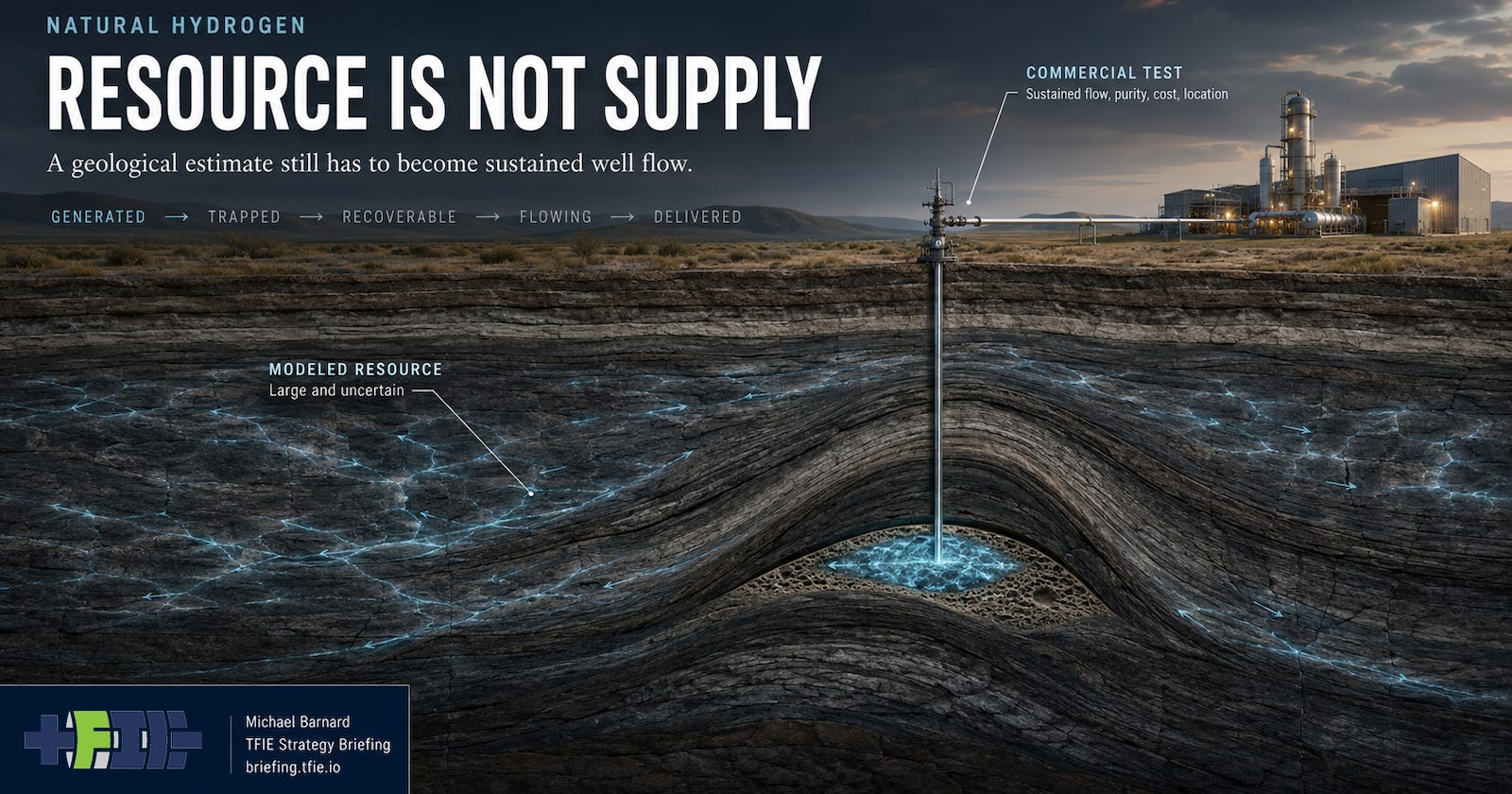
Research published since then has made the global resource estimate much larger without resolving the commercial questions. A 2024 US Geological Survey model put the most probable global in-place resource at about 5.6 million million tons, but its uncertainty range extended across seven orders of magnitude. The authors stressed that most of this hydrogen would probably be impractical to recover. The model estimates hydrogen generated and retained somewhere underground. It does not identify proven reserves, commercial fields or wells capable of sustained production.
A 2025 review in Nature Reviews Earth & Environment reached the same practical boundary. Societally significant reserves have yet to be proven, and commercial accumulation requires a source, water, generation, migration, a gas phase, an effective trap and long-term preservation. The review also found that continental systems do not replenish on decadal or centennial timescales, so the resource should not be called renewable merely because hydrogen continues to form slowly in the crust.
The size of the existing market reinforces the need to distinguish geological resources from production. Global hydrogen demand surpassed 100 million tons in 2025, with almost all consumption still concentrated in refining and traditional industrial uses. New energy applications remained a very small part of demand, and low-emissions production remained close to 1 million tons.
The production test is more useful than the resource headline. How many tons can a well deliver every year? For how many years? At what purity, pressure and decline rate? What processing is required, and how far must the hydrogen travel to reach an ammonia, steel or chemical facility? I examine those questions separately in Natural Hydrogen Is Real. The Production Rates Are Tiny.
The Lorraine prospect should be explored and developed if the geology and economics support it. Even a resource competing with $1 to $3/kg fossil-derived hydrogen could be worth billions of dollars and could displace substantial emissions from existing industrial consumption. It still would not justify wasting hydrogen on transportation, building heating or other uses where direct electrification is more efficient and usually cheaper.
Subscribe to TFIE Strategy Briefing for evidence-led analysis of hydrogen, industrial decarbonization and technologies that still have to survive production rates, infrastructure and delivered cost.
An earlier version of this article appeared on CleanTechnica.