

A new Nature Communications paper has done something natural hydrogen badly needed. It has replaced the size of the rock with the rate of the process.
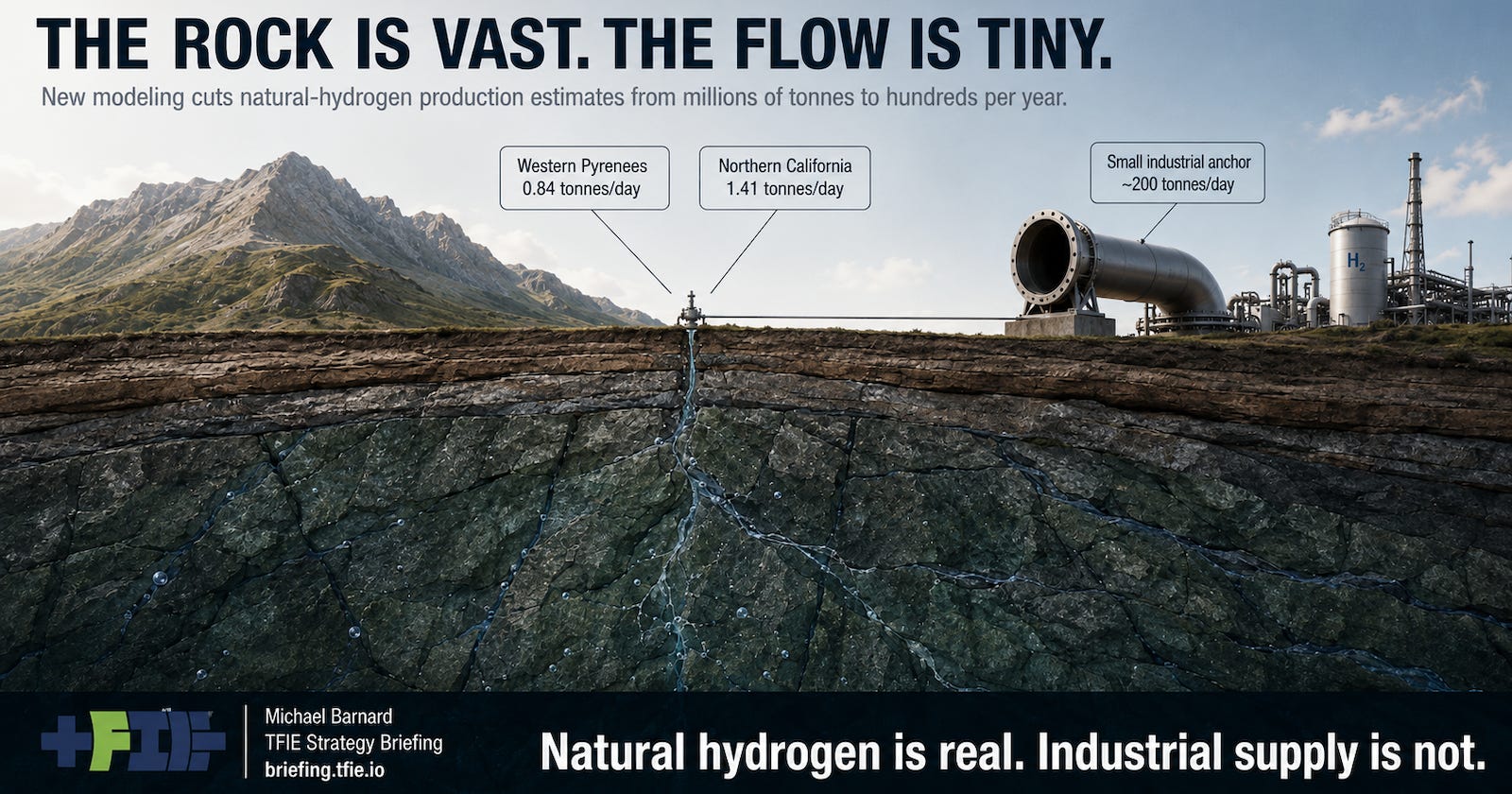
The result is not surprising. Once water flow, dissolved hydrogen saturation, reaction kinetics and the shrinking surface of unreacted minerals are included, earlier annual estimates of hundreds of thousands or millions of tonnes of hydrogen collapse to hundreds. The authors estimate central generation rates of 308 tonnes per year for a modeled ultramafic system beneath the western Pyrenees and 515 tonnes per year for one in northern California. That works out to about 0.84 and 1.41 tonnes per day respectively.
Those numbers describe the modeled geological systems, not individual production wells. They also describe hydrogen generation, not hydrogen reaching a trap, remaining there, being discovered, flowing into a well and arriving at an industrial customer at a competitive price.
This is the distinction that has been missing from much of the natural hydrogen excitement. There is a great deal of iron-bearing rock in the Earth’s crust and upper mantle. Some of it reacts with water in ways that generate hydrogen. Multiplying theoretical hydrogen yield by cubic kilometres of rock produces an impressive number. It does not produce a hydrogen supply.
The new study modeled two different serpentinization environments. Both involve ultramafic rocks derived from the Earth’s mantle, rich in magnesium- and iron-bearing minerals such as olivine. When water reaches these minerals under suitable conditions, the iron is oxidized and water is reduced, producing hydrogen. The western Pyrenees contain relatively fertile lherzolite. Fertile is a geological term: the rock has undergone less partial melting and retains a broader mix of mantle minerals and substantial unreacted material. Northern California contains more depleted harzburgite, the residue left after partial melting has removed some mineral components, and much of it has already been altered by serpentinization. The Pyrenean system is therefore constrained mainly by hydrogen accumulating in the circulating water until further production is suppressed. The California system is more constrained by slower reaction kinetics and the dwindling amount of fresh mineral surface still available to react.
Neither constraint is exotic. Water must reach the right minerals at the right temperature. It must remain in contact long enough for reactions to occur. The resulting hydrogen must leave the reaction zone. Fresh surfaces must continue to be exposed. Permeability must persist rather than being blocked by the alteration products created by the process itself.
Even water flow has no simple more-is-better relationship. Too little flow allows the water to become saturated with hydrogen. Excessively rapid flow can shorten residence time so much that less reaction occurs. That is geology behaving like geology rather than like a spreadsheet.
Readers of my previous assessments of natural and stimulated hydrogen will recognize the result. In 2023, in No, White Hydrogen Isn’t A Limitless Source Of Clean Fuel, I noted that the existence of naturally occurring hydrogen did not make it limitless, conveniently located or inexpensive to deliver. In 2025, I assessed proposals for stimulating hydrogen production by injecting water into reactive rocks. The chemistry was real, but the proposed production system still required drilling, fracture creation and maintenance, sustained water-rock contact, management of passivation and impurities, predictable decline rates and a nearby customer. In April 2026, I returned to the most basic distinction in Natural Hydrogen Is Real. The Business Case Is Not.: generation is not accumulation, accumulation is not a reserve, and a reserve is not sustained commercial deliverability.
The new modeling does not contradict any of that. It puts considerably better geological numbers behind it.
For scale, I used roughly 200 tonnes of hydrogen per day as a screening threshold for a small industrial anchor in that April assessment. It was not intended as a universal commercial law. It was a way to prevent kilograms, tonnes, annual totals and geological speculation from being compared without a useful denominator.
The central estimate for the Pyrenees is about 240 times below that screen. The California estimate is about 140 times below it. Even the upper edges of the authors’ broad modeled ranges, 8,500 and 5,000 tonnes per year, correspond to only about 23 and 14 tonnes per day. Those unusually favourable cases are still far below the demand of a modest industrial hydrogen facility.
This does not mean that natural hydrogen can never be useful. A sufficiently old and well-sealed accumulation could contain commercially interesting volumes, just as hydrocarbons generated slowly over geological time formed useful reservoirs. A small flow might support a nearby local application, as the unusual Bourakébougou occurrence has done in Mali. Other geological hydrogen mechanisms may have different production characteristics.
It does mean that continually replenishing reservoirs should not be treated as underground hydrogen factories until wells demonstrate industrial flow rates over long periods. The burden of proof is production history, pressure behaviour, decline curves, gas purity, recovery factors and delivered cost. An estimate of reactive rock volume is several steps removed from that evidence.
The LIAG press release accompanying the research describes natural hydrogen as a promising low-carbon energy source and says it is continuously released. The numbers in the release are accurate, and its acknowledgement that earlier estimates were too high is welcome. “Continuously,” however, is doing a lot of work. The paper itself says fluid delivery is likely to be intermittent and localized, and that migration, separation, trapping and preservation remain outside the model.
The authors’ PoNHy modeling tool may still be valuable. Screening geological systems using water flow, temperature, mineralogy, saturation and kinetics is much better than screening them using the amount of rock that can be coloured on a map. A tool that identifies where not to drill can save a great deal of money.
That may be the most commercially mature outcome in the near term. Natural hydrogen exploration is moving from imaginative resource multiplication toward models capable of killing weak prospects before expensive wells are drilled.
The rocks really are making hydrogen. They are simply doing it on geological schedules, under geological constraints and without any obligation to meet an industrial customer’s daily order.
Subscribe to TFIE Strategy Briefing for energy-transition analysis grounded in production rates, system costs and practical alternatives.