


BC Hydro’s change to net metering looks, at first glance, like another rooftop solar fight. The old rate, Rate Schedule 1289, is closing to new customers on July 1, 2026. New self-generation customers move to Rate Schedule 2289, where excess generation is paid at 10¢/kWh instead of being banked as future kWh credits. Existing net-metering customers get a transition period, and BC Hydro has also created a community generation option. That is all true, but it is too narrow a frame for the policy issue.
The useful question is not whether net metering is good or bad in the abstract. It is what problem the compensation system is trying to solve at a particular stage of market and grid development. At low penetration, retail net metering is a simple launch policy. It lets households understand the value proposition, installers build capability, lenders get comfortable, and utilities learn how to connect small systems without turning every application into a regulatory proceeding. That is a reasonable early-market bargain.
The mistake is treating annual kWh banking as a durable grid policy. It was a useful early-market simplification, not a serious way to value exports once timing, location and flexibility start to matter. Annual kWh banking says that a surplus kWh exported on a sunny afternoon can be treated as equivalent to a kWh imported later, perhaps during a winter evening peak. That was tolerable when adoption was small. It becomes harder to defend as penetration rises, feeders become constrained, batteries arrive, EVs become flexible loads, and utilities need customers to help with timing, not merely annual arithmetic. The grid is not a battery bank, and a retail rate is not a clean measure of the value of an exported kWh.
That does not make every early reform sensible. NREL’s 2025 review of rooftop solar deployment and rate impacts is useful because it keeps the cost-shift argument in proportion. Below 3% household PV deployment, net metering was unlikely to increase non-solar customer bills by more than $1/month. Between 3% and 7%, the estimated impact was still below $1/month in two-thirds of states, although higher in some. The major cautionary cases were California and Hawaii, where higher penetration and particular rate structures made the cost-shift issue materially larger. Cost shift is real, but at low penetration it is often too small to justify urgent reform rhetoric.
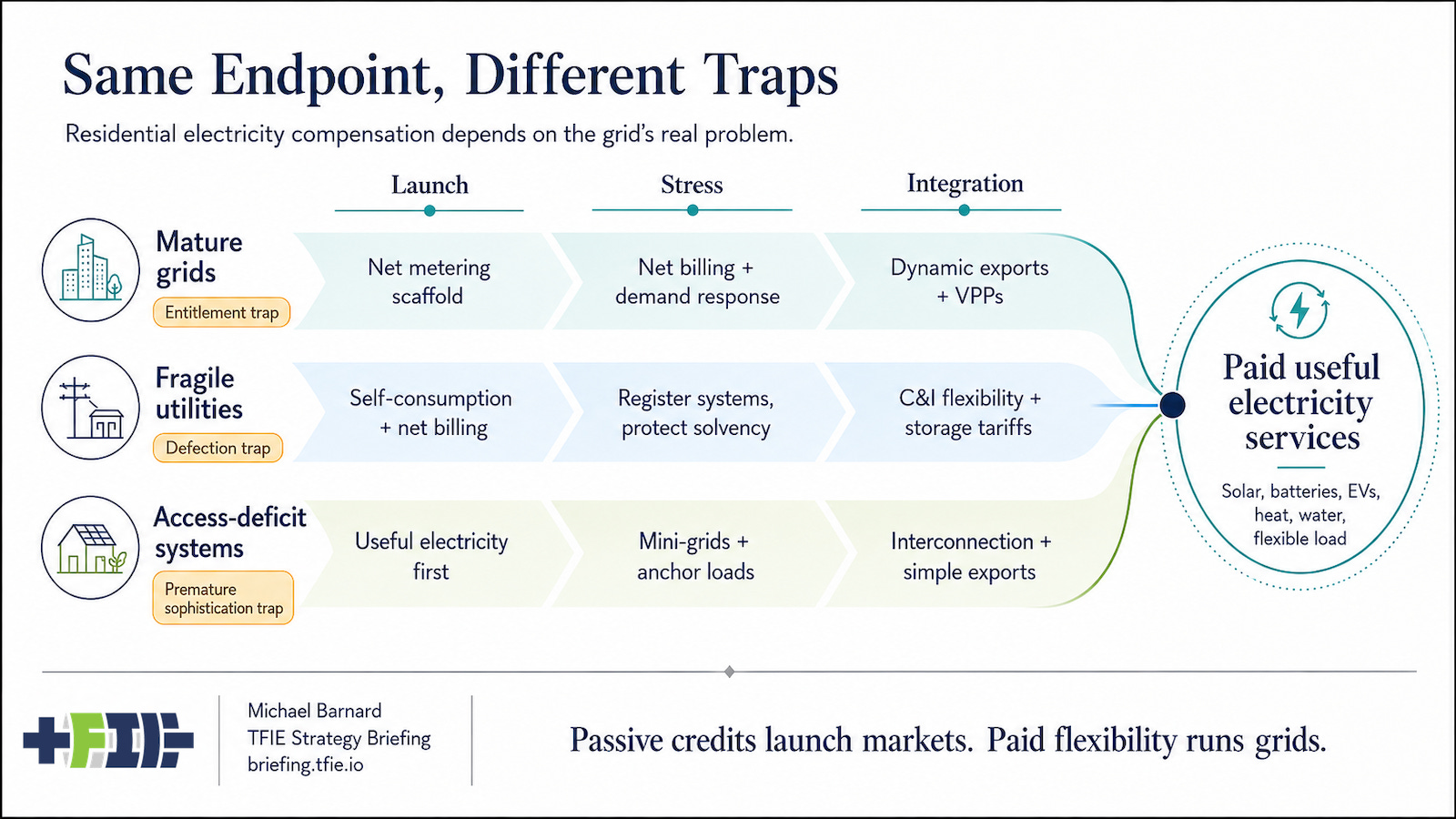
That is why this should be framed as a policy transition pathway rather than a rooftop-solar fairness dispute. Ending old net metering is not automatically anti-solar. Keeping old net metering forever is not automatically pro-transition. The denominator is whether households and small customers are being paid for the grid service they actually provide. Passive surplus electricity is one service. Self-consumption is another. Load shifting, battery discharge, EV charging control, water-heater flexibility, thermostat response and community generation are others.
California shows what happens when export compensation is changed after a large rooftop market has formed. After the move from old net energy metering to the Net Billing Tariff, Lawrence Berkeley Lab found storage attachment rates jumped from roughly 10% under the old regime to about 60% under the new one. That is the expected mechanism. Lower export value pushes the market toward self-consumption and storage. It also changes installer economics, financing assumptions and customer paybacks quickly. Net billing can point in the right direction and still be a rough transition if it arrives mainly as a reduction in value rather than as part of a broader flexibility offer.
South Australia shows a more operationally mature design. SA Power Networks’ flexible export model lets compatible inverters export up to 10 kW per phase when the network can accept power, while dynamically turning exports down when there is excess energy on the grid. That is a different class of policy. It treats export access as a network service with operating limits, not as a permanent right to send every surplus kWh into the grid at a flat value. Sometimes the grid can use the electricity. Sometimes it cannot. Sometimes a customer resource is valuable only if it shows up at the right time, in the right place, in a form the system can rely on.
That is where demand response belongs in the story. The destination is not net billing. Net billing is only a cleaner accounting structure than annual retail kWh banking. The destination is paid useful electricity services. Households should be able to use their own solar, export when useful, shift EV charging away from peaks, let a water heater or thermostat respond within comfort limits, dispatch a battery when the grid actually needs it, and get paid for the service that is delivered. The customer should not have to become a power trader. The customer offer should be simple. The system behind it can be complicated.
The reason this matters internationally is that the same technology creates different policy problems in different systems. Mature grids face the entitlement trap. They used generous net metering to create a market, then discovered that the early-market policy had acquired political weight. Reform arrives late, and customers experience it as a loss rather than a transition to a better compensation stack. That does not mean reform is wrong. It means the off-ramp should have been written before the market became large enough for the old rule to become politically durable.
Fragile utility systems face a different problem. In many middle-income countries, tariffs are high, service is unreliable, utilities are financially weak, and better-off customers can buy cheap solar and batteries faster than institutions can adapt. The World Bank’s distributed PV policy work is direct about the risk: traditional net metering can treat off-peak exports as equivalent to peak withdrawals, while volumetric tariffs may leave utilities unable to recover network costs as self-generation grows. If high-paying customers reduce grid purchases, fixed costs remain, tariffs rise, and more customers reduce grid purchases. That is not an abstract fairness problem. It is a utility solvency problem.
Pakistan is the cleanest current example of that bottom-up transition moving faster than official systems. I wrote about how Pakistan’s solar surge reduced its exposure to LNG shocks, with factories, commercial buildings and households installing distributed solar because the economics and reliability case were immediate. TransitionZero and PRIED estimate that Pakistan imported around 50 GW of panels, with far more off-grid and non-net-metered solar installed than official grid-connected figures capture. Customers were not waiting for a complete distributed-energy regulatory architecture. They were responding to expensive and unreliable electricity.
This is where Yuen Yuen Ang’s How China Escaped the Poverty Trap is useful. Ang’s argument is not that governance is optional. It is that markets and governance can co-evolve, with imperfect institutions learning through local experimentation, visible incentives and useful economic activity. That is a better way to read parts of Pakistan, Africa and other fast-moving distributed-solar markets than the usual formal-policy sequence. The market creates evidence through rooftops, farms, warehouses, mines, telecom sites and small businesses. Institutions then have to decide whether to suppress it, ignore it, misprice it, or use it to build a better electricity system.
That was also the point behind my Briefing article on how Africa’s solar boom is hiding in the import data. Official additions tell part of the story, but cheap Chinese hardware, weak grids, diesel displacement, mines, telecoms, mini-grids, warehouses, farms and factories can move before the statistics know how to classify them. In the earlier Crocodile Economics Comes to Africa piece, the point was not that Africa already had perfect institutions for clean-energy scale. It was that markets, trade, logistics, electricity demand, transport electrification and governance can become reinforcing loops. Governance improves as markets deepen because predictable rules become more valuable.
Access-deficit systems face a third problem, premature sophistication. In countries where large numbers of people still lack reliable electricity, importing California’s net-metering fight is mostly a category error. Tracking SDG7 reports that 666 million people lacked electricity in 2023, most of them in Sub-Saharan Africa. Off-grid solar served hundreds of millions of people, but much of that access is still basic: lighting, phone charging and limited service hours. In that context, the first policy job is useful electricity: clinics, schools, fans, refrigeration, cold storage, water pumps, mills, telecoms and small enterprise loads. Export tariffs can wait until there is something meaningful to export and a grid capable of receiving it.
That is the point of the 3x3. It is not a development ladder, and it is not a moral ranking of countries. A wealthy suburb in Pakistan, a Hawaiian island, a South Australian feeder, a Vancouver strata building, a Lagos mini-grid and a rural clinic can all sit in different cells from their national average. The matrix is useful because it blocks the universal prescription. Net metering is not a universal good. Net billing is not a universal reform. Dynamic exports are not useful where there are no smart inverters or reliable distribution data. Household demand response is not a capacity resource until it performs in real events. Mini-grid productive use matters more than elegant tariff theory where useful electricity is still scarce.
The common endpoint is still clear. Customers should be compensated for useful services, not rewarded through passive accounting rules that no longer match grid value or penalized for responding rationally to poor utility service. In mature grids, that means writing the off-ramp from retail net metering before it becomes an entitlement, then making the replacement visibly better through storage, EV managed charging and demand response. In fragile utility systems, it means allowing self-consumption while protecting network cost recovery and measuring behind-the-meter adoption before the data blind spot becomes a fiscal problem. In access-deficit systems, it means building electricity use before obsessing over export value.
BC Hydro’s new rate is directionally consistent with the global move away from annual kWh banking, but it is only the first move. A flat 10¢/kWh export payment is a tariff correction, not a full residential flexibility strategy. The next question is whether BC Hydro, regulators and other utilities build the rest of the stack: seasonal and time-sensitive value, managed EV charging, water-heater control, battery dispatch, community generation, local flexibility and dynamic export access where feeders need it.
Passive credits launch markets. Paid flexibility runs grids. The policy lesson is to remove the early-market shortcut before it becomes a permanent entitlement, but not before the replacement can pay customers for services the grid can actually use.
Subscribe to TFIE Strategy Briefing for the deeper professional layer behind public transition arguments: denominator checks, comparator cases, policy triggers, scorecards and decision context for people working around grids, storage and electrification.