

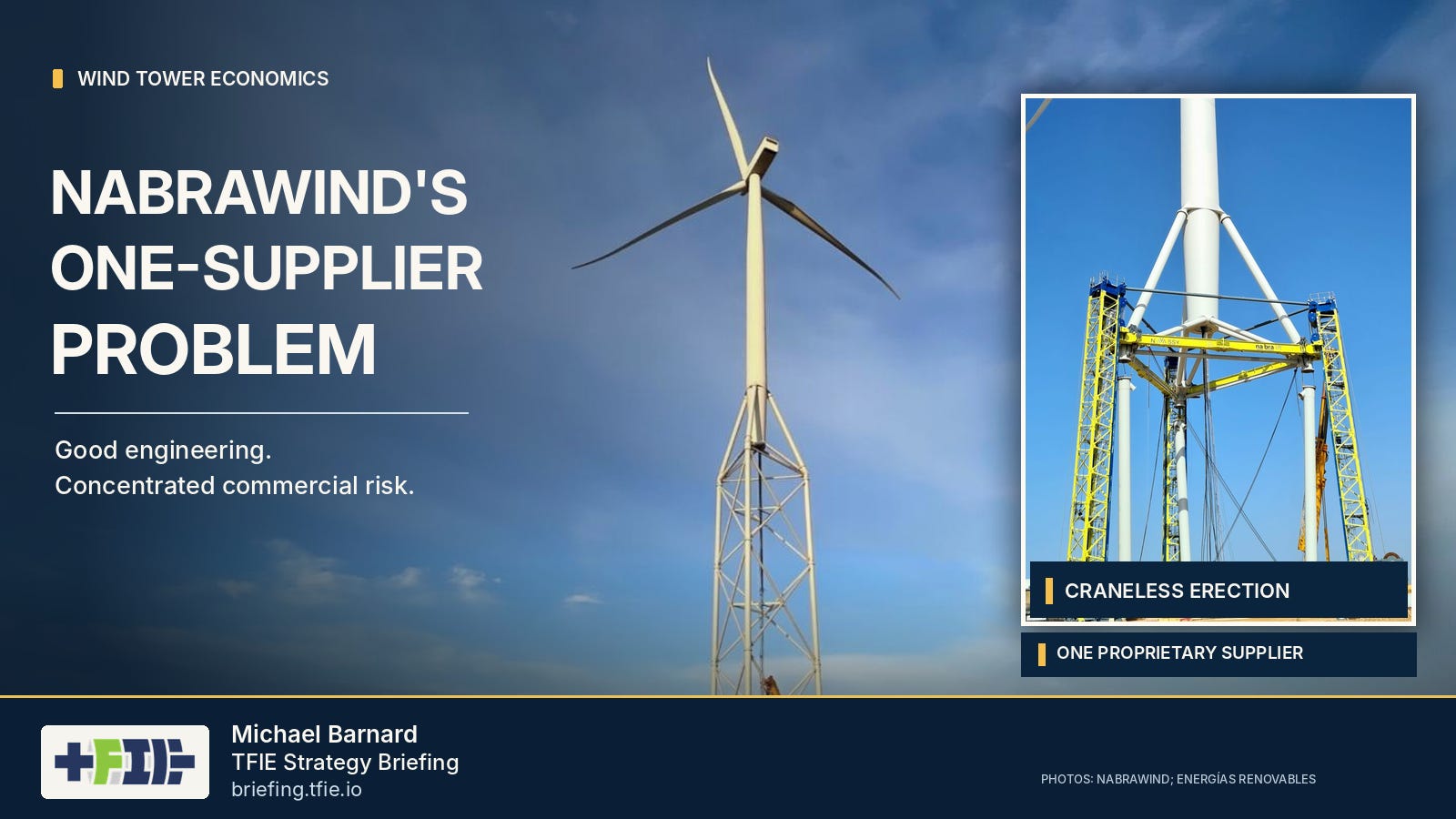
My recent assessment of GICON’s 300-meter wind tower focused on a basic commercial problem. Higher winds mean more electricity, but building extraordinarily tall towers introduces construction costs, specialist crews and scheduling risks that additional generation must overcome. Spain’s Nabrawind has developed an approach that avoids several of those problems, and it deserves attention.
Its Nabralift system combines a tubular upper tower with a three-legged, braced steel structure underneath. Hydraulic equipment raises the assembled turbine progressively while crews insert structural modules at ground level. The lifting equipment is then removed for use elsewhere. Enormous crawler cranes and much of the specialist working-at-height labour are avoided. The first 160-meter prototype was erected in under two weeks in 2018.
There are material advantages as well. Nabrawind reports roughly 20% less tower steel than equivalent conventional tubular steel designs and foundation concrete reductions of up to 80%, depending on site conditions. Transport is easier, and erection can proceed in stronger winds than conventional heavy crane operations permit. The embodied carbon savings are welcome, although wind turbines typically repay their lifecycle energy investment within months. Cost, construction speed and reliability are more important differentiators.
The company has moved beyond prototypes. Its 188-meter tower configuration supporting an Envision 7.8 MW turbine received type certification in September 2026. Fortescue is deploying 17 of these towers at its 133 MW Nullagine wind project in Western Australia. That’s meaningful progress for a technology with relatively few commercial installations.
The engineering proposition is credible. The commercial proposition has a complication that Fortescue’s investment may obscure.