

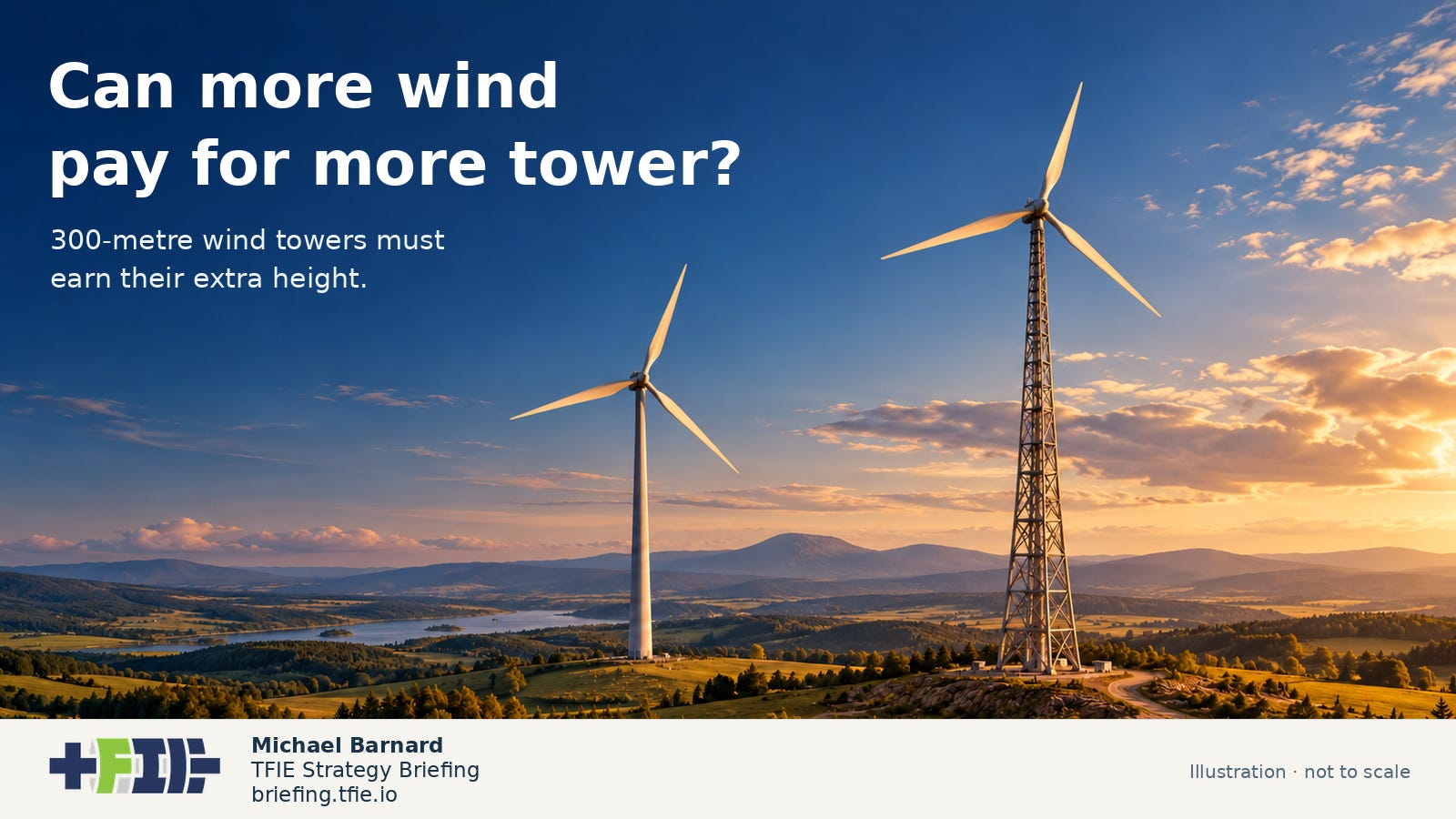
Germany now has a wind turbine with a hub 300 meters above the ground. GICON’s 3.8 MW Schipkau prototype reached its final height on September 28, with the upper blade tip reaching a reported 365 meters. Built for Germany’s Federal Agency for Breakthrough Innovation, SPRIND, the installation is a substantial engineering achievement. At the research cutoff for this assessment, October 16, 2026, commissioning was planned for November. The tower demonstrates that the machine can be raised to this height; its operating record and commercial economics are still ahead of it.
The attraction is straightforward. Higher winds can provide more electricity from the same turbine, increasing the value of an already permitted wind site. The difficulty is that the comparison keeps moving. In September, Max Bögl announced that it had erected a Vestas V172 with a 199-meter hub and a 7.2 MW rating. Its concrete and latticed steel hybrid tower is a series production design. That gives a 300-meter tower a considerably stronger competitor than an older turbine at 100 or 150 meters.

My matched comparison holds the turbine rating, rotor diameter and turbine count constant. For two hypothetical 201.6 MW wind farms, moving the hub from 199 to 300 meters increases annual electricity from about 669 to 745 GWh under the screening model’s wind assumptions. That is an 11.4% gain. Neither farm output is a forecast for Schipkau or the Max Bögl site. The purpose is to isolate what extra height contributes when the turbine equipment stays the same.
The gain is meaningful, but it is also site dependent. A GICON, BEVENTUM and SPRIND study using Schipkau wind measurements estimated gross annual generation of 28.5 GWh at 200 meters and 36.6 GWh at 300 meters for an illustrative Vestas V164 9.5 MW turbine. That is a 28.4% increase. The same study estimated 22.4 GWh at 150 meters, making the increase from that lower baseline 63.4%. These are modeled outputs based on measured wind, using a different turbine from the prototype and from my screening case. They demonstrate why the local wind profile and the chosen comparator matter so much.
The investment question is how much extra construction the additional electricity can support. Using the reference-class forecasting, or RCF, working allowance of nine months and 40,000 field hours per tall tower, the matched lattice farm finishes about €81.3 million behind after discounted electricity receipts and additional field labor. Steel, foundations, lifting equipment, maintenance and other net cost differences remain to be priced. The construction allowance is provisional, drawn from sparse analogues and indirect labor evidence; it is a working case against which a supplier’s delivery plan can be tested.
The subscriber analysis below explains the wind calculation, the construction evidence and the financial thresholds. It also distinguishes the conventional farm’s early lead from the lattice farm’s later effort to recover it.
