

Someone asked me about a Houston-based startup called Gold H2. That was enough to send me down the rabbit hole. After a few hours of reading, checking the chemistry and doing back-of-the-envelope calculations, I had enough material to pull the assessment together. This is not the Australian company with a similar name that explores for naturally occurring hydrogen. It is a private spinout from Cemvita that is trying to manufacture hydrogen underground in depleted oilfields by feeding suitable microbes and letting them consume residual hydrocarbons.
Gold H2 calls its approach Black 2 Gold. It injects nutrients and hydrogen-producing microbes into old oil wells, allows the reservoir to sit for a period, and then produces gas back through the same well. The microbes are intended to break down residual hydrocarbons into hydrogen and other gases. The company argues that the process can reuse existing wells and oilfield equipment rather than requiring new drilling or a conventional surface hydrogen plant. In concept, it resembles microbially enhanced oil recovery, except the objective is hydrogen rather than additional oil.
Microbially enhanced oil recovery uses microorganisms to improve oil movement through a reservoir. Microbes can be injected or stimulated in place with nutrients. Some species produce carbon dioxide, methane or other gases that help move oil toward the wellbore. Others produce biosurfactants that reduce the surface tension between oil and water, allowing trapped droplets to move more easily, or break down heavy hydrocarbons and reduce their viscosity. These techniques have been tested since the 1980s, with mixed results because microbial activity depends on temperature, salinity, pH, nutrient availability and reservoir chemistry.
In practice, microbially enhanced oil recovery has remained a niche technique used in reservoirs where the geology and biology happen to cooperate and conventional recovery methods are exhausted or uneconomic. That is an immediate caution for claims that a similar approach will turn large numbers of abandoned wells into hydrogen producers.
Only a fraction of depleted oil reservoirs are likely to offer the required combination of conditions. Many are too hot or too cold for the target microbes, while others have formation-water salinity above microbial tolerance. Decades of production and water flooding may have left too little residual oil to provide useful feedstock. Sulfate introduced through earlier injection programmes can also consume hydrogen through unwanted pathways. The plausible candidate pool therefore narrows to reservoirs with sufficient residual hydrocarbons, moderate salinity, suitable temperature, workable permeability and limited interference from incompatible fluids or hydrogen-consuming organisms.
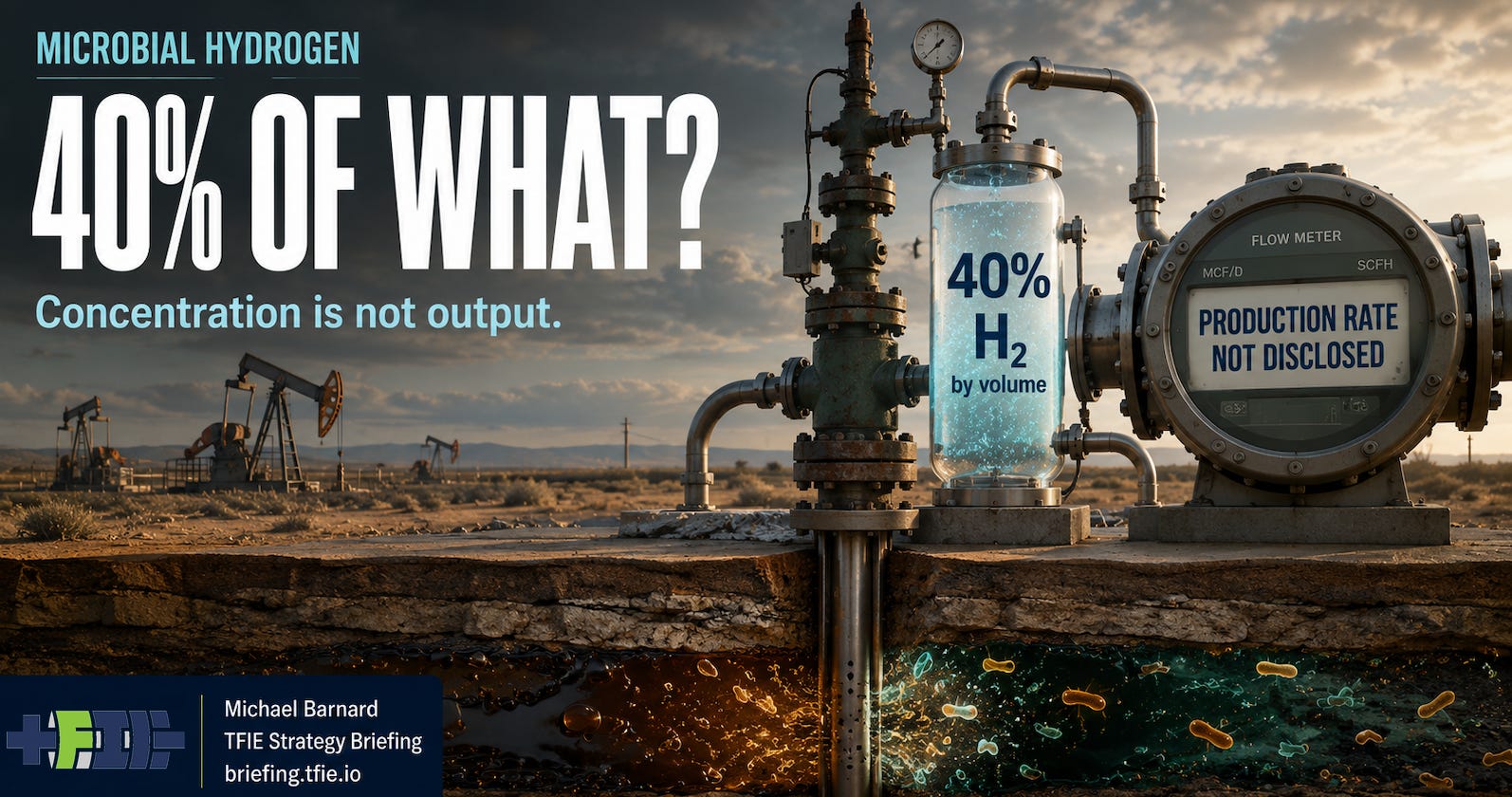
In 2025, Gold H2 conducted a field trial in California’s San Joaquin Basin. The company reported that the produced gas reached 400,000 parts per million hydrogen, or about 40% by volume. The rest of the gas was not disclosed in detail, but could include methane, carbon dioxide, nitrogen and potentially trace hydrogen sulfide. Gold H2 did not publish the total gas-flow rate, the mass of hydrogen produced, sustained cycle-average output or evidence that the hydrogen was purified and stored. Without those numbers, it is impossible to assess how close the trial came to the company’s stated target of hydrogen below $0.50/kg.
Hydrogen concentration in a gas stream is commonly reported by volume. At the same temperature and pressure, volume share is equivalent to mole fraction, which is useful for gas handling but can be misleading when discussing production by mass. Hydrogen is exceptionally light. A mixture containing 40% hydrogen and 60% methane by volume contains only about 7.7% hydrogen by mass. If the other 60% were carbon dioxide, hydrogen would be only about 3% of the gas mass.
The missing flow rate is therefore critical. A high concentration in a small gas stream can still represent very little hydrogen. Because Gold H2 did not release production rates, I bracketed plausible cases using output typical of marginal and end-of-life wells. The US Energy Information Administration has characterized a stripper gas well as producing no more than about 90,000 cubic feet per day over a year, although definitions vary. I used total gas-flow cases of 50,000, 200,000 and 1 million cubic feet per day to test the range rather than to predict the specific well.
At a total gas rate of 200,000 cubic feet per day and a hydrogen concentration of 40% by volume, the well would produce roughly 200 kg of hydrogen per day. At 300 operating days per year, that is about 60 tons annually. The 300-day assumption allows for injection, soaking, maintenance and other periods when a huff-and-puff well is not producing.
For depleted oil wells producing microbial hydrogen, 50,000 and 200,000 cubic feet per day are reasonable screening cases. A million cubic feet per day may be possible in an unusually favourable well, but it should not be used as the base case. These are not undepleted, high-pressure gas reservoirs. Most of their natural drive energy has already been lost, water saturation is often high, and oil-wet rock can constrain gas movement. The cyclic process also lowers average output because production occurs only between injection and soaking periods. A well might briefly flow at a high rate while still delivering a much lower cycle average.
As with my assessment of natural hydrogen production, extracting the gas is only part of the cost problem. Hydrogen must be purified, compressed and delivered to a user. It remains difficult and expensive to transport, so the most credible application for any successful microbial process would be an industrial customer close enough to serve with a short pipeline. Most hydrogen today is consumed in refining, ammonia, methanol and other industrial processes, with global demand still overwhelmingly concentrated in those established uses.
Regional industrial demand puts the likely well output into perspective. Ammonia plants in Louisiana, Oklahoma and Texas produce roughly 7.7 million tons of ammonia annually, requiring about 1.37 million tons of hydrogen. At approximately 60 tons of hydrogen per well per year, around 225 productive wells would be needed to supply just 1% of that hydrogen demand. Supplying 10% would require more than 2,200 wells. Those figures assume that every well maintains the central-case output, exclude separation losses and do not account for the cyclic nature of production.
Purification is unavoidable if the hydrogen is intended for ammonia production, fuel cells or another use requiring high purity. Pressure-swing adsorption and membrane systems become more expensive as inlet hydrogen concentration falls. As a rough screening estimate, purification from an 80% hydrogen stream might add about $0.30/kg. At 40%, the increment could be closer to $0.60/kg, and at 20% it could approach $1.20/kg. These are illustrative estimates rather than project quotations, but they show the problem with a target of less than $0.50/kg when the field trial’s gas stream was only 40% hydrogen before purification.
That is also before capital recovery, nutrient injection, pumping, water handling, well workovers, corrosion management, gas processing, compression, operating labour and financing. Existing wells are not free infrastructure. Many depleted wells require remediation before reuse, and a large field of small producers would require gathering lines, monitoring and surface equipment.
The composition of the remaining gas matters for both economics and climate impact. A methane-rich stream might provide some commercial value or energy for field operations, but selling or burning the methane would extend fossil-fuel use, while venting or leakage would create significant climate impacts. A carbon-dioxide-rich stream would have little market value and would still need to be separated and managed. Hydrogen sulfide would add safety, corrosion and treatment requirements. Reinjection into another suitable well might be more sustainable than release, but would add further equipment and cost.
Gold H2’s concept does have strengths. It seeks to reuse existing wells and surface infrastructure, reducing some initial capital requirements. The biological conversion occurs underground at reservoir conditions rather than in a newly built surface reactor. The field trial shows that microbial stimulation can produce a gas stream with a substantial hydrogen concentration in a real oilfield setting. The unresolved questions are scale, sustained output, microbial stability, gas composition, purification and total delivered cost.
Research published after the original article strengthens the scientific basis for microbial hydrogen generation in depleted reservoirs. A 2025 field and laboratory study found hydrogen concentrations ranging from 2% to 20% in samples from depleted hydrocarbon fields and reproduced hydrogen production using reservoir brine, residual oil and indigenous microorganisms. The study identified several potentially relevant microbial groups and found that adding oil increased microbial growth and hydrogen yield.
Other experiments have also demonstrated the reaction under controlled conditions. A 2026 study using thermophilic microbial consortia achieved much higher yields under optimized laboratory conditions, while another experiment designed to reproduce reservoir temperature, pressure and salinity reported only 0.08 to 0.99 mL of hydrogen per litre under reservoir conditions. A separate core-flood study produced about 2.1% hydrogen after ten days, again supporting technical feasibility without demonstrating commercial production.
The newer work makes the chemistry more credible. It does not establish sustained gas flow from a commercial well, cycle-average kilograms of purified hydrogen, long-term microbial stability, nutrient requirements, reservoir decline, gathering costs or a delivered price. Laboratory yield and gas concentration are not substitutes for a multi-month well-production curve.
Without knowing how much hydrogen a well can produce over months or years, and what it costs to deliver that hydrogen at the required purity, it remains difficult to judge whether this will be commercially irrelevant or a niche option for a few unusually suitable reservoirs. The evidence does not currently support a pathway to significant hydrogen volumes.
As a reminder, I am a broad-spectrum nerd who has spent a great deal of time working to understand domains most people have not, but I am not a subsurface oil and gas engineer. I do make mistakes. My reading of the data could be wrong, but I am comfortable that enough of the assessment is right to consider large-scale, economically competitive microbial hydrogen production from depleted oil wells deeply unlikely.
Subscribe to TFIE Strategy Briefing for evidence-led hydrogen and industrial decarbonization analysis.
Originally published by CleanTechnica; lightly updated.