

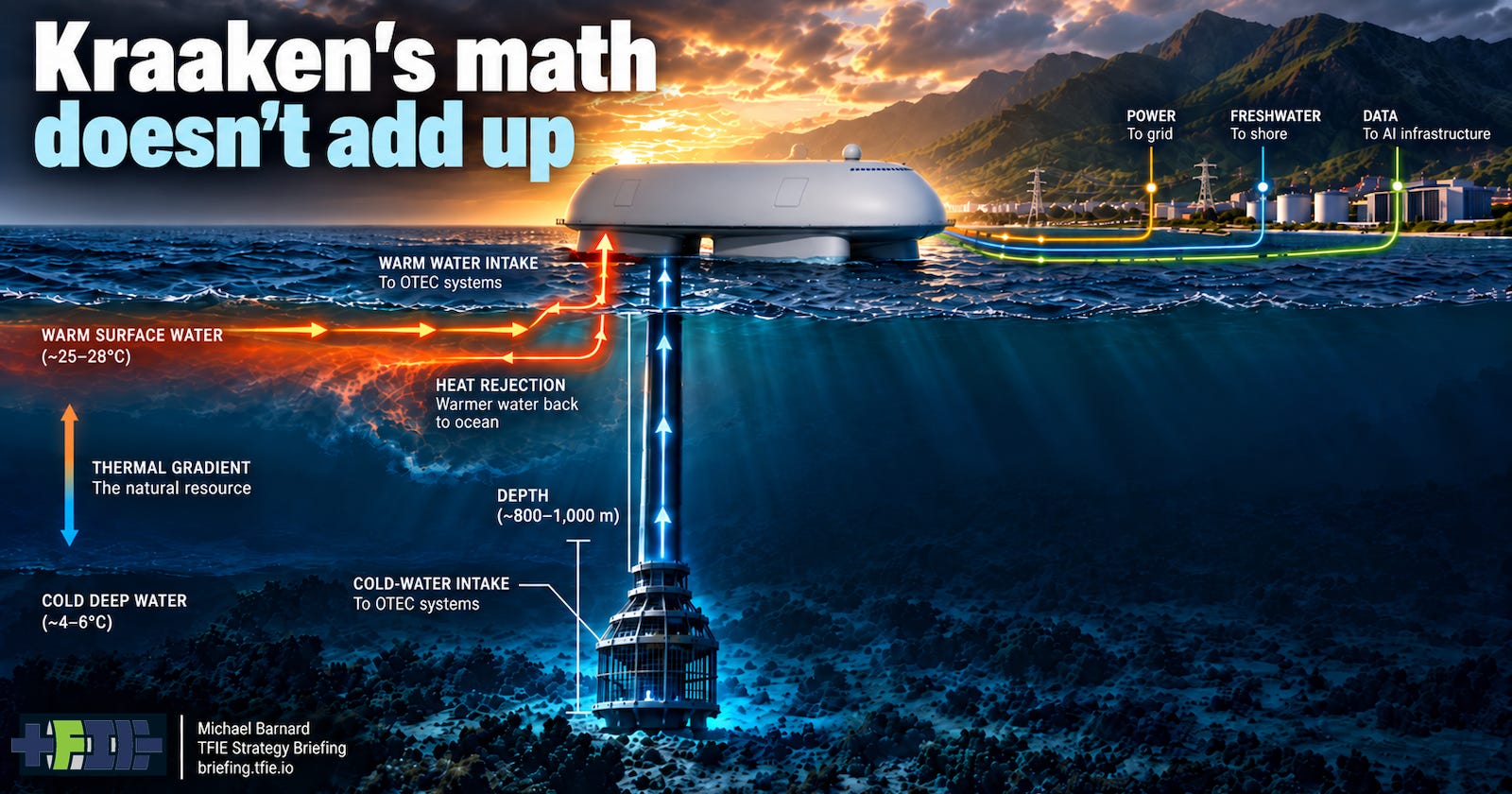
A floating data centre that makes its own electricity, cools itself with the ocean, produces drinking water for a coastal community and can sail away when a hurricane approaches is almost perfectly designed for the current AI infrastructure hype cycle. Optimal Transit says its Kraaken platform can deliver 100 MW of continuous power, reserve 60 MW for AI computing, send as much as 40 MW ashore and produce about 30 million litres of freshwater every day, all from a vessel only about 91 metres long. None of the constituent ideas is imaginary. Ocean thermal energy conversion (OTEC) is real, ammonia Rankine cycles are real, liquid-cooled computers reject useful quantities of low-temperature heat, and offshore vessels, desalination plants, subsea pipelines and disconnectable mooring systems all exist. That is precisely why Kraaken deserves more scrutiny than a proposal built around an obviously impossible technology.
A large part of my work is taking energy and infrastructure propositions apart into their denominators: mass flow, energy flow, civil works, operating constraints and the equipment that has to connect one to the next. Kraaken turned out to be unusually interesting because almost every attractive feature depends on the interfaces among several real technologies rather than on any one of them. The first question is where the electricity comes from. Optimal Transit’s answer is a proprietary development of OTEC it calls Digital Ocean Thermal, or DOT. Conventional OTEC exploits the small temperature difference between tropical surface water and deep ocean water. As I laid out in my recent assessment of OTEC itself, the underlying thermodynamics work; the difficulty is the denominator. With perhaps 25°C water at the surface and roughly 5°C water at depth, enormous quantities of water and heat have to move through the plant to produce comparatively modest quantities of electricity.
Optimal Transit says DOT changes that equation dramatically. Its own published process diagram says the technology reduces the cold-water pipe by 70%, reduces the cold-water pumps and condenser by 70%, and allows a turbine about 70% smaller. It also routes data-centre waste heat through something it calls the AHEB, likely for ammonia heat exchange booster, to “supercharge” the ammonia vapour and says that higher vapour pressure is part of the reason the turbine can shrink. Those claims cannot really be considered independently. If less cold water flows through the plant, less heat can be carried away unless the water temperature rise changes; if the same flow passes through a much smaller pipe, velocity and pressure loss increase; if the condenser really has 70% less heat-transfer area while rejecting the same heat, something else in the heat-transfer equation has to increase substantially; and if the turbine becomes much smaller because its inlet conditions have changed, the source of the additional pressure and enthalpy has to appear somewhere in the cycle balance.
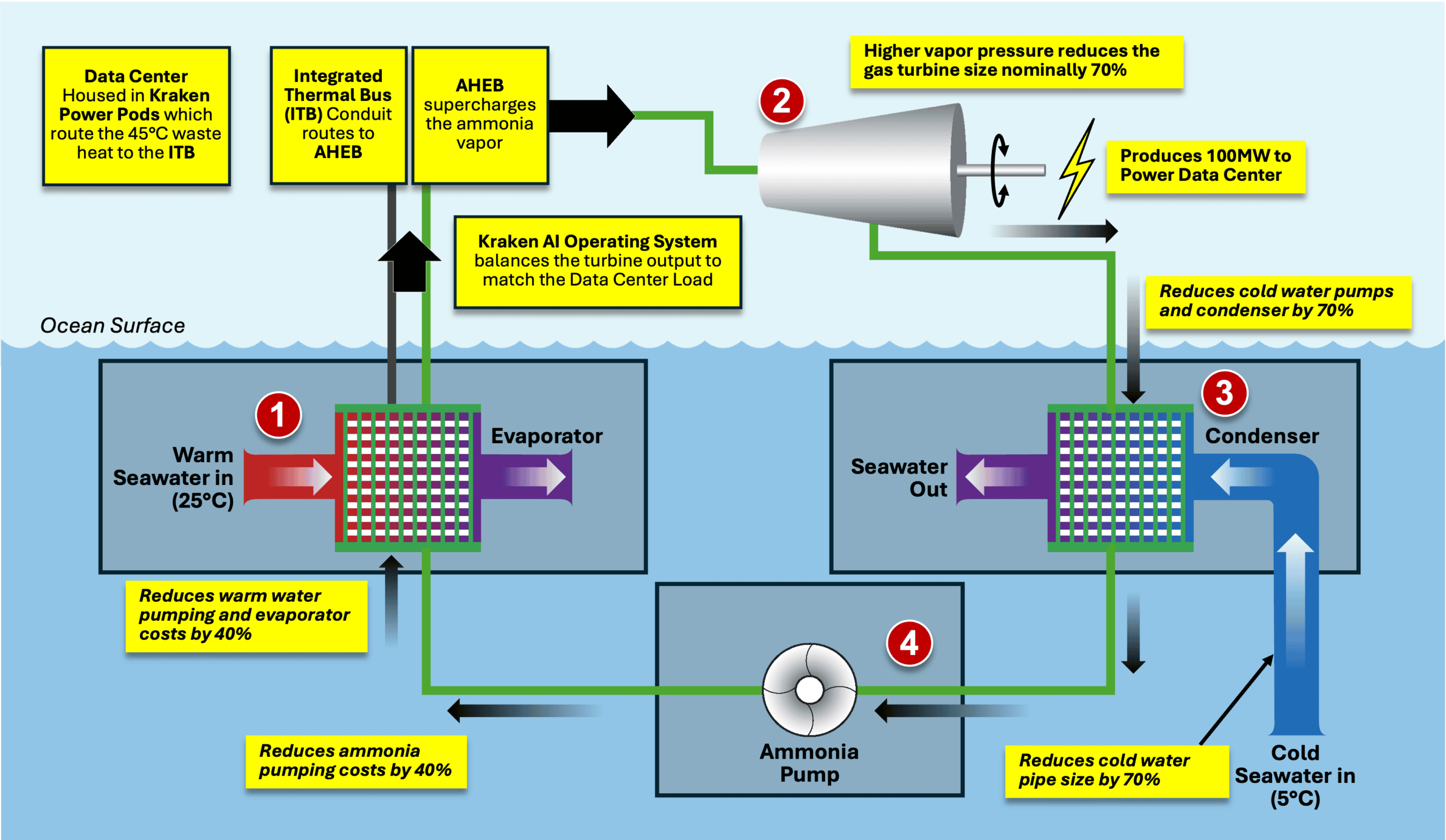
That raises some deceptively simple questions. What does “70% smaller cold-water pipe” mean: diameter, cross-sectional area, an individual pipe in a multi-riser bundle, flow capacity, mass or cost? If the answer is multiple smaller risers, that can make individual pipes easier to manufacture, but it does not make condenser heat duty or total seawater flow disappear. The same ambiguity exists around the condenser and pumps. Are they 70% smaller in physical volume, heat-transfer area, installed power, equipment count or cost? Those are very different propositions. A 70% reduction in physical condenser area at unchanged heat duty, for example, requires more than three times the product of heat-transfer coefficient and usable temperature difference.
Then there is the AHEB. A liquid pump can establish a higher pressure in a Rankine cycle, while heat exchangers supply the enthalpy needed to heat and vaporize the working fluid. But the temperature of the heat source limits the pressure at which that vaporization can occur. Twenty-five-degree ocean water cannot boil ammonia at a saturation temperature approaching 45°C, and server heat at 45°C is a finite low-grade heat stream, not a new primary energy source. I also gave Kraaken a more generous test: suppose none of the data centre’s electricity comes from the OTEC plant. Supply all 100 MW externally and give DOT the entire resulting 100 MW of 45°C server waste heat. That removes the feedback-loop objection entirely and leaves a cleaner question: how much useful work can that heat possibly contain against a 5°C sink, and how much heat still has to be rejected afterward?
The physical scale raises another set of questions. Optimal Transit describes a vessel roughly 91 metres long and “50,000 long tons,” although the public material does not identify whether that tonnage means displacement, deadweight or something else. Published OTEC reference platforms of 50–100 MW are roughly 198–285 metres long, while Kraaken additionally has to contain a large AI installation, electrical systems, desalination, propulsion and whatever machinery enables storm departure. And storm departure itself is not the same as unplugging a laptop. If one enormous cold-water pipe becomes a dozen or more kilometre-class risers, what remains suspended when the ship leaves? What happens to the moorings, manifold, shore power connection, freshwater line and fibre? Currents can vary in both speed and direction with depth, so the vessel and its riser field do not necessarily see the same environmental forces, and a small net stationkeeping force can hide much larger opposing loads distributed along the submerged structure.
The proposition may contain genuinely clever engineering. But by the time the public claims are followed through the water flows, heat rejection, ammonia cycle, platform dimensions and offshore interfaces, the central diligence question is no longer whether the technologies are individually real. It is whether the complete system closes.
I rebuilt the public Kraaken proposition from the bottom up: seawater flow, pipe hydraulics, condenser duty, ammonia state points, waste-heat exergy, riser arrays, stationkeeping loads, platform dimensions and shore interfaces. Several claims remain possible in principle. Others require improvements much larger than the public explanation accounts for. Below are the calculations, the published OTEC reference designs, Optimal Transit’s own claims and the specific engineering numbers that would have to exist for Kraaken’s 100 MW proposition to close.