

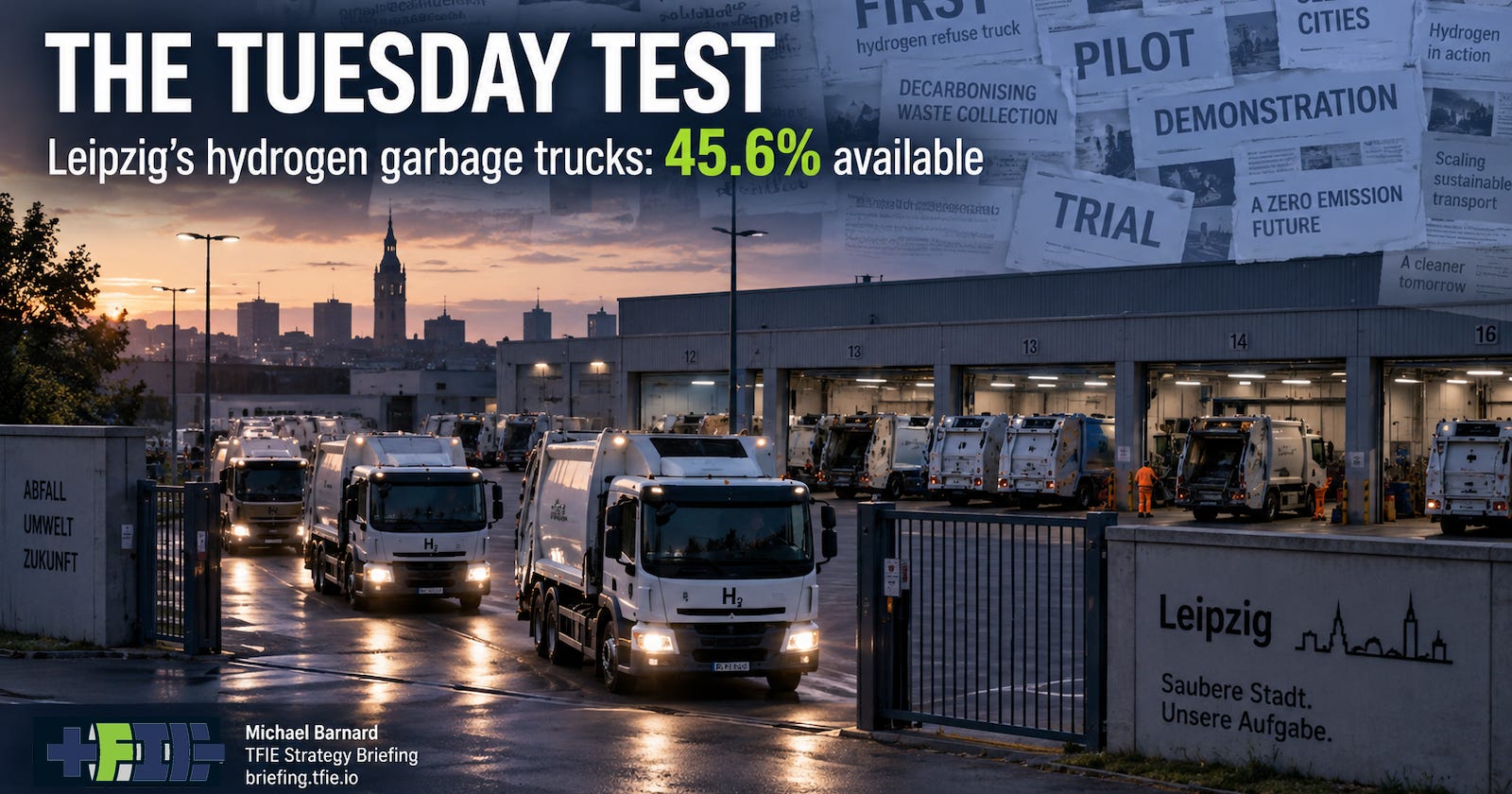
A couple of months ago I wrote about battery-electric garbage trucks as a heavy-duty electric vehicle story hiding in plain sight. Refuse collection is unusually well suited to batteries: relatively short and predictable routes, constant stopping and starting, lots of regenerative braking, fixed depots and long overnight parking periods. The people buying these vehicles aren’t trying to make transportation exciting. They’re trying to get Tuesday’s route completed. Hydrogen garbage trucks received only a couple of paragraphs because their record was already dominated by trials while battery-electric fleets were scaling. Then Leipzig’s experience with 16 hydrogen refuse trucks crossed my screen, and it was worth going back to see whether I had been too dismissive. I hadn’t been.
Leipzig bought the FAUN BluePower trucks in 2024, enough to make up roughly a third of its collection fleet. Two years later, their reported deployment rate is 45.6%, compared with about 80% for conventional refuse trucks. Technical faults, maintenance and repairs keep them off the road, and conventional replacement vehicles supplied by the manufacturer cover the missing work. Leipzig already has dedicated hydrogen refueling infrastructure, so the usual explanation that the pilot failed because nobody built a station doesn’t apply. This is a substantial fleet with purpose-built fueling, public subsidies and two years of operating experience, and the trucks still aren’t available often enough for normal municipal service.
The relevant financial comparison isn’t with diesel. A city decarbonizing refuse collection is choosing between zero-emission alternatives, and battery electric is the obvious benchmark. The stronger cost literature does not show hydrogen and batteries naturally converging on similar total costs. A 2026 Nature Communications study of real-world European heavy-truck utilization found hydrogen beating batteries only when favorable assumptions for fuel-cell development and hydrogen prices were paired with unfavorable assumptions for battery trucks. A separate Swiss assessment of demanding bus duties, including infrastructure and the additional vehicles required to deliver the service, again found battery electric the lowest-cost zero-emission option. These aren’t refuse-truck invoices from Leipzig, so they can’t tell us the city’s exact cost premium. They do tell us that hydrogen needs an unusually friendly set of assumptions to win a lifecycle-cost comparison.
The refuse-truck evidence makes the economic problem less abstract. Researchers in Helsinki measured total battery-electric refuse-truck consumption at about 2.3 kilowatt-hours per kilometre, including collection work, and recorded a February shift of more than 120 kilometres and 500 container lifts without intermediate charging. Hydrogen operators have had to pay for a more complicated support system. Arnhem needed conventional backup because its hydrogen truck could not reliably replace a normal vehicle, while Herten experienced months-long waits for parts and heavy dependence on the specialist supplier. Leipzig adds the most damaging cost variable of all: expensive capital that spends much of its life unavailable while another truck does the work. A total-cost model that assumes a vehicle delivers its scheduled workload is not describing a fleet that manages 45.6% deployment.
Europe has spent years trying to turn hydrogen refuse trucks into an ordinary product. The Hydrogen Waste Collection Vehicles in North West Europe project, HECTOR, ran from 2019 through 2023 with seven trucks at seven locations. Its objective was to create operating experience and provide a basis for wider deployment. The Refuse Vehicle Innovation and Validation in Europe project, REVIVE, ran from 2018 through 2024 and ultimately deployed 11 trucks across seven European cities. The vehicles collected garbage and the projects generated years of technical reports, demonstrations and follow-up announcements. What they did not generate was the wave of larger repeat orders that would indicate a technology graduating into routine fleet procurement.
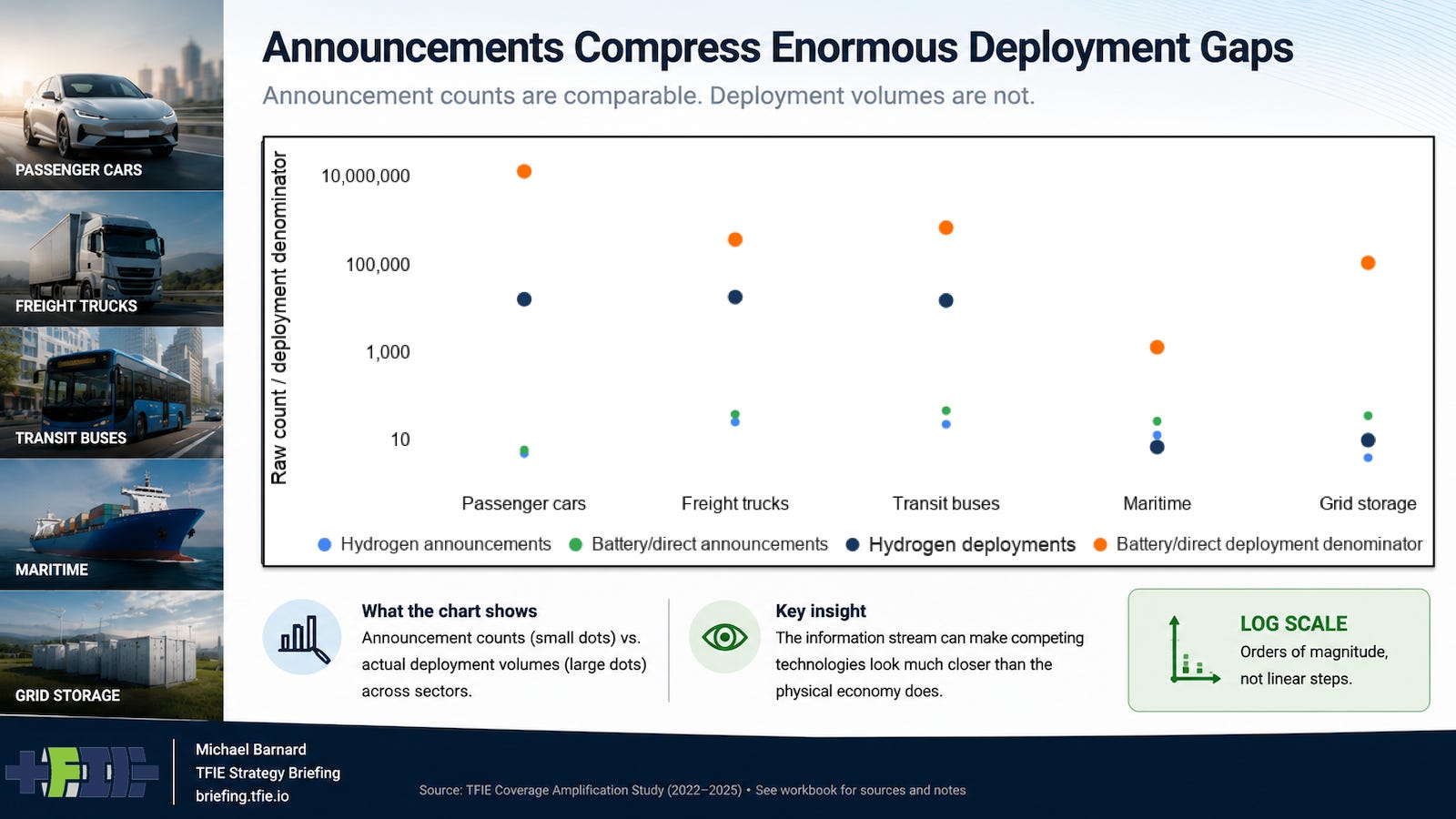
That is a textbook example of what I described in Hydrogen Has Narrative Density. Electrification Has Deployment Density. Firsts, pilots, funding awards, partnerships, demonstrations and small orders each generate a news event. Mature deployment does not generate a separate story for every additional machine. In the bounded six-sector dataset behind that analysis, battery technologies produced only 1.8 times as many positive milestone announcements as hydrogen, while the physical deployment differences were routinely one, two or three orders of magnitude larger. For trucks, the deployment gap was about 29 to one. Narrative volume compressed the physical difference between the technologies.
North America supplied an almost perfect refuse-truck example. New Way Trucks and Hyzon developed a hydrogen refuse truck, put it through successful trials with waste companies and attracted positive operator comments. GreenWaste then signed a conditional agreement in October 2024 for 12 vehicles promoted as North America’s first commercial hydrogen refuse-truck order. The sequence looked compelling: prototype, first trial, more trials, customer endorsement, commercial order. Then Hyzon collapsed before supplying the fleet. At WasteExpo in 2025, New Way said it still wanted to continue the programme but was looking for another fuel-cell supplier or a buyer of Hyzon’s assets. The truck had proven it could collect garbage. The product ecosystem failed before commercialization.
The European projects show the same problem in less dramatic forms. Arnhem suffered low vehicle reliability and station outages. Herten had component failures, long waits for spares and insufficient reliability to retire the diesel truck it was supposed to replace. Bielefeld bought seven hydrogen refuse trucks and then lost its practical refueling option when regional stations closed. Moving the vehicles to the city’s hydrogen bus station required resolving technical and funding restrictions, with a solution finally implemented in April 2026. A functioning fuel-cell truck without fuel is still a truck that cannot collect garbage. Hydrogen adds another chain of dependencies—fuel production or delivery, compression, storage, dispensing, specialist maintenance and a thin parts network—and every link has to work on collection day.
Freiburg is the strongest counterexample, and it is a real one. The city has 22 fuel-cell refuse trucks across its municipal fleet, a second hydrogen station for redundancy and plans for local hydrogen production. Freiburg proves that a city determined to operate a hydrogen refuse fleet can build enough infrastructure around it to make the system function. It also illustrates the price of doing so: specialized trucks, redundant refueling and a local fuel-production project for a fleet of 22 vehicles. That is not evidence of an intrinsically competitive technology. It is evidence that sufficient institutional commitment and infrastructure can make one work.
Battery-electric refuse trucks have had failures as well, including a particularly poor early vehicle in Mobile, Alabama, charging and reliability problems in Nottingham and a troublesome conversion in Somerset. The difference is no longer subtle: successful battery trials turned into fleets, while successful hydrogen trials usually turned into more trials. Westminster committed £20 million to 45 electric refuse trucks and a dedicated charging depot. Copenhagen was running 86 electric refuse trucks by 2023. Republic Services had more than 250 battery-electric collection trucks operating by September 2026 and was heading toward 300. Its management says suitably selected routes are achieving one-for-one replacement of conventional trucks and completing full working days without midday charging. Battery refuse collection has moved from proving that the machines can work to deciding which routes and depots to electrify next.
Of course, compared to China those Western battery-electric fleet numbers are already small. China registered at least 7,900 new pure-battery garbage trucks in 2025 across seven refuse-specific categories, including 2,269 battery-electric compactor trucks, the closest direct analogue to the rear-loading refuse vehicles being discussed here. Shanghai alone registered 302 battery-electric compactors in that single year, with Chengdu adding 174 and Changsha 151. China also has hydrogen refuse trucks, so this isn’t a case where one technology was tried and the other ignored. The cleanest national hydrogen figure I found recorded 59 fuel-cell garbage trucks in 2023, within 159 fuel-cell sanitation vehicles of all kinds. Individual hydrogen refuse deployments since then have generally been measured in single digits or low tens. China has tested both pathways inside the same manufacturing ecosystem, and the market has chosen battery electric at vastly greater scale.
That Chinese evidence makes the narrative-density problem particularly obvious. Seven HECTOR trucks can sustain a four-year European demonstration programme. Eleven REVIVE trucks can generate six years of project activity. A single New Way/Hyzon demonstrator can produce a series of firsts, trials and partnership stories before a conditional 12-truck order becomes another headline. Meanwhile one country can add thousands of battery-electric garbage trucks in a year without anything like thousands of international stories. The difference between narrative density and deployment density is not an abstract media critique. It changes how mature the technologies appear.
Pilots are supposed to graduate. Hydrogen refuse trucks have repeatedly demonstrated that fuel cells can propel a truck down a street, operate the compactor and finish a collection route. That question was settled years ago. Commercialization requires something harder: reliable daily dispatch, affordable fuel, available technicians, durable suppliers, spare parts, sensible infrastructure costs and customers who come back to buy much larger fleets. On those measures the hydrogen refuse-truck story remains weak. Battery electric has moved well beyond it.
Leipzig matters because most of the usual excuses have already been removed. Sixteen trucks are not an experimental singleton. They have dedicated refueling infrastructure. Public subsidy reduced the purchase burden. The fleet has had two years to settle into service. Yet conventional vehicles still have to cover for it while reported deployment remains at 45.6%. The original hydrogen story was about 16 zero-emission garbage trucks entering service. The useful story arrived two years later, when someone finally published the denominator.
Tuesday morning still comes. The garbage still has to be collected. In Leipzig, the hydrogen trucks are failing that test more often than they are passing it.
For more evidence-first analysis of what is actually scaling in the energy transition, subscribe to TFIE Strategy Briefing.