

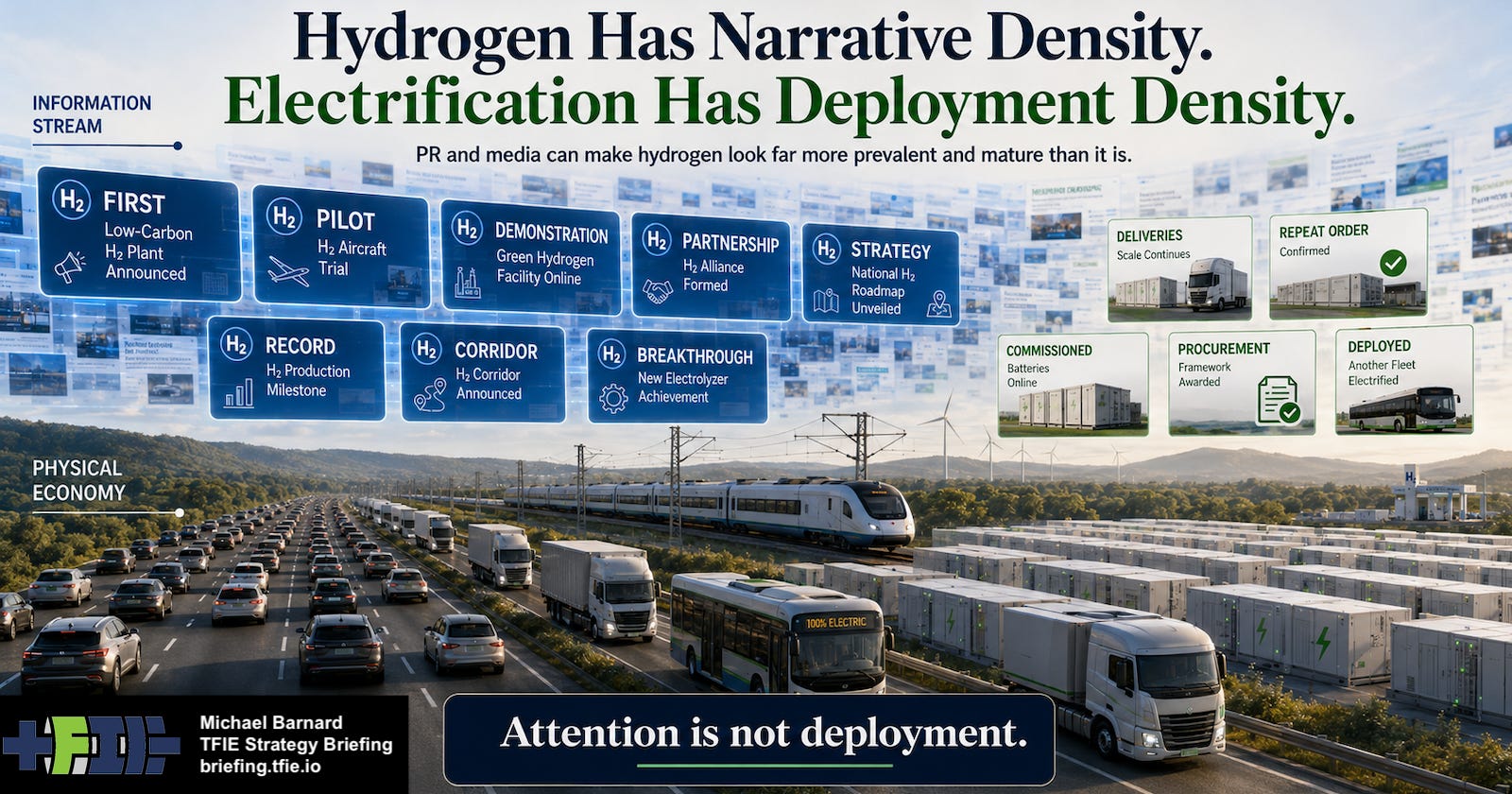
Hydrogen occupies a remarkably large share of the energy-transition conversation for a technology with remarkably little deployment behind it. Fuel-cell trucks, hydrogen buses, hydrogen trains, hydrogen ships, hydrogen storage projects and one-off demonstrations recur through corporate press releases, government announcements, trade publications and mainstream coverage as significant branches of the transition. The cumulative impression is of a technology progressing alongside battery-electric and direct-electric alternatives across multiple sectors, with each new first, pilot, project, partnership or procurement adding another piece of apparent commercial momentum.
JCB’s recent Hydromax speed record provides an unusually clear example of how that happens. One purpose-built hydrogen-combustion record car completed two timed runs at Bonneville and averaged 406.320 mph. The achievement was real and independently verified by the FIA, but its commercial evidence was narrow: one vehicle, no fleet, no customer utilization, no operating economics and no repeat procurement. Ground News nevertheless grouped 127 news sources around the completed record, after an earlier pre-attempt publicity cycle had already generated an 88-article cluster. Those counts include wire syndication, partner amplification and independent reporting rather than 127 independent validations, but that is precisely the point: the underlying engineering event remained one commercially irrelevant car while the number of opportunities to encounter it as evidence of hydrogen progress multiplied dramatically.
The deployment data show the same distortion at market scale. Across the bounded 2022–2025 announcement register behind this analysis, battery-electric technologies actually produced somewhat more positive milestone announcements than hydrogen: 206 versus 114 across six common sectors. Among announcements representing scaled deployment or repeat procurement, the difference widens to 168 battery milestones versus 55 for hydrogen. Yet even that three-to-one maturity-weighted announcement advantage bears little resemblance to the physical markets underneath it, where battery and direct-electric deployment exceeds hydrogen by factors ranging from roughly 20 to 10,800 in the directly comparable cases.
Freight trucks show the same compression. The announcement register contains 26 hydrogen milestones and 39 battery milestones, a ratio of 1.5 to one. China had about 18,000 fuel-cell heavy trucks at the end of 2025, compared with about 366,000 electric heavy trucks, a stock difference of roughly twenty to one. Using the broader medium-plus-heavy category, the best reconstruction is approximately 24,000–25,000 fuel-cell trucks against an electric fleet above one million, placing the deployment difference above forty to one.
Transit buses look similarly close in announcements and similarly distant in deployment. There are 47 battery milestones and 23 hydrogen milestones in the register, almost exactly two to one. Hydrogen buses are not merely prototypes in this sector; substantial fleets have been purchased and put into service, and transit is the one common sector in the normalized dataset where hydrogen announcements reach commercial stages comparable with battery announcements. Even so, the physical fleet comparison is about 15,000 fuel-cell buses globally against more than 680,000 electric buses in China alone, a deployment gap greater than 45 to one.
Maritime pushes the discrepancy much further. Thirteen hydrogen ferry and harbour-craft milestones sit beside 27 battery milestones, again approximately two to one. DNV’s operating-fleet evidence shows seven hydrogen-fuelled vessels against more than 1,300 battery-equipped vessels, a difference of roughly 186 to one. The battery figure includes hybrid installations, so it is not an exact propulsion-for-propulsion comparison, but the architectural qualification is far too small to reconcile a two-to-one announcement ratio with an operating-fleet difference approaching two orders of magnitude.
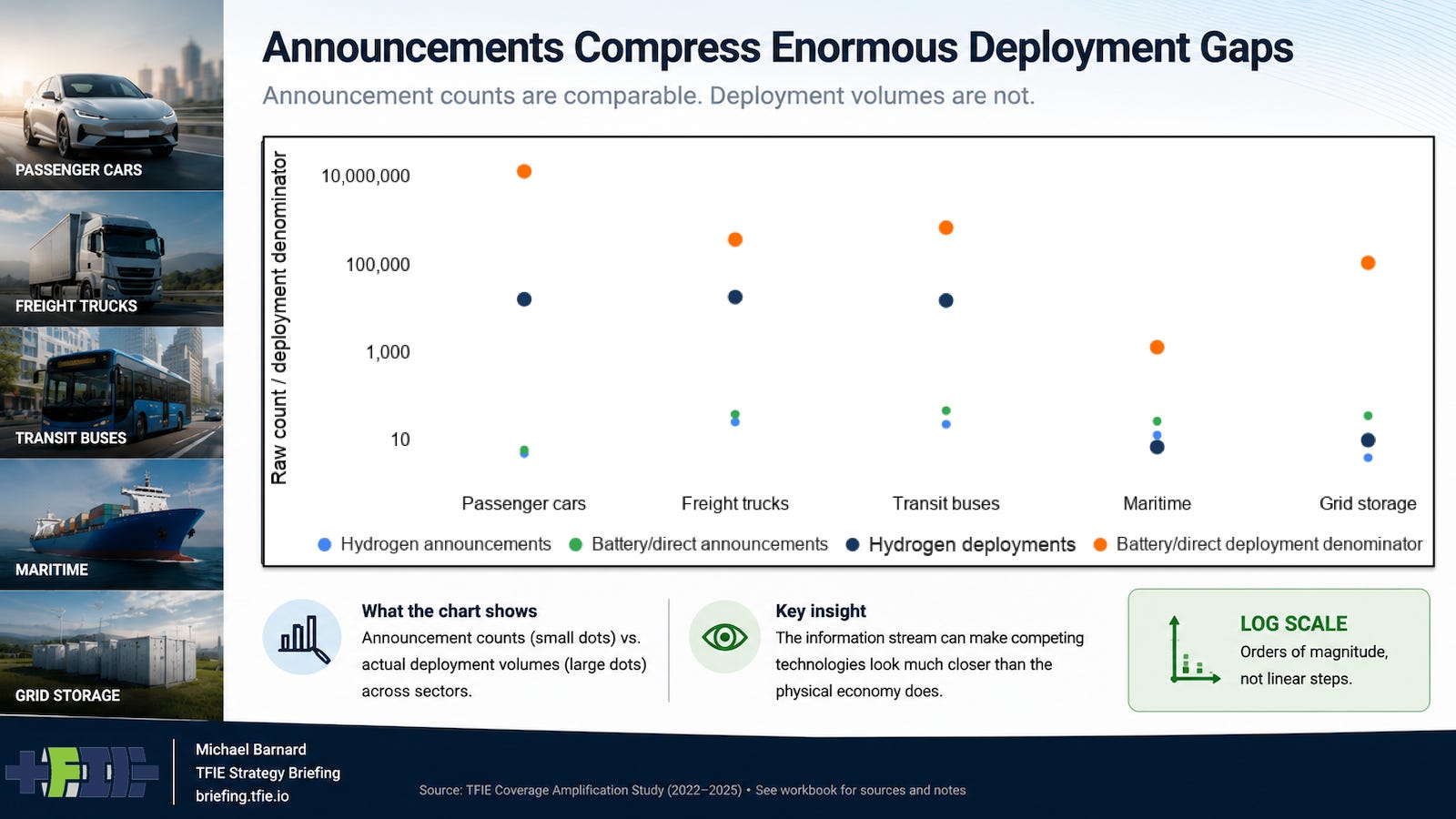
Passenger cars are more extreme still. The separate passenger-car extension contains five hydrogen milestone roots and six battery roots, which would make the technologies appear almost evenly represented if the announcements were all a reader saw. Against those announcements are approximately 16,000 fuel-cell passenger vehicles in the 2025 sales denominator and about 13 million battery-electric cars. The physical-flow difference exceeds 800 to one.
Grid storage provides the clearest demonstration of the effect. A strict review of hydrogen’s stationary-power announcements leaves only four cases from 2022 through 2025 in which hydrogen genuinely functions as an electricity-storage vector or integrated storage medium: H2Évora, HYFLEXPOWER, Denham and EMEC. There are 36 battery-storage announcement roots, so batteries already lead hydrogen nine to one in the information stream. The corresponding physical scale is approximately 10 MW for the hydrogen demonstration denominator against 108,000 MW of battery-storage additions in 2025, a difference of about 10,800 to one. Those figures compare power rather than energy capacity, duration or equivalent storage service, so they are a measure of physical market scale rather than storage performance.
The graph is the central finding of the research. Hydrogen and battery announcement counts occupy roughly the same part of the logarithmic scale, while their deployment numbers progressively separate by one, two, three and finally four orders of magnitude. Corporate communications, government PR, industry amplification and journalism are taking markets with radically different physical scale and turning them into streams of discrete announcements that are much closer in frequency. The result is an information environment in which hydrogen appears far more prevalent than its installed base, sales, operating fleets and deployed capacity justify.
This does not require journalists to fabricate hydrogen successes or communications departments to publish false statements. Most of the events are real. A hydrogen bus enters service, a truck completes a demonstration, a train sets a distance record, a storage project begins operating or a government awards funding. Each becomes a legitimate news event, but a news event has no natural mechanism for carrying the scale of the market behind it. One hydrogen demonstrator and another hundred thousand battery vehicles can each produce a press release, a trade article, a government announcement and social-media posts. Once converted into stories, radically unequal quantities of physical activity become much more nearly equal units of information.
The maturity of the underlying events compounds the effect. Across the normalized four-year sample of 140 eligible events in six common sectors, battery events averaged 5.97 on the seven-stage commercial-development ladder compared with 4.40 for hydrogen. About 82% of battery events were at scaled deployment or repeat procurement, compared with about 40% of hydrogen events. Hydrogen announcements also carried more future/readiness framing, averaging 1.35 on the zero-to-two measure compared with 0.88 for batteries. The media and PR system is therefore giving substantial visibility to a hydrogen event population that is both much smaller in physical scale and materially earlier in commercial development.
The research did not support every mechanism I initially expected to find. Novelty language occurs on both sides, with battery companies and customers readily describing first plants, largest orders, records and technical milestones. A normalized one-root-per-event comparison also found only a small difference in explicit utilization evidence, and source-lineage work did not show that hydrogen publicity is uniquely dependent on copied press releases. Those findings matter because the distortion does not depend on a special conspiracy of hydrogen-friendly journalism or a uniquely aggressive hydrogen PR machine. It emerges from the ordinary operation of an information system that treats discrete events as news while largely discarding the denominator behind them.
The stronger conclusion is therefore about the proportions produced by the system. Battery technologies generated more announcements in the period studied and vastly more commercial deployment, but the announcement advantage is tiny compared with the deployment advantage. Hydrogen receives announcement-scale visibility while batteries and direct electrification receive deployment-scale capital, hardware and useful work. That difference is large enough to make technologies separated by orders of magnitude in the physical economy appear to remain serious peers in the public information stream.
Below the paywall, the analysis turns from the scale mismatch to the mechanism behind it: how firsts, pilots, partnerships, repetition and institutional amplification can make a small market feel much larger and more mature than it is. I trace that effect through the announcement corpus, commercial-stage data and source genealogy, then show the three checks that separate genuine market formation from a dense stream of activity: restore the physical denominator, collapse correlated publicity back to the underlying event, and follow what actually happened next.
