
UK firm CPH2’s destroyed 1 MW hydrogen electrolyzer is useful because it failed in a way that clarifies a recurring hydrogen startup problem. Test failures happen. New industrial equipment breaks, trips, leaks, overheats, refuses to start, refuses to stop and occasionally teaches engineers something expensive. The interesting question is not whether a novel hydrogen system can have a bad test. The interesting question is why this particular company, with this particular architecture and public-market story, was still presenting itself as if the hardest system questions had already been answered.
This was not a trivial failure by a two-year lab startup. CPH2 traces its origins to Ireland in 2012, established the UK operating company in 2016, raised £2.5 million from angel investors in 2019, raised another £3 million from private investors in 2020, listed on AIM in 2022 after a £30.5 million gross raise, and then raised £13.7 million gross in 2025. Add the £338,000 Innovate UK grant and the undisclosed 2017 external round, and this was roughly a £50 million disclosed-funding story before the 2026 rescue raise. It also had a public-company board, nominated adviser, broker, company secretary, legal counsel and communications adviser around it. That makes the failure harder, not easier, to excuse. After roughly a decade of UK development, a public listing, repeated capital raises and a governance structure that should have been asking hard stage-gate questions, why was a 1 MW mixed hydrogen-oxygen system still able to fail destructively during an automated shutdown sequence, and why was CPH2 still presenting the architecture as proven before that question had been answered?
The location of the failure is what makes the case so clean. CPH2’s advertised breakthrough is a membrane-free electrolyzer, but its own process description says mixed hydrogen and oxygen gas is generated in the stack, moves through the balance of plant to dryers, and then enters cryogenic separation. After the incident, CPH2 said the MFE220 could not be repaired to continue testing and required substantial redesign of the mixed gas system to operate safely in all conditions. That is the real business. Not just the stack. Not just the patent. Not just the attractive avoidance of membranes, platinum group metals and PFAS. The business is the full industrial system that safely creates, dries, cools, separates, depressurizes, controls, services and warranties hydrogen and oxygen streams.
CPH2’s 1 MW MFE220 unit was in the final stages of factory acceptance testing at its Rossington test site when an unexpected error caused it to enter a standard shutdown procedure. During that shutdown, according to the company, an incident caused significant damage to the equipment. A week later, CPH2 said the unit could not be repaired to continue testing and that its Chief Technical Officer and Chief Operations Director had advised the board that the MFE220 required substantial redesign of the mixed gas system to operate safely in all conditions. The board also concluded that the company did not have the financial, engineering or technical resources to undertake that programme at the time.
The company later said its initial internal assessment was that a hydrogen and oxygen mixture ignited during automated depressurization, causing loss of containment. That is not a generic “hydrogen is hard” anecdote. It is the central risk surface of this specific architecture showing up during a standard system state: shutdown. The later fundraising disclosure added potential contributors including moisture through the cryogenic separation unit, possible particles and a valve velocity apparently exceeding EIGA standards. Those are ordinary industrial details, which is precisely why they matter.
A lot of hydrogen startups have versions of this problem. The promoted object is a fuel cell, electrolyzer stack, tank, aircraft powertrain, truck, modular refuelling concept or production pathway. Then the real product boundary expands. The company is also responsible for water quality, power electronics, drying, cooling, compression, storage, oxygen compatibility, valves, sensors, purges, controls, hazardous-area design, field service, warranty reserves, insurance, permitting, customer training and capital structure. None of those are peripheral when the system has to operate safely and repeatedly.
This is why “uses known components” is not the reassurance people often think it is. Known components in hydrogen and oxygen service are not automatically low-risk components. Oxygen purity changes materials and cleanliness requirements. Hydrogen adds demanding leak detection, ventilation, ignition control, purge logic and maintenance requirements. Compressors, dryers, valves, chillers, seals, sensors and controls become the practical safety case. The novelty may sit in the stack, but the customer does not buy a stack. The customer buys uptime, compliance, serviceability, insurability and someone else’s balance sheet behind the warranty.
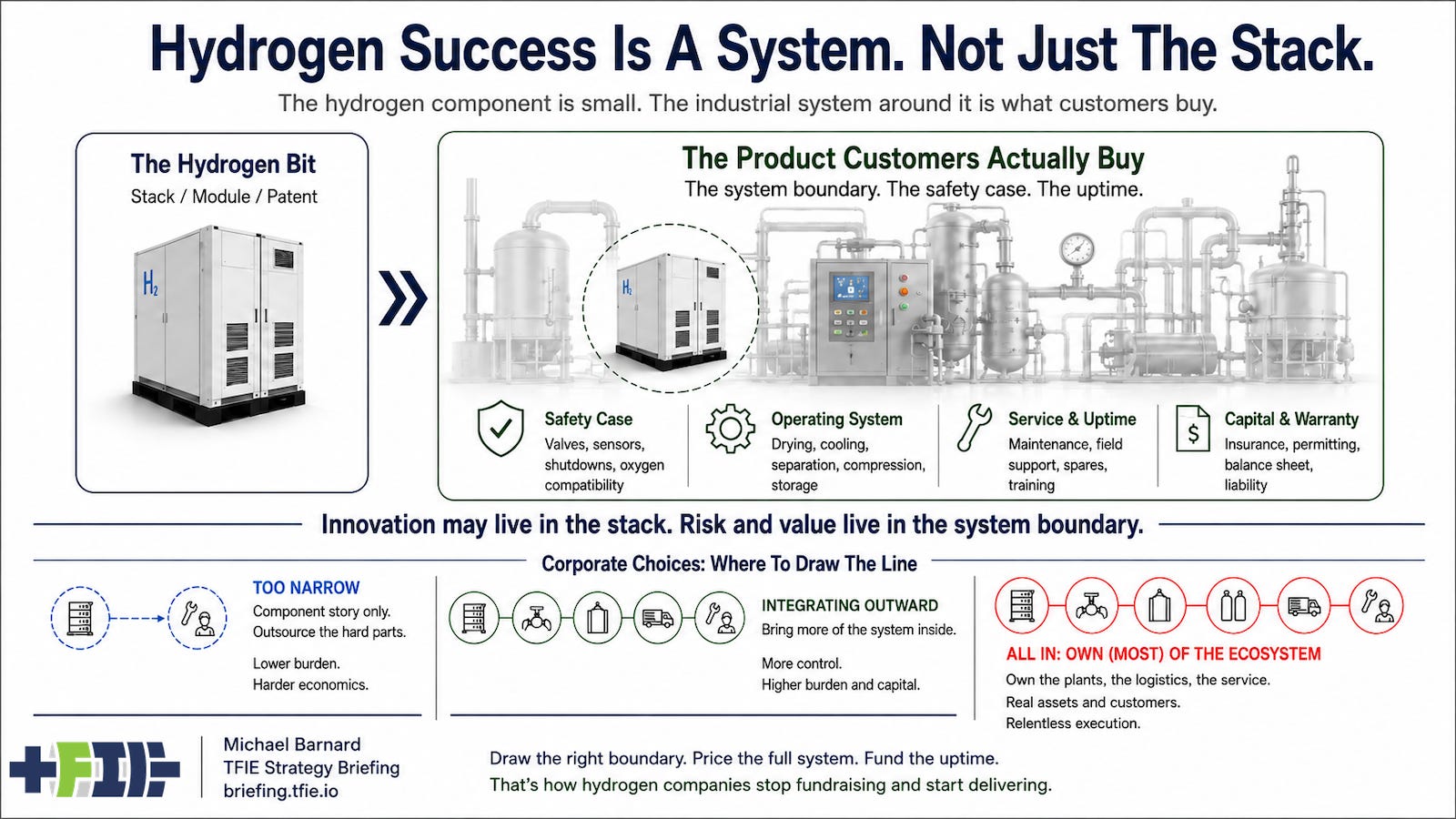
That is the strategic failure CPH2 exposes. It appears to have tried to be inventor, stack developer, mixed-gas process integrator, manufacturer, deployer, licensor and public-market growth story on a small-company capital base. The board did not need to know more electrochemistry than the CTO. It needed to know what business the company was actually in. A membrane-free electrolyzer company that deliberately creates a mixed hydrogen and oxygen stream before separation is not merely an electrolyzer company. It is a hazardous process equipment company.
That distinction should have driven the strategy. If the core capability was the stack and process IP, then cryogenic separation, oxygen-service engineering, process safety, manufacturing quality, installation and field support should have been placed under industrial partners with accountable design authority much earlier and much more deeply. If CPH2 wanted to own the full system, then it needed the capital, staff, safety maturity and validation discipline of a real industrial OEM. What it could not safely be was a lightly capitalized listed growth story with a complex hazardous process wrapped around a claimed simple breakthrough.
The broader hydrogen reference class has two connected patterns: product-boundary denial and capital-market survival. I have covered the second pattern separately as the hydrogen recapitalization cycle: decades of hydrogen-for-energy firms surviving through enthusiasm waves, share issuance, retrenchment and renewed narratives rather than durable operating profits. That matters here because CPH2 is not an outlier in kind. It is an unusually clean example of what happens when the industrial-system burden catches up before the next financing story can carry it.
Plug Power shows what happens when a hydrogen firm tries to own much more of the ecosystem itself. It has more operating substance than many hydrogen companies, including production plants, delivery, customer-site equipment, service, fuel logistics and large customer relationships. That also means more of the hard parts sit on its own balance sheet. By late 2025, I had described Plug as being in a hydrogen maintenance and cash-burn squeeze, suspending DOE-backed green hydrogen projects, looking for liquidity through electricity-right monetization and restricted-cash release, and cutting maintenance costs. For a company running hydrogen production plants, maintenance is not a back-office saving. Compressors, cryogenic systems, valves, seals and leak detection are part of the safety case. When the financial strategy starts leaning on those budgets, the system boundary has reached the workforce.
Ballard shows the narrower-boundary version. For most of its life, it managed to keep the hardest parts of hydrogen commercialization as other people’s problem. It sold stacks, modules and promises into buses, trucks, marine trials, rail trials and stationary applications, while customers, integrators, governments and project developers carried much of the vehicle, fuel, infrastructure, utilization and service burden. That helped Ballard survive for decades through losses, re-raises and dilution because the company could stay close enough to the attractive hydrogen component story without owning the full industrial system.
The recently announced GeoPura acquisition changes the category. Ballard described the deal as a move toward an integrated hydrogen ecosystem provider, expanding from fuel-cell supply into hydrogen production, distribution, logistics, refuelling and stationary power generation. That sounds more complete, but it also means more of the hard parts move onto Ballard’s side of the ledger. GeoPura brings hydrogen power units, electrolyzers, tube trailers, manifolded cylinder packs, employees, customers, field assets and operating obligations. It is not just a module buyer. It is the operating interface between hydrogen equipment and users who need power.
That makes Ballard useful here because it shows both sides of the product-boundary problem. The old Ballard model kept the boundary narrow enough to keep raising capital around the component story, even while continuing to lose money every year since its IPO decades ago. The GeoPura deal pulls more of the system inside the company, but it does so through the familiar hydrogen finance pattern: partial cash, a large block of newly issued shares and sellers exposed to Ballard paper, and dilution of equity for existing investors. It may give Ballard a more defensible application than many hydrogen mobility stories. It also makes the operating burden harder to keep off the balance sheet.
The vehicle and aircraft examples make the same product-boundary problem visible in a different form. Nikola put hydrogen trucks on the road and dispensed hydrogen, but still filed for Chapter 11 in 2025. Hyzon shareholders later approved the liquidation and dissolution of the company. Universal Hydrogen flew a demonstrator and then shut down after failing to raise more financing. ZeroAvia is still alive, but its plan has narrowed toward fuel-cell systems while broader powertrain ambitions have slowed. These companies are not the same, but the pattern is familiar: the pitch starts with a hydrogen component, truck or aircraft and ends up needing an industrial system, fuel supply chain, maintenance model, customer operating change and financing structure.
There are partial counterexamples, but they mostly prove the rule. More credible hydrogen industrialization comes from companies that either narrow the product boundary or bring industrial-system depth to it. ITM Power’s FY2025 results are not a story of easy hydrogen scale-up. They discuss product simplification, cost and capital discipline, manufacturing debottlenecking, factory acceptance test pass-rate improvement, full-scope containerized plants and a still-negative adjusted EBITDA. That is what seriousness looks like in this sector: less confidence around the molecule and more discipline around the plant.
The lesson is not that every hydrogen technology company is doomed, or that every hydrogen use case is nonsense. Hydrogen remains a large industrial molecule with real decarbonization work to do in places where it is already used. The lesson is that hydrogen startup claims should be tested at the system boundary, not at the promotional boundary.
When a company says it has solved the hydrogen bit, the diligence questions are straightforward. Who owns everything around it? Who validated abnormal operation, not just steady-state operation? Who is responsible for the dryer, valve, compressor, chiller, separator, sensor and control sequence? Who warranties the field unit? Who services it at 2 a.m.? Who pays when the routine component fails? Who has enough balance sheet to survive the answer?
CPH2 has not proven that hydrogen innovation is impossible. It has shown, rather usefully, that the hydrogen bit is not the product. The product is the whole industrial system around it, and that is where strategy, capital and safety either show up or fail.
Use TFIE Strategy Briefing as the diligence layer before the next hydrogen story turns a component claim into a system-risk bet. Paid posts provide the professional layer behind the public argument: denominator checks, evidence notes, pathway verdicts, update triggers and decision-grade context for people working around the transition.
I'm not a chemist, but did take chemistry courses in the past. Even I know that 2H2+O2 tends to go to 2H2O+energy. All it needs is a nudge (and may not even need that). If I were looking at CPH2's design, one of my first questions (which I would have a chemical engineer look at to confirm the answer is correct) is how do they prevent that from happening in their mixed output. Not "minimize the risk", but prevent, make not possible.