

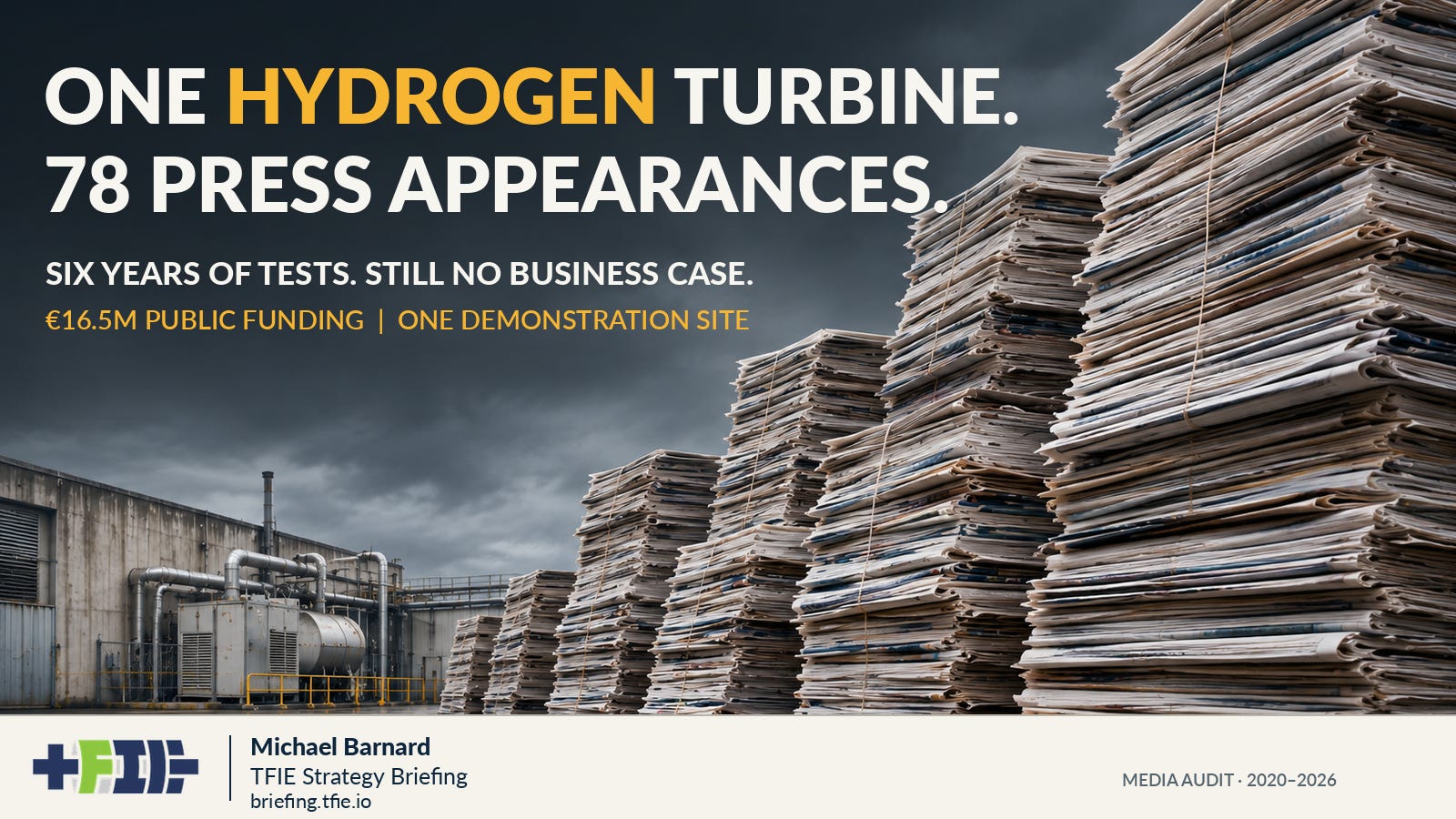
Hydrogen burns. Hot gases turn turbines. Exhaust heat produces steam. None of this is news, yet Siemens Energy has spent six years testing variations on these established facts at a French paper mill, supported by approximately €16.5 million in European and British public funding. The latest redundant demonstration has already generated another round of hydrogen trade-press coverage, adding to at least 78 identifiable press appearances over the project’s history. One turbine, two publicly funded research programmes, dozens of articles, and still no credible explanation of why anyone should manufacture hydrogen from electricity to produce electricity and steam that could be supplied directly.
This is an unusually clear example of the mechanism I documented in Hydrogen Has Narrative Density. Electrification Has Deployment Density. That research examined positive milestone announcements across six sectors from 2022 through 2025. Battery technologies generated 206 milestones against hydrogen’s 114, a difference of less than two to one, while physical deployment gaps commonly ran to tens, hundreds or thousands of times in favour of batteries. HYFLEXPOWER was already one of only four qualifying hydrogen electricity-storage demonstrations in the stationary-power portion of that dataset. HyCoFlex is not another commercial installation. It is another cycle of announcements about the same equipment, with additional public funding and another wave of coverage. The information stream suggests expanding technological progress. The physical economy still contains one demonstration site.
The project involves a Siemens Energy SGT-400 turbine at Smurfit Westrock’s Saillat-sur-Vienne paper mill. In its November 16, 2026 announcement, Siemens reports that the turbine operated on pure hydrogen across a range of conditions, including startup, full load and simultaneous electricity and steam production. The company presents fuel compatibility as progress toward industrial decarbonization. But an ability to burn hydrogen does not establish a reason to burn it, especially when the hydrogen itself must first be manufactured using electricity.
The project’s own numbers expose the gulf between a combustion test and a commercially useful energy system. Siemens Energy documented that the onsite electrolyzer produces approximately 16.4 kg of hydrogen per hour. The turbine consumes approximately 810 kg per hour when producing 10 MW of electricity on hydrogen. The onsite production system supplies 2% of the fuel required at that output. Sustained operation using onsite hydrogen production would require nearly 50 times the installed electrolyzer capacity. These figures appeared in a March 2024 technical article by Benjamin Witzel, Siemens Energy’s Head of Fuel Flexibility, Hydrogen and Carbon Capture.
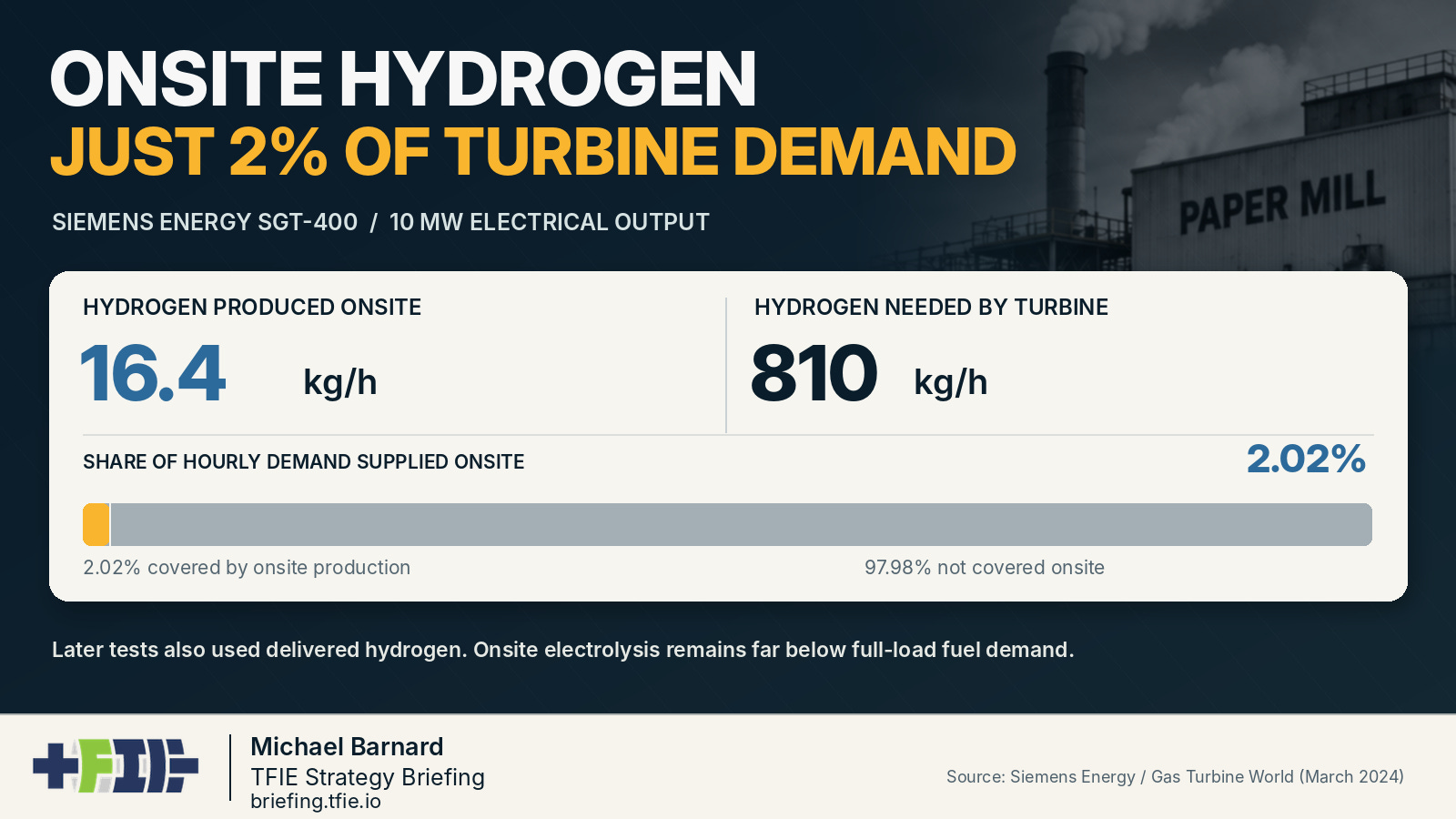
That publication documented approximately 90 hours of hydrogen-natural gas blending tests during the 2023 campaign, including just over four hours on pure hydrogen. Siemens identified hydrogen availability as the constraint. HyCoFlex subsequently added infrastructure for externally delivered hydrogen and conducted further tests. The 2026 announcement provides no cumulative full-load hydrogen operating hours, sustained fuel-supply arrangement or commercial operating costs. The small onsite electrolyzer was built for demonstration, but six years of work have not established the much larger, affordable hydrogen supply needed for routine industrial operation. The publicity emphasizes the percentage of hydrogen in the fuel rather than whether that fuel can be supplied economically. One hundred percent hydrogen is a fuel composition, not an industrial energy supply.
The underlying technology was not new when the first European grant was awarded. In April 2018, Kawasaki Heavy Industries and Obayashi demonstrated a gas turbine running on 100% hydrogen while delivering electricity and useful heat to four facilities at Kobe Port Island. In 2020, Kawasaki demonstrated pure-hydrogen operation using dry low-NOx combustion technology. Those turbines were smaller and used different combustion systems, but hydrogen combustion, cogeneration and low-NOx turbine operation were already established. Siemens has tested its own equipment against additional operating requirements. It has not identified a new energy conversion pathway, changed the fuel economics or removed the supply constraints. Each new operating condition becomes another announcement, while the fundamental energy proposition remains uncompetitive.
What have European and British taxpayers received for €16.5 million? Why has a French paper mill spent six years hosting demonstrations of an inefficient energy pathway when direct-electric alternatives already exist? Why did Siemens’ own economics require electricity below €35/MWh, and how did one installation produce so much enthusiastic press coverage without the basic questions about fuel supply, costs and commercial relevance being answered? The funding records, energy balance and media audit expose the failure.
