

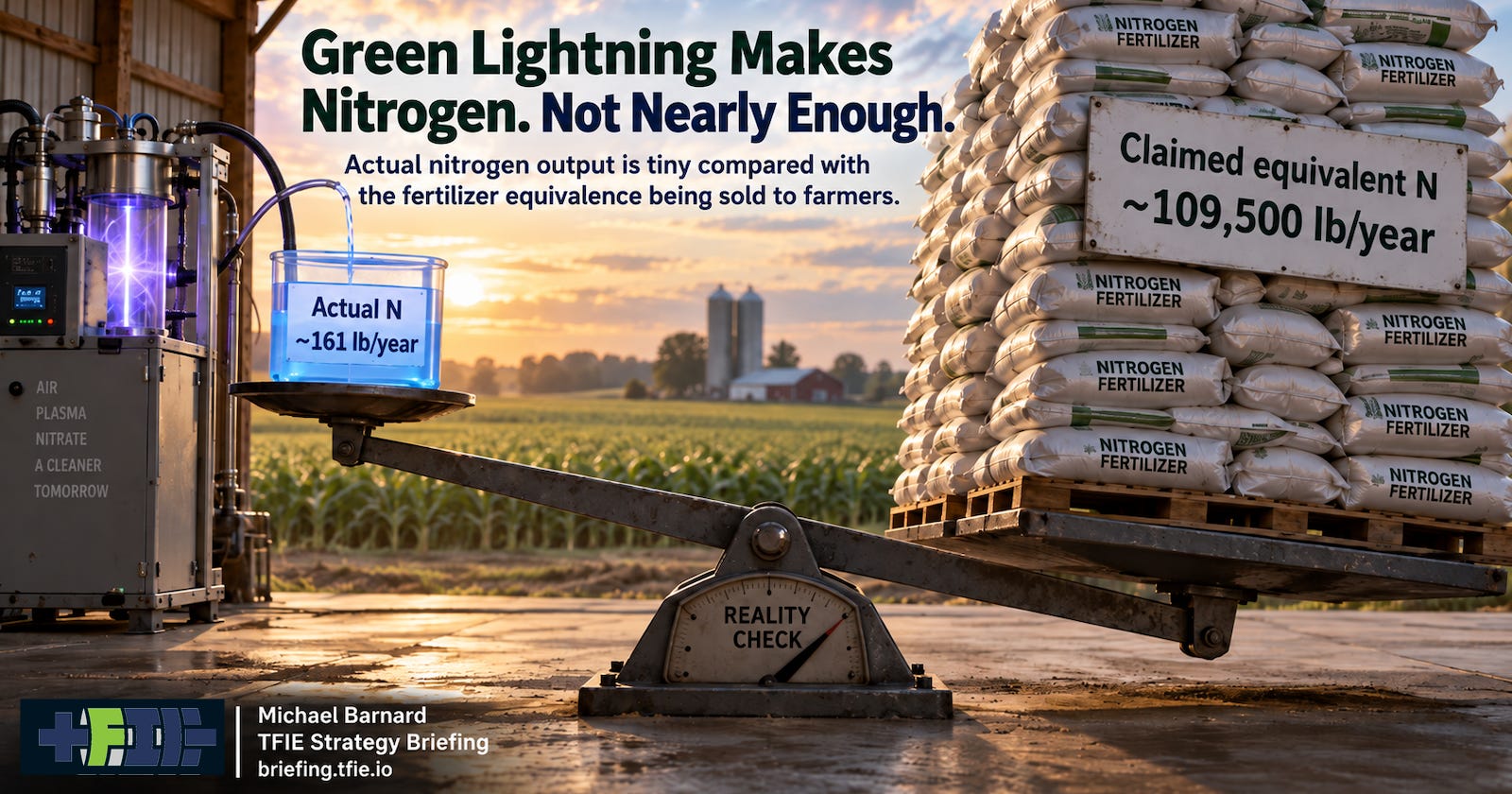
Green Lightning really does make nitrogen fertilizer from air and electricity. But nitrogen atoms do not multiply. At the concentration reported by Washington State University Extension, a 100-gallon-per-day Green Lightning machine puts about 161 pounds of newly fixed nitrogen into its water over a year. That is the physical quantity that matters: nitrogen that was in the atmosphere and has actually been converted into a form plants can use.
That is what made the claim particularly striking when it surfaced after I published Farm Electrification Should Follow The Work. On-farm nitrogen production would fit the electrification thesis beautifully if the numbers worked: air and water are available everywhere, electricity increasingly is as well, and avoiding industrial ammonia production and fertilizer transport would have obvious attractions. The problem is not whether electricity can fix nitrogen. The problem is whether Green Lightning makes remotely enough of it to support what farmers are being told it can replace.
The marketing claim needs to be kept separate from the measured nitrogen. Green Lightning and Canadian distributor Nytro have described each gallon as the equivalent of about three pounds of conventional nitrogen, and Nytro president Chris Nykolaishen was still using three pounds of nitrogen equivalence per gallon in February 2026. At 100 gallons per day, that becomes 109,500 pounds of claimed conventional-nitrogen replacement per year.
Those two numbers sound as though they are different ways of measuring the same thing, but they are not. About 161 pounds is a mass of actual nitrogen atoms. About 109,500 pounds is an assertion about agronomic performance. At the WSU-reported concentration, the claimed fertilizer equivalence is roughly 680 times the quantity of nitrogen actually produced. Calling that larger number “equivalent nitrogen” does not create the missing nitrogen any more than making a truck more fuel-efficient creates diesel.
This distinction matters because crops physically incorporate nitrogen into biomass. Nitrogen is a constituent of amino acids, proteins, nucleic acids and chlorophyll, and better fertilizer timing, placement or uptake can reduce losses but cannot make more nitrogen atoms enter a crop than are available from all of its nitrogen sources. If a few thousandths of a pound of newly fixed nitrogen accompanies a crop response normally associated with several pounds of fertilizer nitrogen, the additional nitrogen has to have come from somewhere else.
There is a straightforward alternative explanation for apparently successful reduced-fertilizer trials. Agricultural soils can supply substantial nitrogen through mineralization of soil organic matter, while residual fertilizer, manure, previous crop management and other sources can contribute more. A field can therefore maintain yield after a large fertilizer reduction without the replacement treatment having supplied the missing nitrogen. That is why fertilizer-substitution trials need controls, soil nitrogen accounting and repeated seasons rather than simply observing that a treated crop grew well.
The plasma chemistry itself does not rescue the equivalence claim. Green Lightning’s patent describes a gliding-arc plasma reactor that oxidizes atmospheric nitrogen, using a pathway descended from the Birkeland-Eyde process industrialized more than a century ago. Plasma nitrogen fixation is real chemistry, but historically its disadvantage has been energy consumption, not whether it can make nitrate at all.
North Dakota State University’s assessment puts modern Haber-Bosch production at roughly 800–1,100 kJ/mol and the old Birkeland-Eyde process at roughly 2,500–3,000 kJ/mol, while saying current non-thermal plasma approaches remain roughly five to ten times less energy-efficient than Haber-Bosch. Researchers are actively trying to improve those numbers, but there is no overlooked physical pathway that turns a small amount of electrical energy into enormous quantities of fixed nitrogen.
Green Lightning’s earlier marketing illustrates how easily actual nitrogen and claimed equivalence can become conflated. NDSU preserved an older Green Lightning graphic advertising “110K lbs of N/yr” alongside an 1,100-watt electrical requirement. The current six-head machine is rated at 100 gallons per day, and 100 gallons multiplied by three pounds of claimed nitrogen equivalence and 365 days gives 109,500 pounds per year, almost exactly the old 110,000-pound figure.
That strongly suggests the older number was an annualized fertilizer-equivalence figure, despite being labelled simply as nitrogen. NDSU showed why reading it as actual fixed nitrogen makes no physical sense: producing roughly 100,000 pounds of nitrogen annually from a continuous 1.1 kW input would require about 19.47 kJ/mol, compared with NDSU’s stated theoretical minimum of roughly 200 kJ/mol for making nitrogen oxides. The literal interpretation would therefore beat the theoretical energy minimum by roughly an order of magnitude.
The useful number remains the amount of nitrogen actually in the water. WSU reported approximately 530 ppm nitrate-N, or 0.00442 pounds of nitrogen per gallon. A machine making 100 gallons per day at that concentration would produce about 0.442 pounds of nitrogen per day, approximately 161 pounds per year. Those 36,500 annual gallons are simultaneously being credited, at three pounds of conventional-N equivalence per gallon, with replacing 109,500 pounds of conventional nitrogen.
Nytro says newer systems make more nitrate. Its 2026 Ag in Motion submission says recent optimizations have doubled, tripled and even quadrupled nitrate concentrations, while its own operating guidance says nitrate concentration varies and the product has no guaranteed analysis. The public material does not establish that WSU’s 530 ppm value is the exact baseline for those claimed improvements, so a direct current comparison would be inappropriate.
A generous sensitivity test still shows the scale of the problem. Quadrupling the WSU-reported concentration to 2,120 ppm would increase actual nitrogen production to roughly 645 pounds per year from a 100-gallon-per-day machine. That is an appreciable improvement over 161 pounds, but it remains about 170 times smaller than the 109,500 pounds of claimed annual conventional-N replacement. Better equipment narrows the gap without coming close to eliminating it.
The crucial empirical question is therefore simple: do controlled field trials show that this very small amount of newly fixed nitrogen reliably substitutes for the much larger quantity of conventional nitrogen claimed? The independent results available so far do not demonstrate that multiplier.
In a 2025 Carrington Research Extension Center corn trial summarized by NDSU, Green Lightning treatments under conventional tillage fell into an intermediate statistical group and were not distinguishable from either the conventional urea-ammonium nitrate (UAN) treatment or the untreated check. That portion of the trial therefore demonstrated neither equivalence nor failure. It showed exactly why a crop growing after treatment is not enough evidence to determine where its nitrogen came from.
The strip-till portion produced a clearer result. Conventional UAN yielded about 211 bushels per acre and occupied a separate statistical group, while Green Lightning treatments yielded roughly 195 to 200 bushels per acre and were statistically grouped with the approximately 189-bushel untreated check. One site-year cannot settle the technology, but this trial did not show Green Lightning delivering the agronomic equivalent of the conventional nitrogen treatment.
Precision Planting tested complete fertilizer replacement even more directly in 2024. Its 100% Green Lightning treatment applied 120 gallons per acre across six applications and produced 235.9 bushels per acre, compared with 280.7 bushels under the conventional UAN program. The 44.8-bushel loss exceeded the 30.7-bushel loss the researchers calculated the cheap Green Lightning treatment could tolerate while still breaking even financially.
Precision Planting noted that hard water and difficulty producing a consistent Green Lightning product may have contributed, and proposed reverse-osmosis-treated water for later testing. That is a legitimate qualification on one trial rather than evidence that every future system must perform the same way. But reliable fertilizer production is also part of the proposition farmers are buying, and Nytro’s current instructions now specify reverse-osmosis-quality water for optimized operation.
A 2025 pasture experiment associated with the University of Missouri and Ohio State offers another useful check. The North Central Soil Fertility Conference proceedings report that nitrogen was below detectable levels in the Green Lightning material used during the first application and note technical problems with the machine that may have limited nitrate production. In April, Green Lightning plots produced 20.6% less forage than the untreated control, a marginal statistical result, and 32% to 39.4% less than the conventional nitrogen treatments. The equipment problems limit what can be concluded about future machines, but the experiment did not demonstrate the claimed fertilizer-replacement effect.
Nytro cites more favourable results, and those should be considered rather than ignored. Its 2026 Ag in Motion submission says more than a dozen small-plot trials conducted during 2025 found that replacing 50% to 75% of synthetic nitrogen could save $35 to $60 per acre without reducing yield. The public summary, however, does not provide the individual trial protocols, soil nitrogen measurements, nitrate concentration of the applied Green Lightning product, replication or statistical results required to distinguish nitrogen supplied by the machine from nitrogen already available in the field.
Formal testing is still underway. Olds College describes its Nytro evaluation as a three-year program beginning in 2025 and continuing through 2028, examining wheat, barley and canola yields, biomass, nutrient uptake and soil effects. RealAgriculture likewise reported in February 2026 that work involving Olds College and Lakeland College was still being used to establish application rates.
Commercial sales have moved faster than that validation process. In March 2025, Saskatchewan Hansard recorded an MLA quoting Nykolaishen saying Nytro was already selling machines and collecting data during what he called a “soft release.” By February 2026, Nykolaishen told RealAgriculture that approximately 150 six-head units were operating across about 65 farms, while larger containerized systems were starting to ship.
These are significant capital purchases rather than inexpensive experimental devices. Nytro currently lists its six-head machine at C$70,000 and its 30-head containerized system at C$349,000, including delivery, installation and onboarding. Farmers are therefore buying commercial equipment while the multi-year trials intended to establish how much conventional fertilizer it can reliably replace are still underway.
The correction is simpler than the technology. Green Lightning makes nitrogen, and that nitrogen can be measured. Nitrogen atoms do not multiply. At the WSU-reported concentration, a 100-gallon-per-day system produces about 161 pounds of newly fixed nitrogen annually; even a hypothetical fourfold improvement raises that to only about 645 pounds. If a field maintains yield after tens of thousands of pounds of conventional nitrogen are removed from the calculation, the rest of the crop’s nitrogen must come from soil or another source unless controlled experiments show otherwise.
So far, the independent field evidence has not demonstrated the enormous agronomic multiplier on which Green Lightning’s fertilizer-equivalence claim depends. The plasma chemistry is real, but the commercial proposition requires something much more consequential: convincing evidence that a comparatively small mass of newly fixed nitrogen can reliably substitute for vastly more conventional fertilizer nitrogen. Not all farm electrification is created equal.
Subscribe to TFIE Strategy Briefing for evidence-based assessments of technologies being sold as climate solutions.