

In my April assessment of Ireland’s fuel protests, I argued that farmers blockading fuel terminals were exposing something more important than temporarily high diesel prices. Irish agriculture had built a business model around fuel whose price it could not control, then treated excise reductions, rebates and emergency support as the natural response whenever that exposure became politically painful. The direction of the argument still looks right. The strategy was too narrow.
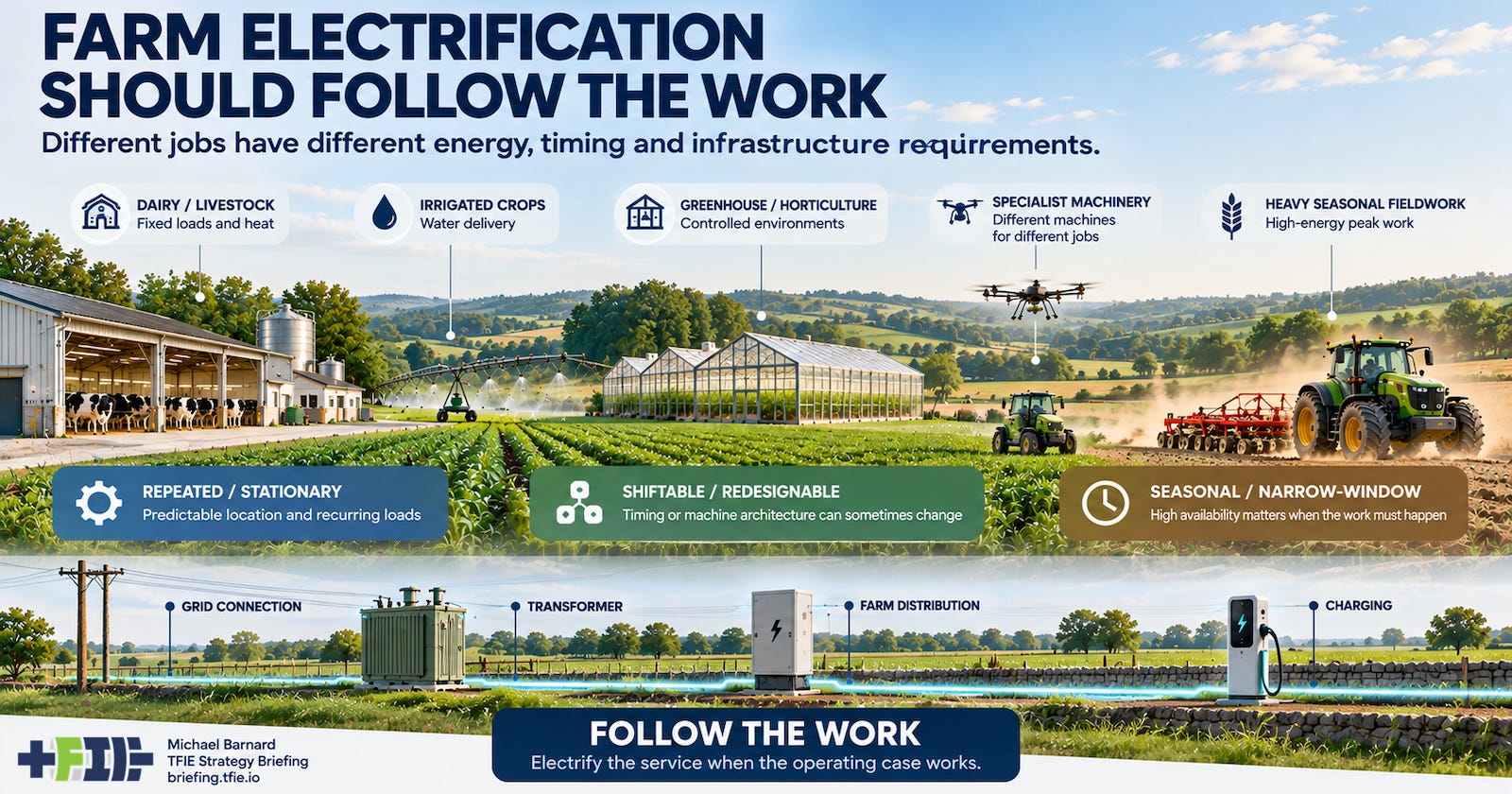
Ireland is a useful case because the fuel shock made dependency visible, but agriculture does not have an Irish electrification problem. It has a work problem. Dairy farms, irrigated cropping, greenhouses, grain farms, orchards, livestock operations and smallholders all use energy differently. Some loads are stationary and predictable. Some are seasonal but flexible. Others require hundreds of kilowatt-hours or even megawatt-hours in a narrow weather window when delaying the job means losing yield or crop quality. Treating all of those as one category called “farm energy,” then asking whether electric tractors are ready, obscures most of the decisions that actually have to be made.
The way the problem is framed determines what gets funded, what gets deferred and what gets measured. One approach waits for a battery tractor capable of replacing a large diesel machine in every application. Another puts solar panels on a barn and equates annual PV production with farm energy independence. Product announcements can be treated as evidence of operating viability, while equipment purchases supported by large subsidies can be reported as evidence of competitiveness. Each approach uses evidence from one part of the farm energy system to draw conclusions about the whole.
Richard Rumelt’s Good Strategy/Bad Strategy provides a useful discipline. His kernel of good strategy starts with a diagnosis of the critical challenge, chooses a guiding policy for dealing with it, then aligns coherent actions behind that policy. Applied to farm electrification, the framework forces choices about which constraints deserve attention, which investments should proceed and which should wait.
The diagnosis is that agricultural fossil dependence consists of jobs with different energy quantities, power requirements, timing constraints, infrastructure needs and utilization rates. A ventilation fan running every day, a milk chiller, a groundwater pump, a drone sprayer, a vineyard tractor and a 300-horsepower machine working intensively before a change in weather present very different energy problems even though all of them happen to operate on farms.
Heavy tractors receive disproportionate attention because they are highly visible, genuinely difficult to electrify in demanding applications and central to many farm operations. Their difficulty, however, says little about whether hot water should still come from fossil fuel, whether an irrigation pump should remain diesel-powered, whether refrigeration heat can be recovered, or whether spraying still requires moving several tonnes of tractor across every hectare. High-energy seasonal fieldwork deserves its own engineering and economic analysis without setting the timetable for unrelated farm loads.
Solar illustrates a different accounting problem. Teagasc’s 2025 solar guide for dairy farms models a 100-cow farm consuming 25,000 kWh per year with a 25 kWp solar system generating 23,484 kWh. Annual PV production therefore equals about 94% of annual electricity consumption, but only 30% of the PV generation is consumed on site without a battery. Adding a 12.5 kWh battery raises self-consumption to 45%, yet the modeled unsubsidized simple payback lengthens from eight years to ten.
Teagasc modeled electricity at €0.26/kWh during the day, €0.12 at night and €0.19 for exports, assumptions it identified as typical in May 2025. Under those conditions, moving water heating from cheap nighttime electricity into solar hours increased self-consumption while slightly worsening the investment return. Elsewhere the guide recommends increasing self-consumption where avoided imports are worth more than exported electricity. The result depends on tariffs, load shapes and export arrangements. Self-consumption, operating-cost reduction, fossil displacement and resilience are separate metrics and should be evaluated as such.
The same boundary matters for emissions. Farm electrification can reduce diesel, kerosene, LPG and other energy emissions without eliminating biological agricultural emissions. Ireland’s EPA greenhouse-gas inventory put agriculture at 37.9% of national greenhouse-gas emissions in 2024, dominated by methane from livestock and nitrous oxide associated with soils, fertilizer and manure. Electrification can therefore address a significant set of energy costs and emissions while leaving much of agriculture’s methane and nitrous oxide challenge untouched.
The guiding policy I would use is follow the work. Electrify an agricultural service when electricity can deliver it reliably and economically. Change the machine performing the work where a different architecture provides the service more effectively than a one-for-one replacement. Build electricity infrastructure ahead of foreseeable loads where connection and construction lead times justify doing so. Where the duty cycle, economics or service ecosystem remain inadequate, retain existing equipment until the replacement case improves.
That policy also provides reasons to decline investments. A battery needs a defined service rather than merely increasing self-consumption. An electric machine has to complete the required duty cycle. Scrapping a serviceable asset early has to be justified against continuing to use it. Infrastructure plans have to account for loads expected during the lives of transformers, connections and buildings rather than only equipment operating today.
That does not produce a simple sequence in which the easiest loads move first and everything difficult waits. Rural grid capacity, transformers and high-power charging can take years to add, so some infrastructure has to precede the machinery that will eventually use it. At the same time, higher self-consumption or a newer electric machine can still be a poor investment. The useful sequence emerges only after the work, the infrastructure and the ownership model are considered together.