

Greater Manchester is beginning to discover what happens when bus franchising enters its second round. In September 2026, Go-Ahead announced that Go North West had won two Bee Network operating contracts, with operations due to begin in March 2027. The contracts cover 38 routes and around 60 buses, including 18 routes to be served from a new depot in Leigh. Greater Manchester’s first franchised services began in September 2023, with the final tranche introduced in January 2025. Considerable attention has gone into the transition from commercially planned routes to a publicly specified metropolitan network. Now operating packages are being awarded again, with different companies potentially responsible for delivering the same passenger services.
The new depot at Leigh is an interesting part of the announcement. Changing the operating company involves vehicles, drivers, maintenance facilities, depot access, information systems and the ability to begin service on the appointed date. Greater Manchester has already invested considerable effort in acquiring and arranging access to depots as part of its franchising programme. That work matters beyond the initial transition. A transport authority can design the passenger network and award operating contracts, but those contracts still depend on physical assets and the arrangements that make them available to the successful bidder.
Electrification adds substantial capital investment to that relationship. Major bus operating contracts commonly last around five to seven years, while depot buildings, charging installations and electricity connections can serve the network for much longer. An electric bus may be reassigned to another route, depot or operator if its specification and operational requirements are compatible. Chargers are tied more closely to a site, while depot land, substations and grid connections are difficult to relocate. A change of operating company can happen on a date established in a contract. The infrastructure supporting the service follows a much slower development and investment cycle.
Imagine a city retendering a group of electric-bus routes after five years. The incumbent has invested in buses, chargers and a depot with a multi-megawatt electricity connection. A competitor offers to run the services for less money while meeting the required standards. It has experienced managers, qualified drivers and a credible operating plan. However, the best-positioned depot and its charging infrastructure remain controlled by the incumbent. The challenger now needs to negotiate access, establish another suitable operating base or make different arrangements for the vehicles and infrastructure. Any of those choices affects its costs and the credibility of its proposed start date. A cheaper bid is of limited value if the bidder cannot obtain the assets needed to deliver the service.
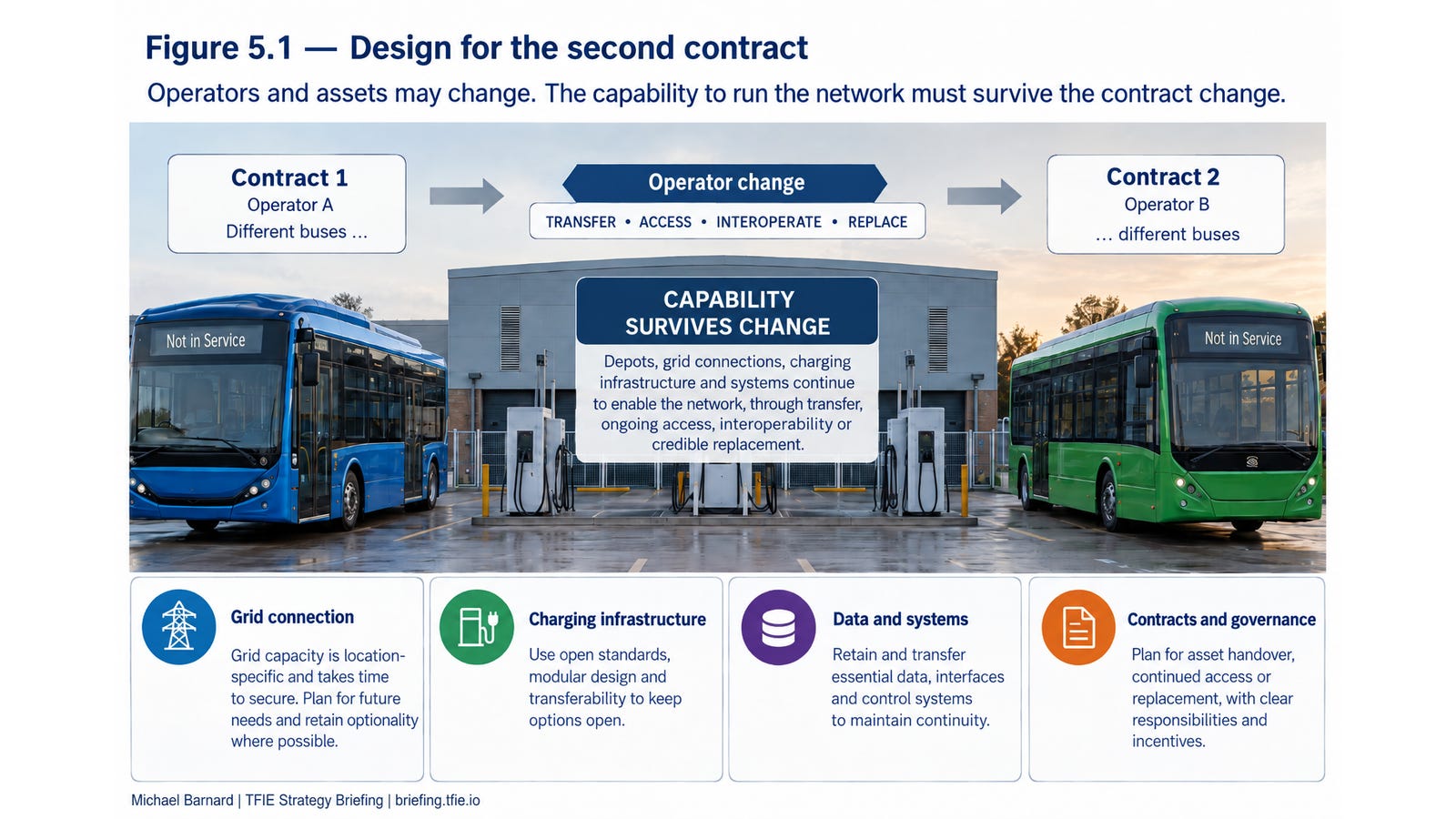
The complication extends beyond depot ownership. The buses might belong to the authority, the incumbent, a leasing company or a specialist fleet provider. Batteries have warranties, degradation risks and replacement obligations. Charging equipment must be compatible with the vehicles and capable of meeting their operating schedules. Electricity connections have technical and contractual conditions that may require the involvement of the local distribution network operator. Charging software, maintenance histories and vehicle operating data need to remain available across the transition. Drivers and other employees may also be covered by transfer protections such as TUPE. Conventional bus contracting already deals with many of these issues. Electric fleets add valuable infrastructure and electrical dependencies that may remain in use through several rounds of competition.
The investment’s remaining value deserves particular attention. Suppose a charging installation is designed for twenty years of service, but the company financing it holds a five-year operating contract. After five years, much of the installation’s useful life remains. If the operator loses the contract and cannot put the equipment to another use, the financing arrangements must establish what happens to that remaining value. An investor facing an unpredictable loss will demand compensation for the risk through higher prices or more restrictive financing terms. The transport authority, meanwhile, needs to retain the use of infrastructure that may already have benefited from public funding. A well-designed agreement can establish how assets are valued, transferred, leased or made available to the next operator, and what compensation is due when commercial arrangements change.
Those provisions influence the cost of both the first contract and every subsequent one. An incumbent with exclusive control of an essential depot may have an advantage that goes beyond its ability to operate buses efficiently. A challenger required to develop an alternative depot could face additional capital costs, grid-connection delays and empty running between the depot and the routes it serves. The authority might receive several bids that appear competitive on operating costs but are materially different once infrastructure access and transition costs are included. Equally, an incumbent that has invested responsibly should have contractual protection for the value it has created. Good procurement arrangements need to preserve legitimate investment incentives while keeping future operating contracts genuinely contestable.
South Yorkshire has taken a direct approach to securing the assets on which its future franchises will depend. In March 2026, the South Yorkshire Mayoral Combined Authority purchased five major bus depots from private operators, adding them to the publicly owned Leger Way depot in Doncaster. The acquired sites include Olive Grove, Ecclesfield and Holbrook in Sheffield, Rawmarsh in Rotherham and Wakefield Road in Barnsley. First Bus and Stagecoach agreed to lease the depots back while their existing services continue. The authority plans to use the estate to support its franchised network and its transition toward zero-emission buses, with the first franchised services scheduled to begin in September 2027.
The acquisition separates control of strategically important depots from the contracts to operate buses. South Yorkshire can provide future operators with access to established facilities without requiring every bidder to purchase or develop an equivalent site. The authority also retains responsibility for the long-term estate. In June 2026, six operators qualified for the next stage of bidding for the first two service packages, based at Olive Grove and Leger Way. That gives the authority a field of potential operators competing to deliver services using infrastructure it has chosen to secure in advance. The long-term financial performance of this ownership model will depend on acquisition costs, financing, maintenance, electrification expenditure and the value of the operating flexibility it provides.
The investment also illustrates how public ownership and private operating expertise can work together. South Yorkshire has arranged for First Bus to deliver electrical infrastructure work at Olive Grove and Leger Way as part of its wider depot programme. The authority can own the sites and determine how they support the future network while using an established operator’s experience in delivering charging infrastructure. Ownership, financing and operational management need not sit with the same organization. The valuable arrangement is one that gives each participant a clear responsibility and preserves the ability to operate the passenger network when contracts change.
Other cities can achieve continuity through different arrangements. London has operated a publicly specified, competitively tendered bus network for decades while much of its garage estate remains outside direct Transport for London ownership. Its 2025 electric-vehicle infrastructure strategy identified 76 bus garages with varying ownership, space and electrical capacity. Private garages can remain important to a franchised system when access arrangements and operating contracts allow services to continue through changes of operator. An authority might instead secure long leases, establish contractual access rights or use specialist infrastructure providers that supply charging services to successive operators. Each approach allocates capital requirements, operating responsibilities and investment risks differently.
For operators, clarity about those arrangements can make contracts more attractive. They should be responsible for performance they can manage, including staffing, dispatch, maintenance, vehicle availability and charging schedules. The authority’s decisions about future routes, service packages and depot requirements affect investments extending beyond any one operator’s contract. A specialist infrastructure company may be well positioned to finance chargers, maintain equipment or manage technology replacement. Electricity utilities control their networks and connection requirements. Investors need predictable treatment of asset life, termination, compensation and residual value. When risks are assigned to parties capable of managing them, the financing and operating propositions become easier to evaluate.
England’s January 2026 bus-franchising guidance addresses these issues directly. It asks authorities to consider how sufficient depots and charging infrastructure will be available, including transfer arrangements at the end of contracts, and how competition will be maintained in second and subsequent procurements. It also requires attention to capital expenditure, operating costs, market interest and the practical arrangements needed to introduce services. These are important commercial decisions that should be considered while the original contracts and infrastructure investments are being designed. Waiting until the first retender approaches leaves less room to negotiate or develop alternatives.
A useful exercise for any transport authority approaching electric-bus procurement is to imagine that the strongest qualified challenger wins the next contract. Can it obtain buses suitable for the required services? Does it have assured access to a depot with the charging and electrical capacity it needs? Can the relevant maintenance and operating information be transferred? What happens to the remaining value of equipment financed under the first contract, and who pays when the authority changes the network? What options are available if a strategic depot becomes unavailable? These questions identify which assets must remain accessible across operating contracts and which can be supplied competitively without threatening service continuity.
The answers will differ across cities and even across depots in the same city. Some locations have alternatives nearby, while others provide access to scarce land or electrical capacity that would be expensive to reproduce. Some fleets can be reassigned between depots with little operational penalty, while others have duties and charging requirements closely tied to a specific location. Authorities should compare the full costs of transfer, continued access and replacement before selecting the arrangement. Public ownership may be attractive for a strategic site; a private lease or infrastructure-service agreement may be preferable elsewhere. The objective is to preserve meaningful choice over who operates the network while retaining access to investments that must serve it for many years.
Greater Manchester’s replacement awards demonstrate that operator changes are becoming routine business in the new franchising system. South Yorkshire has chosen to secure major depots before its first franchised services begin. Both developments reinforce the importance of designing electric-bus infrastructure and operating contracts together. A city can procure excellent vehicles, install capable charging systems and select a competent first operator, yet make later competition unnecessarily expensive if access to essential infrastructure is settled only for the initial contract. The better measure of procurement quality is whether the network can continue to change operators, services and technologies without repeatedly rebuilding assets that remain useful.
The full TFIE Strategy report, The Bus Is Not the System: Metropolitan Transit Governance, examines how fleet ownership, depot access, charging infrastructure, residual value and operating contracts interact across British and Irish metropolitan systems. TFIE Strategy helps transport authorities, operators, utilities and investors assess long-term fleet strategies, depot requirements and procurement risks before major commitments are made. Contact Michael Barnard to discuss an assessment or request the report’s supporting Evidence Book.
Fourth in a five-part series. Next: What Is the Next Bus Decision You Cannot Undo?