

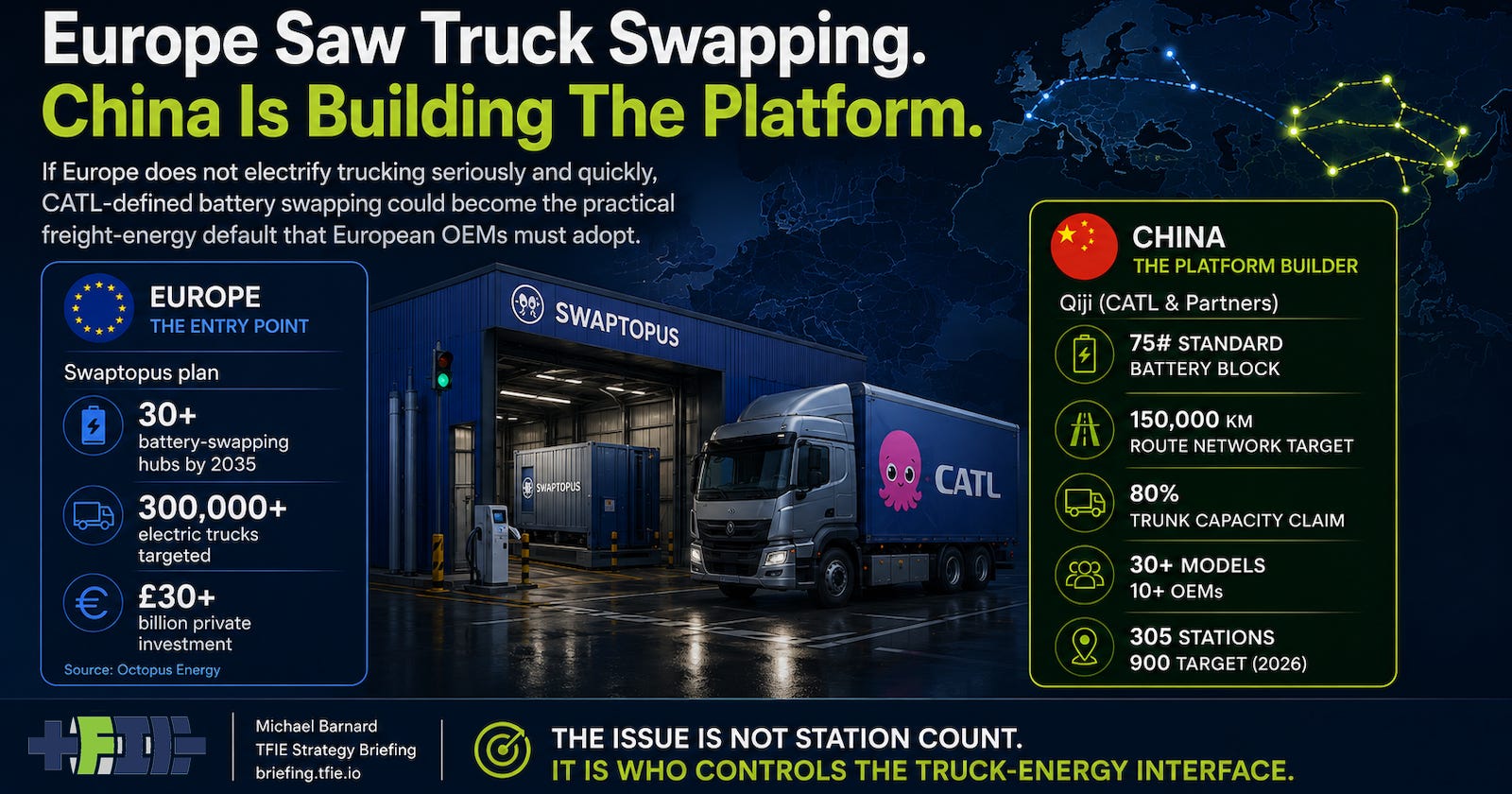
Octopus laid out the European plan directly. Swaptopus is intended to be an automated battery-swapping network across Europe for electric trucks. An electric lorry pulls into a hub, the depleted battery is replaced within minutes, and the truck gets back on the road instead of waiting through a charging session. Octopus says CATL already has more than 300 battery-swapping stations in China, and Greg Jackson’s most important point was about route structure: trucking companies often run defined routes, which means stations can be placed where those trucks need to swap.
The European warning is not sovereignty. It is speed. China’s official 2030 plan is already an operational floor: new-energy heavy trucks at 40% penetration, more than 1.6 million in stock, roughly 3,000 heavy-truck charge and swap stations, and 30,000 km of zero-carbon freight corridors. CATL and Sinopec are aiming above that floor, not waiting for it. CATL brings battery scale, Qiji’s 75# swap-block architecture and OEM alignment. Sinopec brings energy retail sites, operational reach and the logic of refuelling infrastructure. Swaptopus brings the same direction of travel into Europe.
If Europe’s response is cautious charging deployment, slow standards work and OEM hesitation, the market will move around it. Fleet operators do not need a perfect European consensus. They need trucks that can run routes, refill energy quickly, preserve uptime and make economic sense. If CATL and Swaptopus make that easier first, their interface becomes the market default. European OEMs then risk being forced to build around someone else’s battery geometry, state-of-health data, lease structure and route-energy system.
Europe has ambitious heavy-truck CO₂ rules and serious charging regulation. That is not the same thing as moving fast enough to electrify freight operations. Targets and access rules matter, but freight operators buy uptime, cost control and route confidence. China is assembling vehicles, batteries, routes, stations, data and finance into an implementation system. Europe is still at risk of treating trucking electrification as a charger-rollout problem.
That defined-route point matters. Repeated freight patterns are where electric-truck infrastructure becomes buildable: standard sites, standard energy increments, known dwell points and fewer one-off designs. In my 2025 report with Rish Ghitikar The New Logistics: Electrifying Freight with Microgrids, the core argument was that the hard problem is reliably getting clean electricity into trucks, with modular, incrementally scaled infrastructure as the answer. Qiji shifts that logic one layer deeper: the repeatable unit may be the battery block, station inventory and control layer, not only the charging site.
Swaptopus is therefore not just a European swapping announcement. It is the European entry point into a larger platform question: what happens when battery geometry, chassis interfaces, station mechanics, battery inventory, state-of-health data, leases, insurance, residual value, energy procurement and software dispatch are bundled into a freight-energy system?
The easiest European framing is to make this a swapping-versus-charging story. That misses the strategic layer. Europe already has charging rules, heavy-duty vehicle CO₂ rules, battery law and serious megawatt-charging actors. The Qiji signal is different because it asks who defines the truck-energy interface. If the answer comes from the firms that standardize the battery block, station mechanics, data layer, leasing model and commercial terms, European policy and OEM strategy will be reacting to market defaults, not shaping them.
CATL’s Qiji pathway sits above China’s official floor as a platform ceiling. CATL says the pathway uses a standardized 75# battery-swap block, which should be read as a heavy-truck swap-block format rather than a published kWh specification. CATL has not disclosed public dimensions, weight or energy capacity for the 75# block in the release. Octopus’s Swaptopus announcement refers to a 500 kWh truck battery swapped in minutes. That makes the operating scale clear enough for this review: this is heavy-truck battery inventory, not passenger-car pack swapping.
CATL targets 150,000 km of Qiji route coverage by 2030, aims at 80% of trunk transportation capacity, has more than 30 chassis-swap models across more than 10 OEMs, had 305 commercial or truck swap stations built by the end of 2025, and is targeting 900 stations in 2026. Those numbers matter because they describe a platform ambition, not because station count alone proves freight capacity.
Sinopec changes the reading. A battery company can define a pack. A battery company paired with a national fuel-station giant can define a refuelling architecture. That does not prove utilization or economics, but it materially improves the platform conditions: sites, grid interconnection experience, energy retailing, fleet relationships, operations discipline and state-aligned capital. This is why Qiji should not be read as a station-count story. CATL and Sinopec’s broader 10,000-station battery-swapping partnership includes passenger-vehicle choco-swap technology and Qiji chassis battery-swapping for heavy-duty trucks; it should not be misread as 10,000 Qiji heavy-truck stations, but it is a clear statement of direction and scale.
For policymakers and transportation strategists, the task is not to copy Qiji. It is to make Europe’s own electrification pathway operationally serious enough that fleets do not simply adopt the fastest workable imported answer. For truck OEMs, the risk is more direct. If a battery-swap platform owns the battery geometry, station access, battery-health data, lease terms, insurance logic, residual-value pathway and route-energy software, the OEM risks becoming the chassis supplier inside someone else’s freight-energy platform.
For paying subscribers, the rest of this pathway review goes under the surface of the announcement: what is solid evidence, what is CATL ambition, what is TFIE inference, and what still has to be proven. It includes the companion workbook, China’s policy floor, CATL’s Qiji platform ceiling, the New Logistics fit test, the Flyvbjerg modular-native argument for the 75# block, the denominator problem behind the 305-station figure, the managed-charging economics of swapping, the European market-default risk, the full pathway scorecard and the update triggers that would change the verdict.
