

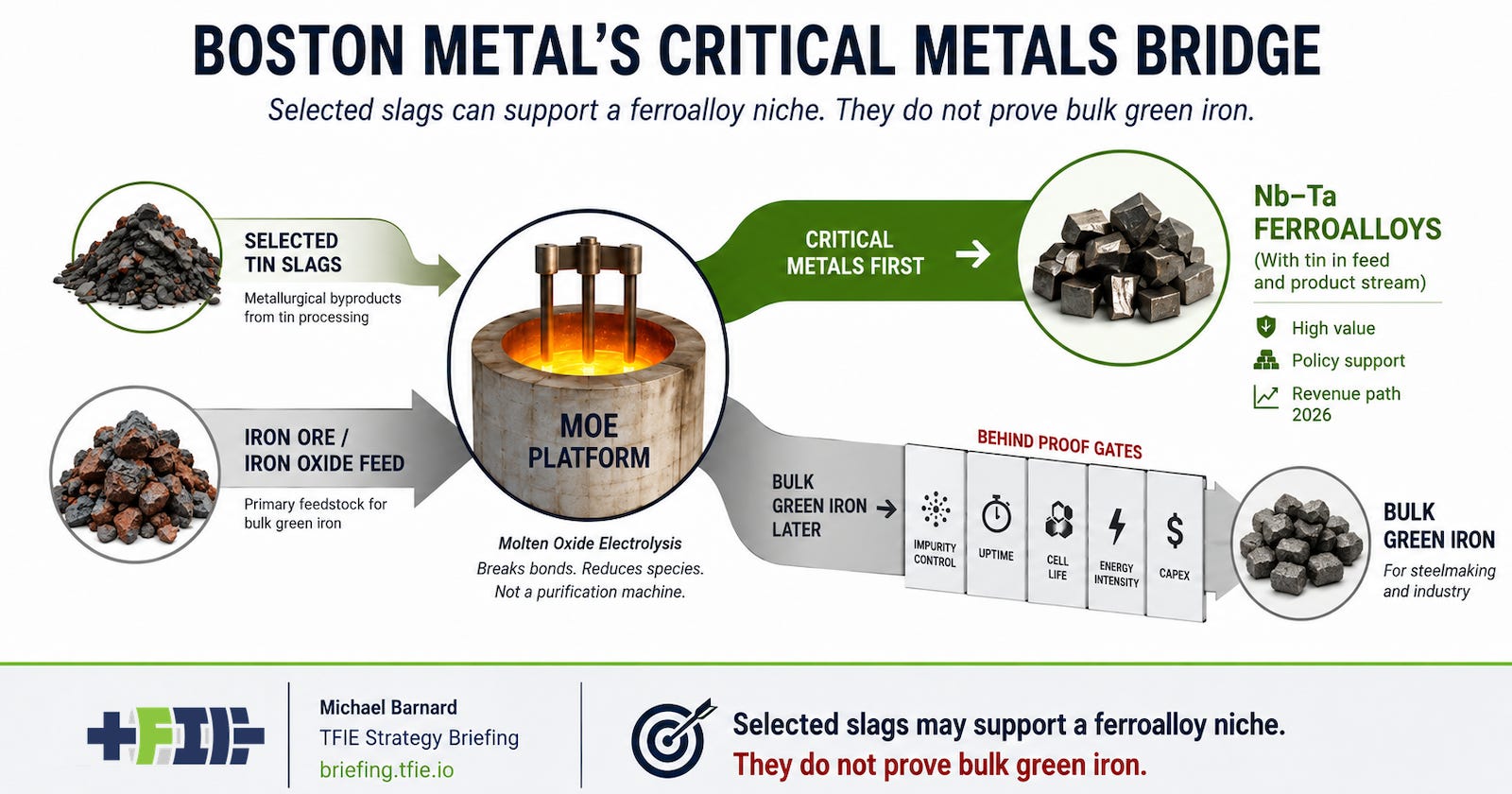
Boston Metal’s public emphasis has shifted from green steel first to critical metals first. The company has not abandoned molten oxide electrolysis, or MOE; it continues to present MOE as its core platform. But the near-term business case has moved toward high-value ferroalloys, while bulk green iron has become the longer-dated proof case. Boston Metal uses MOE Steel as the platform label, but the relevant technical proof point here is bulk green iron: reducing oxide feed into primary iron at steel-industry economics.
The broader denominator for that question is the one I laid out in my steel transition pathway review: steel decarbonization starts with demand, scrap, electric arc furnaces and clean electricity, leaving a smaller but still important contest over new iron. This article is narrower. It asks what Boston Metal’s current evidence says about one company’s MOE route inside that residual new-iron problem.
That distinction sharpened for me in January after Don Sadoway, founder of Boston Metal and long-time MIT professor, reached out after reading my piece on why green steel, not green iron, determines Europe’s industrial future. I asked him whether MOE could be used to clean up Europe’s lower-grade scrap, where copper, tin, chromium, nickel and other tramp elements constrain higher-value electric arc furnace expansion. His answer was a useful technical reset: Boston Metal Brazil was about high value-added ferroalloys, particularly niobium and tantalum, and electrolysis should not be confused with general-purpose purification.
That is a narrower story than the policy and investor wrapper around “critical minerals” can imply. Boston Metal is not presenting Brazil as a solution for the whole strategic-materials basket. Its near-term case is selected tin-processing slags, niobium-tantalum ferroalloys, and related specialty-metal products, with its own materials attaching near-term revenue to critical metals while putting MOE Steel into the “coming years” category. The current timing signal is therefore selected critical-metals recovery first, with bulk green iron still waiting for a larger proof set.
That narrower version is more credible technically and less transformative strategically. Claims about extracting valuable metals from industrial residues have been a recurring feature of mining, metallurgy and cleantech markets for decades, and most fail because contained value is not recoverable margin. It’s a professional red flag when I hear a startup claiming that they are going to get valuable minerals out of leftovers from processing and refining. Boston Metal’s case is stronger than the generic version because tin-processing slags can be materially enriched in niobium and tantalum, and ferroalloy products are more forgiving than ultra-pure metals. It still has to prove the hard part: repeated processing of selected slags into saleable products with acceptable recovery, energy use, uptime, impurity control and margin.
That is a first-market correction, not a trivial wording change. Green steel remains in the company’s long-term platform story, but the financeable business has moved to the specialty-metals route. Boston Metal’s May 2026 funding announcement framed the $75M raise around scaling critical-metals production in the U.S. and globally, and said the company had raised more than $500M in total. That is a serious amount of patient capital for an industrial deep-tech company, but the new round was explicitly framed around critical metals rather than near-term bulk green steel.
The financing stress is the other half of the story. Canary Media reported in February 2026 that Boston Metal’s critical-metals business missed a key milestone after an incident at its Brazil plant, leading the company to lose financing and lay off 71 U.S. employees. An industrial incident can happen in a real plant. The important signal is not that equipment failed, but that missing one operational milestone was severe enough to interrupt committed capital and force a material workforce cut. Canary’s reporting on the Brazil incident and layoffs is the clearest public fiscal signal in the story.
That points to a company still financed by milestones, not by durable operating cash flow. This is not unusual for industrial deep tech, but it is a different risk class from a commercially established metals producer expanding capacity. The $75M raise after the incident keeps the company alive and supports the critical-metals-first path. It does not, by itself, validate the unit economics of the Brazil ferroalloy route, much less bulk green iron.
The technical issue behind this is simple to state and hard to solve. The electrolysis cell is not the refinery. It breaks chemical bonds and reduces species according to the chemistry of the melt. If impurities reduce with the target metal, they can codeposit. Feedstock quality, impurity ordering and product tolerance determine whether the cell is useful, not just the elegance of the electrochemistry.
That is why the Brazil case is interesting and bounded. A niobium-tantalum ferroalloy from selected tin slags may be a product where the chemistry, feedstock and market value line up well enough. Bulk iron is a different problem. It is a high-volume, low-margin material market where uptime, cell life, energy intensity, refractory durability, anode performance, capex and product qualification all have to become boring. A process can look promising when recovering high-value metals from a selected slag and still fail to compete when asked to make hundreds of millions of tons of iron at steel-industry economics.
The assessment, then, is not “Boston Metal has failed.” It is also not “Boston Metal has proved MOE.” The better reading is that Boston Metal has shifted MOE’s first commercial market toward the place where the unit value, product form, feedstock chemistry, policy language and investor appetite are more forgiving.
Below the paywall is the professional layer: an Executive Scorecard, the company-specific evidence map, the slag-recovery technical test, the electrolysis-is-not-purification constraint, the fiscal-stress read, comparator analysis, update triggers, decision implications and the final verdict I’ll use to judge whether Boston Metal’s MOE pathway is progressing, niche-valid, stalled or merely raising capital around a better story.
