

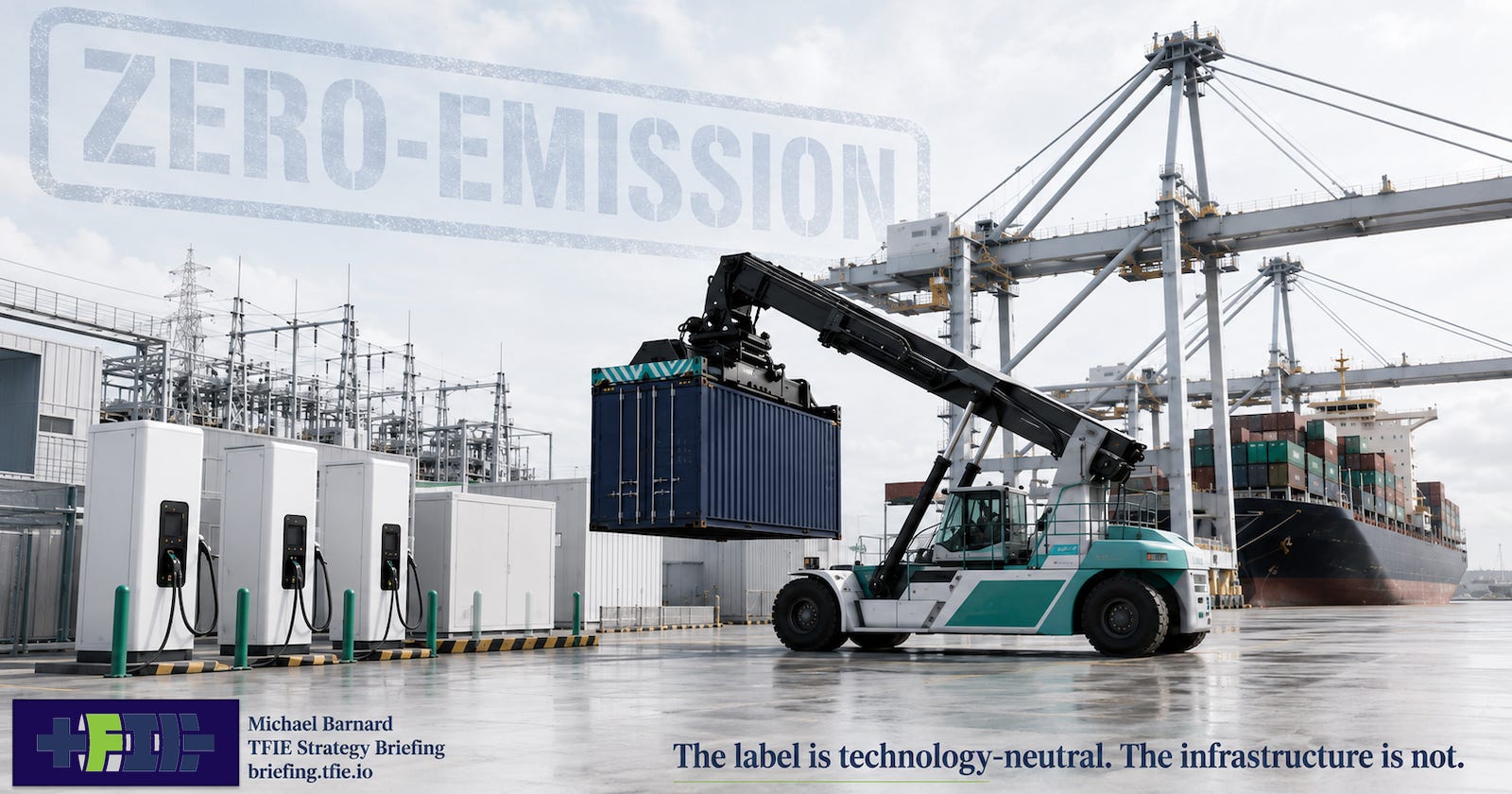
The Port of Long Beach’s latest clean-technology announcement looks evasive at first glance. The release keeps saying “zero-emission,” while avoiding the simpler phrase battery-electric. In California port policy, that is enough to make a hydrogen skeptic check the small print twice. California has a long habit of keeping hydrogen in the policy tent long after the operating evidence has become unkind to the molecule.
But the useful reading is not that Long Beach is hiding a hydrogen strategy inside a cargo-handling program. The useful reading is almost the reverse. The Port is using technology-neutral language while the funded assets are increasingly electric. That is how pragmatic institutions retreat from hydrogen without saying so directly.
The denominator is not the word zero-emission. The denominator is what is being bought, installed and made easier to procure next. In the Long Beach package, the cargo-handling side includes zero-emission human-operated equipment and chargers. Chargers are not a neutral technology platform. They do not support hydrogen top handlers, hydrogen yard tractors or hydrogen forklifts. They support electric equipment, electric maintenance routines, electric depot planning, electric interconnection work and the next round of electric procurement.
This matters because “zero-emission” is doing at least three jobs at once. It is a regulatory category, a grant-program category and a coalition-management term. California agencies, ports, terminal operators, OEMs, truck fleets, fuel suppliers and elected officials have all spent years using zero-emission as the broad tent under which both batteries and hydrogen could stand. That language made some sense when evidence was thinner and the political coalition was easier to hold together than the infrastructure plan.
The problem is that technology-neutral language has started to obscure technology-specific deployment. Batteries and hydrogen are not two interchangeable ways of powering the same future port. Battery-electric cargo-handling equipment extends the power system into a terminal. Hydrogen fuel-cell equipment requires a parallel fuel system: production, delivery, storage, compression or liquefaction, dispensing, safety management, fuel quality control, station maintenance and sufficient utilization to make the whole chain something other than an expensive demonstration.
That systems difference is the fulcrum. It is not enough to ask whether a hydrogen machine can move a container. A prototype can do many things once. The real test is whether the equipment class exists commercially, whether it is being bought repeatedly, whether the infrastructure serves more than a demonstration fleet, whether uptime is good enough for port operations, and whether the delivered cost competes with plugging equipment into an increasingly electrified terminal.
The California Air Resources Board’s (CARB) own draft 2025 cargo-handling equipment assessment makes the asymmetry visible. It finds no commercially available hydrogen fuel-cell container cargo-handling equipment, while the listed hydrogen fuel-cell yard trucks and several container-handling categories remain in development or demonstration rather than commercial deployment. That does not mean every battery-electric category is already mature. Some electric port equipment still has lead-time, uptime, charging-window and infrastructure constraints. But the battery-electric pathway is working through commercialization problems. Much of the hydrogen pathway is still trying to earn the right to have commercialization problems.
That distinction explains the language. Long Beach does not need to announce that hydrogen has failed. It does not need to irritate Sacramento, Washington, hydrogen suppliers, demonstration partners or terminal operators that have grants attached to hydrogen projects. It can keep using the approved phrase zero-emission while putting money into chargers and electric equipment. The public language preserves optionality. The physical assets narrow it.
There is still backslide risk, especially because this is California. Hydrogen remains politically durable in drayage trucking, rail demonstrations and fuel-subsidy programs. A zero-emission locomotive could still become a hydrogen demonstration. A truck incentive can still subsidize hydrogen fuel long after battery-electric drayage has become the more obvious system answer for many routes. A port can still fund a hydrogen pilot because pilots are easier to defend than scaled procurement and because “optionality” remains one of the most expensive words in clean-transport policy.
But the risk is not evenly distributed. For this cargo-handling tranche, the hydrogen risk is low because chargers and terminal electrical upgrades are hard assets. They create institutional learning, maintenance familiarity, procurement confidence and charging routines. Once a terminal has invested in that base, the next electric purchase becomes easier and the next hydrogen purchase has to justify not only the vehicle, but the whole fuel chain beside it.
For drayage trucks and rail, the risk is higher. Those sectors still attract hydrogen arguments because range, duty cycle, refuelling time and corridor coverage can be framed as reasons to avoid charging complexity. Some of those constraints are real. But the comparator is not diesel-like refuelling in the abstract. The comparator is battery-electric trucks plus depot and corridor charging, against hydrogen trucks plus production, distribution, dispensing, fuel cost, station reliability and subsidy dependence. Hydrogen has to beat the whole electric system, not just point to a larger battery and declare victory.
That is the professional takeaway from Long Beach. Follow the assets, not the adjectives. A press release can say zero-emission for political, regulatory and grant-alignment reasons. A procurement program reveals more when it specifies chargers, grid work, electric equipment classes and repeatable operating assets. Announcements are soft. Infrastructure is harder. Utilization will be harder still.
Ports are not going to exit hydrogen with a press conference called “we were over-optimistic about molecules.” They will exit by installing chargers, training maintenance teams, upgrading electrical systems, revising terminal workflows and buying the next electric unit because the previous one worked well enough. The hydrogen language will linger after the capital strategy has moved on.
That is not hypocrisy. It is transition diplomacy. The cleanest reading of Long Beach is that the port is preserving the political umbrella while the operational pathway becomes increasingly electric. Hydrogen advocates can still point to the word zero-emission and claim the door is open. They are not wrong. But an open door is not a deployment pathway, and it is not a charger.
TFIE Strategy Briefing tracks the difference between transition language and transition deployment: what is announced, what is funded, what is operating, and what survives the comparator test. Subscribe for decision-grade context on electrification, fuels, ports, grids and industrial decarbonization.