

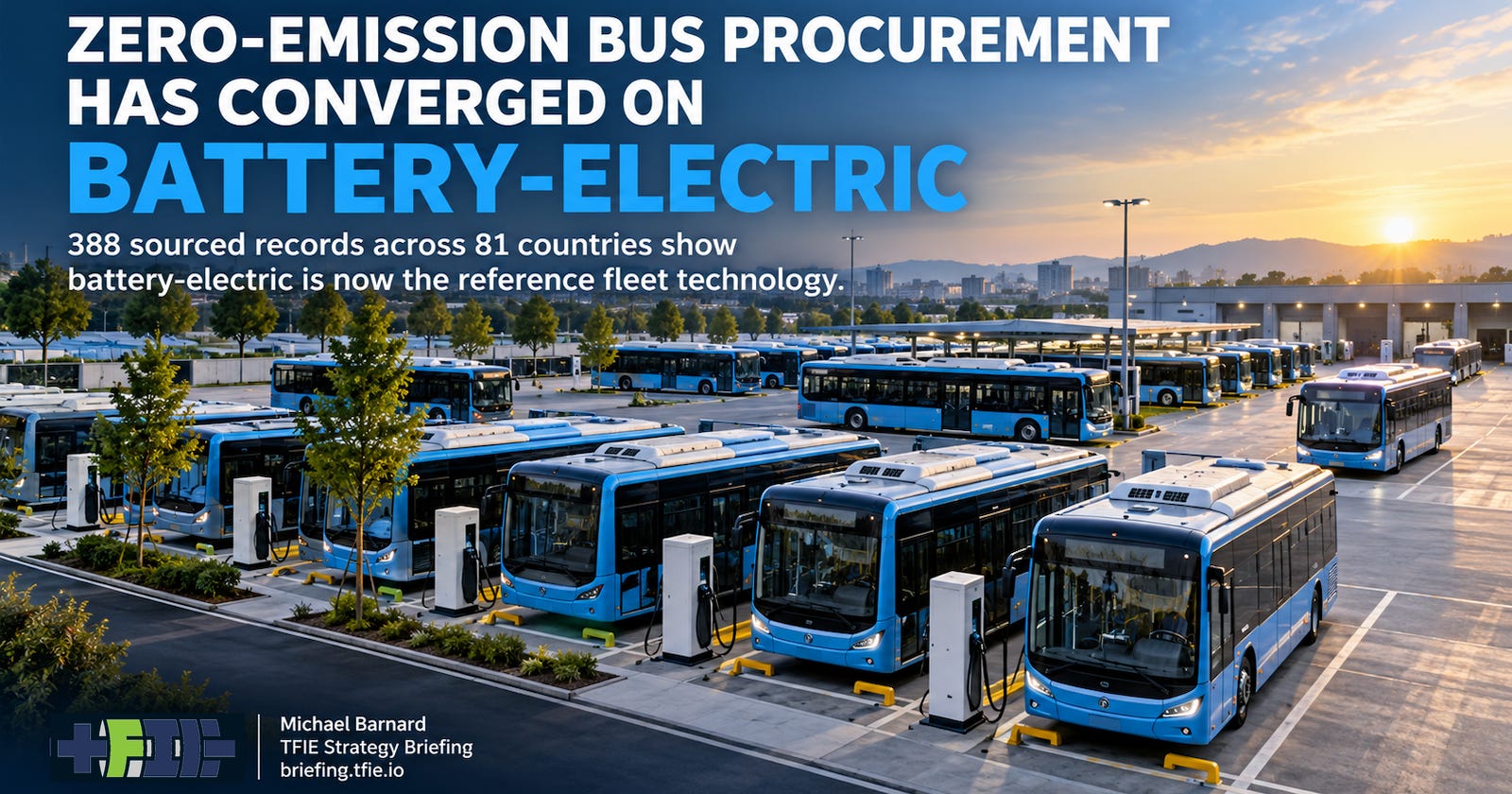
Transit agencies have now had enough practical experience with zero-emission buses that procurement tells us more than another technology comparison. Agencies have tested vehicles, rebuilt depots, installed charging and refuelling equipment, trained technicians, negotiated energy supplies and learned which assumptions survive daily service. Manufacturers have had years to improve their products, while governments have funded demonstrations and early fleets. Battery-electric and hydrogen fuel-cell buses can both carry passengers in regular service. The more useful measure of maturity is what transit agencies are prepared to buy repeatedly and at fleet scale.
That purchasing evidence no longer supports the familiar framing of battery-electric and hydrogen as parallel zero-emission technologies whose eventual roles remain broadly unresolved. The global 2026 procurement register I assembled contains 388 sourced records across 81 countries, spanning firm orders and awards, open tenders, completed procedures whose outcomes remain uncertain, framework quantities and other identifiable stages of procurement. The pattern is overwhelmingly battery-electric.
The distinction between procurement stages is important because bus purchasing produces several public records around the same vehicles. A tender for 100 buses, the subsequent award and an announcement that the first vehicles have arrived can all describe the same purchase. Options may never be exercised. Funding approvals do not necessarily become bus orders. The register treats firm orders and awards separately from tenders and other forward-looking procurement signals instead of adding everything into one headline total.
On that conservative basis, the firm procurement in the register contains 13,165 battery-electric buses and 65 hydrogen fuel-cell buses. That is a little over 200 battery-electric buses for every hydrogen bus. Among the firm acquisitions captured for those two zero-emission technologies, about 99.5% are battery-electric.
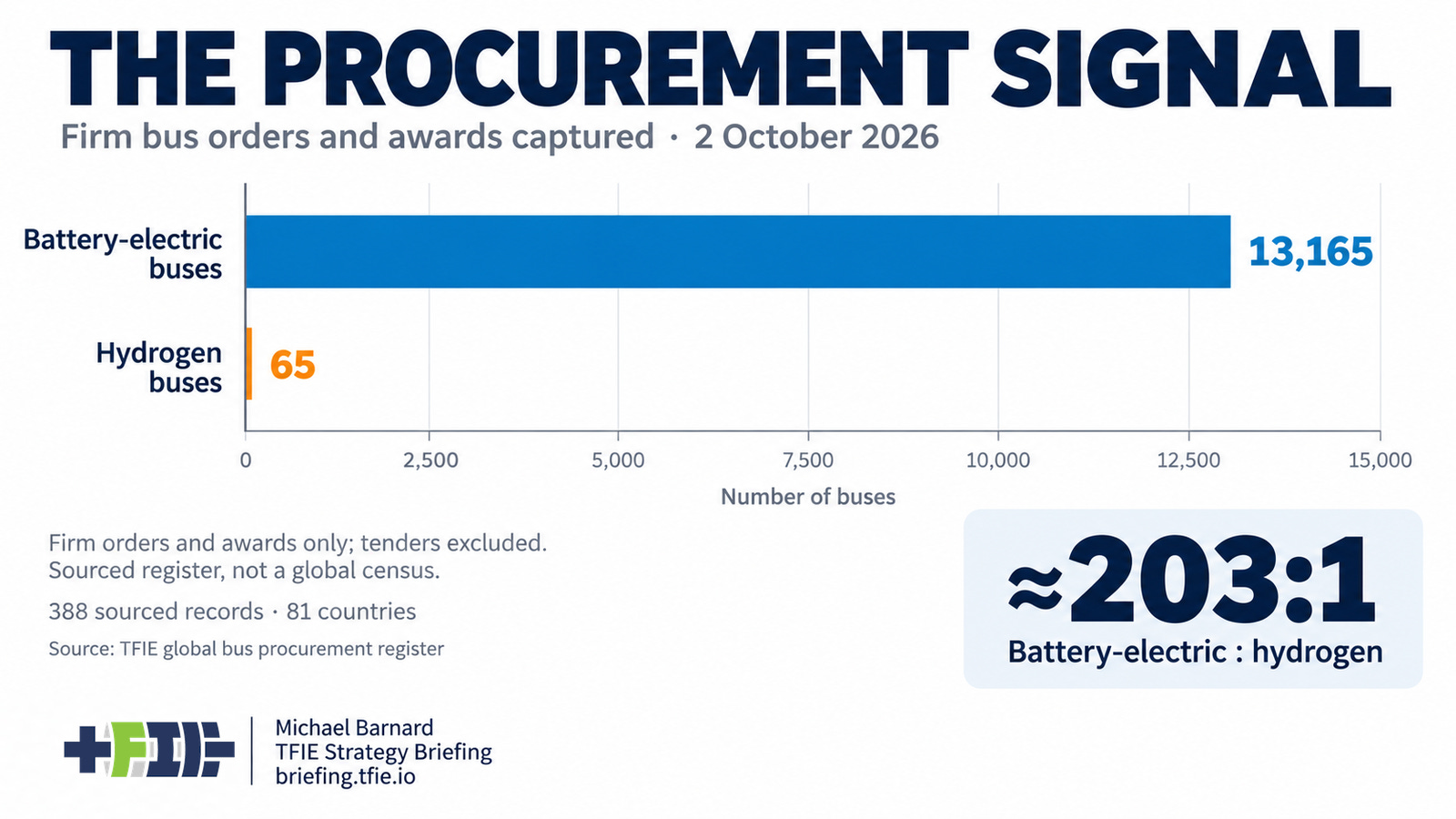
The forward procurement evidence points in the same direction. Open procedures in the register contain thousands more battery-electric buses, while the identifiable hydrogen pipeline remains small. That matters because deliveries and registrations can lag procurement decisions by years. A bus entering service today may reflect a technology choice made when subsidy programs, vehicle prices and operating experience looked quite different. Current tenders and awards provide a more immediate view of what agencies are choosing after absorbing the lessons of the past several years.
The register is not a census of every bus purchased everywhere. Procurement transparency varies widely, terminology is inconsistent across countries and Chinese awards do not map neatly onto European tender procedures or North American multi-year contracts. Some purchases will inevitably be missing. Closing a 13,165-to-65 gap, however, would require a very large hydrogen procurement market that has escaped the available public record while battery-electric orders remained observable across dozens of countries. I have found no evidence of one.
Nor does convergence mean that every transit agency has selected battery-electric or that no more hydrogen buses will be bought. It means that the evidence is no longer balanced enough to justify treating the two as similarly established fleet pathways. Battery-electric buses now have a much larger commercial reference class: many agencies, many suppliers, repeated orders and deployments under very different operating conditions. That accumulated experience should matter when the next agency makes the same decision.
The complete workbook contains the individual procurement records, source register, classifications, country and regional fields, fleet denominators and calculations behind the analysis. Transit agencies, policymakers, investors and researchers who want access to the workbook or want to discuss the findings can email me.
The headline hydrogen number also turns out to be much less broad than it first appears. Most of the 65 firm hydrogen buses in the global register come from a single Chinese city where the municipal government is deliberately expanding hydrogen applications, financing the buses and developing the surrounding hydrogen supply chain.