

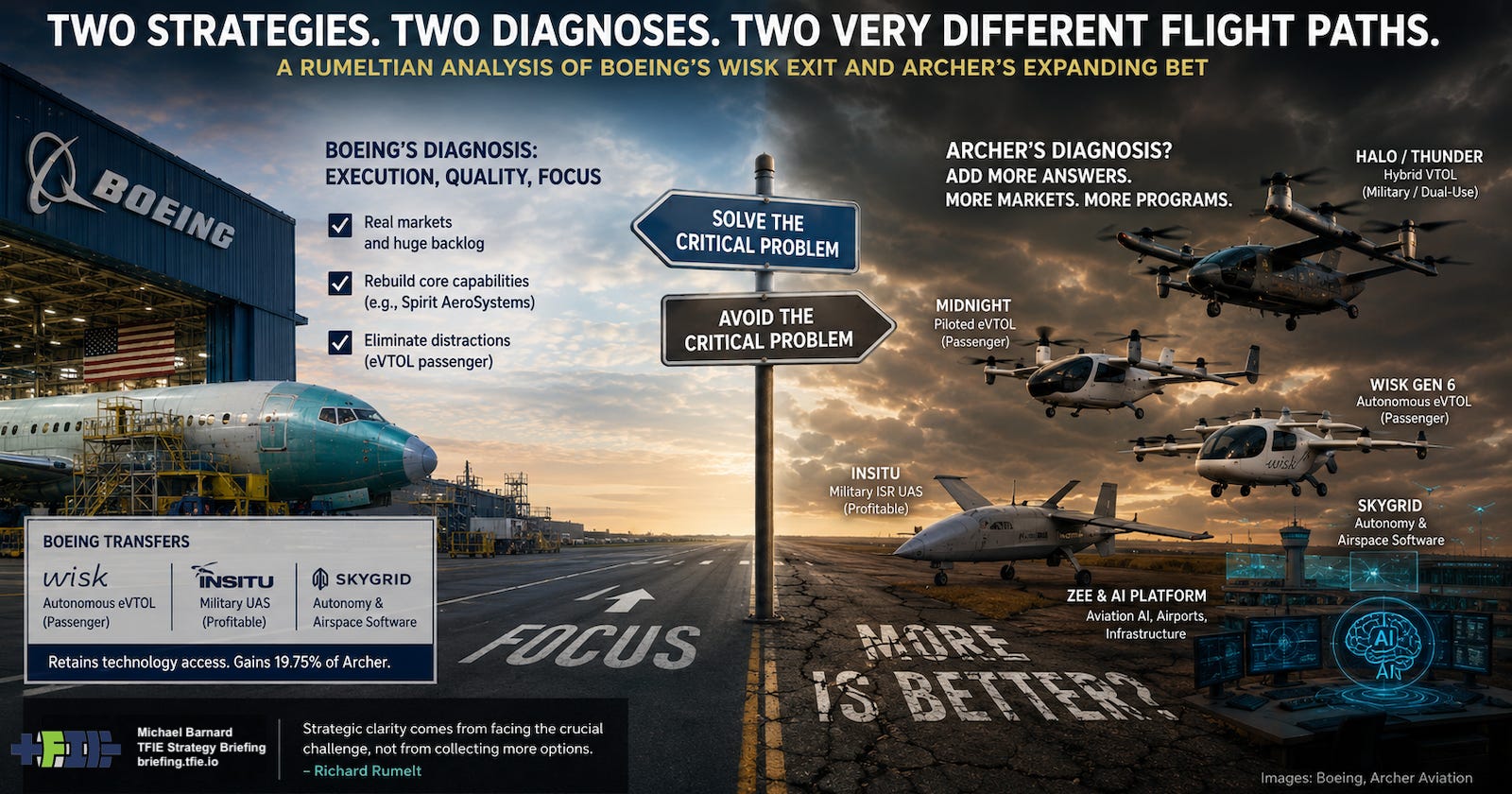
Richard Rumelt’s Good Strategy/Bad Strategy provides a useful lens for Boeing’s decision to move Wisk Aero, Insitu and SkyGrid into Archer Aviation. This is a Rumeltian assessment of both sides of the transaction, starting with his kernel of diagnosis, guiding policy and coherent action. Before deciding whether Boeing is giving away valuable businesses or Archer is assembling a powerful new aerospace company, the useful questions are what critical problem each company faces, what policy follows from that diagnosis and whether the actions reinforce it. On that basis, the two sides of the deal look quite different.
Under the transaction announced August 10, Boeing is transferring autonomous passenger eVTOL developer Wisk, profitable military drone company Insitu and airspace and autonomy software business SkyGrid to Archer. Boeing receives Archer shares equal to 19.75% of Archer’s pre-closing Class A share count, gains board representation and retains access to Wisk’s core autonomous-flight technology. The straightforward interpretation is that Boeing is streamlining while Archer gains technology, revenue and scale. Some of that is true, but Boeing’s history makes it important not to confuse selling businesses with having a strategy.
I’ve written before about Boeing’s decades of financialization and the outsourcing, loss of engineering authority and erosion of institutional capability that followed. Boeing did not end up in its current difficulties because the world stopped wanting airliners. It ended 2025 with a record $682 billion backlog, including more than 6,100 commercial aircraft, while still working through production stability, quality and certification problems of its own making. That makes its reacquisition of Spirit AeroSystems, an operation Boeing spun out two decades earlier, strategically significant. Critical manufacturing integration was once treated as something Boeing could push outside its corporate boundary. Bringing it back inside reflects the recognition that some capabilities are fundamental to solving Boeing’s actual problem.
Wisk is difficult to put in the same category. I described Wisk as a dead-end distraction in 2024, after Boeing had already put hundreds of millions of dollars into the autonomous air-taxi venture. Boeing needs to restore reliable execution on commercial aircraft and major defense programs for markets with demonstrated demand. It does not need to own an autonomous passenger powered-lift program whose eventual market remains highly speculative, so transferring Wisk while retaining useful autonomy access is consistent with the challenge Boeing actually has to solve. Insitu is less obvious. It generates more than $200 million annually and is profitable in a defense market Boeing says is core, while SkyGrid’s autonomy and airspace capabilities could also have future value. Given Boeing’s history of throwing organizational capability over the wall in pursuit of financial neatness, I would not assume that disposing of all three businesses is strategically wise simply because Wisk plainly does not belong.
