

Verdox has done something worth taking seriously. In a two-month test at Hydro’s Sunndal smelter, the company reported capturing CO₂ from exhaust containing only about 1% CO₂, including exposure to contaminants found in smelter gas. Hydro’s investment and continued work with Verdox give the trial a serious industrial counterparty. The published account establishes a relevant field test, but it does not provide the gas mass balance, complete electricity boundary, pressure drop, product specification, electrode replacement record or installed cost needed to price a commercial facility.
I have spent more than a decade assessing dozens of CCS technologies and projects, from direct air capture to industrial flue-gas systems. That experience makes the Sunndal trial interesting, and it makes me follow the gas, energy and money all the way to permanent storage before putting an investable cost on it.
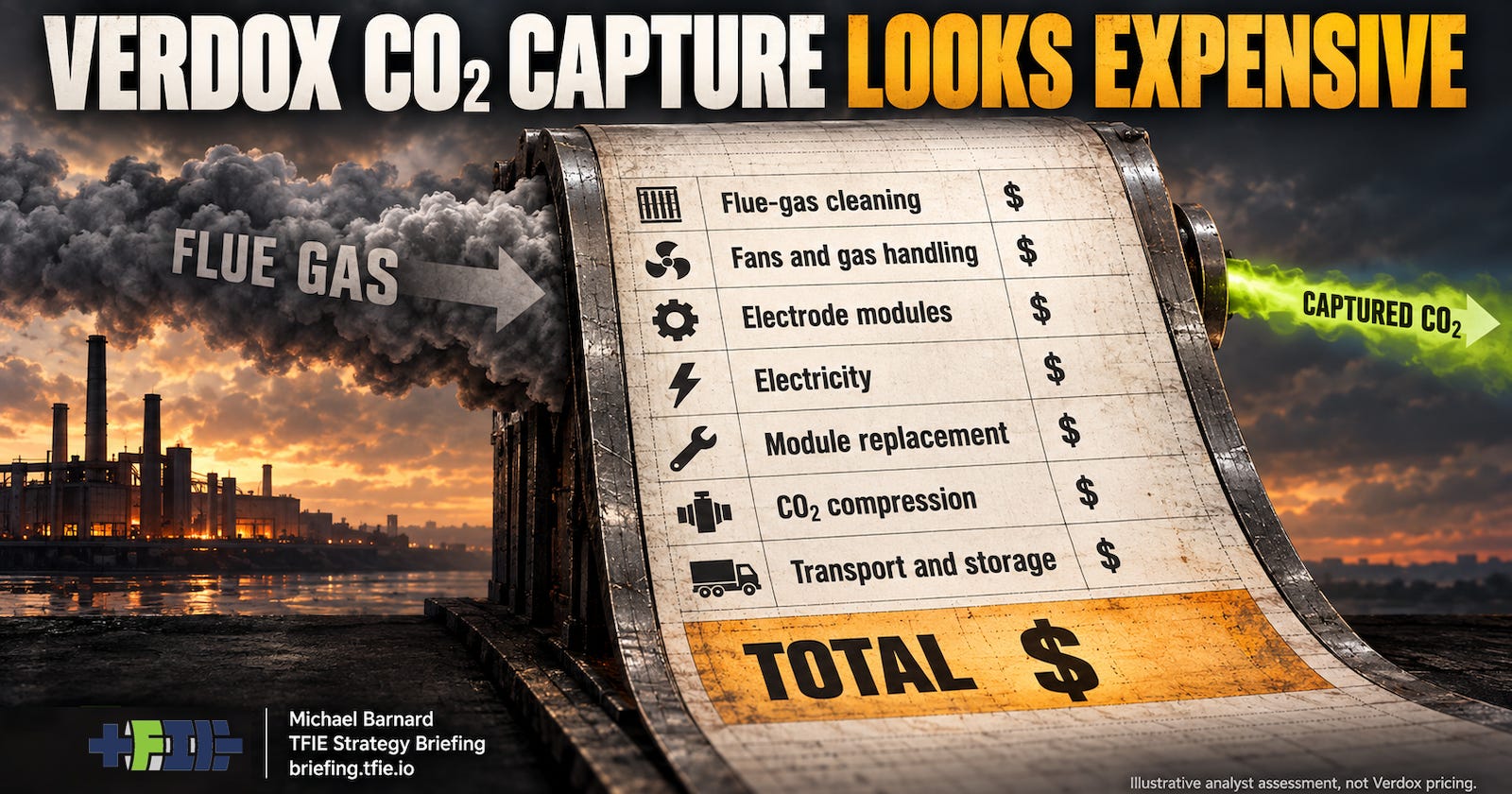
The first test is the gas volume: at 1% CO₂, a facility must move an enormous amount of mostly non-CO₂ gas for each tonne captured. Verdox advertises roughly 1.5 GJ, or 417 kWh, per tonne for its electrochemical process. Investors need to know which fans, pretreatment, switching, purge, drying and compression loads are inside that number, and how long a finished electrode lasts in the actual exhaust. A result measured at the cell cannot pay the bills for an entire capture, delivery and storage chain.
Aluminum adds a second question. Its carbon anodes produce most of a smelter’s direct CO₂ emissions, and both Hydro and Rio Tinto are developing ways to change the smelting process while they investigate capture. A capture plant attached to an existing potline may have a useful role; its investment life must be tested against changes in the process that produces the CO₂. The answer depends on the particular smelter, power supply, storage access and timing of alternative technology.
To make that diligence inspectable, I built a Verdox carbon-capture workbook that separates company claims, peer-reviewed cell results, engineering assumptions and complete-system cost scenarios. It follows the gas from additional flue-gas cleaning to a compressed CO₂ flange, then tests illustrative routes to geological storage. It uses Flyvberg reference class forecasting against the class to determine the likely costs. The assumptions can be changed; the central case is a screening estimate rather than a Verdox quote or a project forecast. Paid readers get the findings, key assumptions and questions for their own diligence below. Access to the working workbook can be arranged separately for a live investment or project decision.
Behind the paywall: the modeled cost through storage and the assumptions that can overturn it; the plant needed to process a one-percent stream; and whether a cleaner biogenic CO₂ stream or a changed aluminum process is the better use of capital. The evidence that would change the investment case is more revealing than any single energy claim.
