

A LinkedIn contact asked me whether I had a thesis on underwater data centers through a European sovereign data lens, with China now deploying them. My first reaction was that this sounded like a technology that solved one problem by creating several more. Cooling is a real problem for data centers, and putting compute in cold water has an obvious appeal. But a data center is not just a cooling load. It is an electrical, thermal, digital, maintenance, permitting, security and land-use system. Underwater data centers are no longer science fiction, but the useful question is not whether they can work. It is where they are better than a well-sited, grid-integrated, heat-recovering data center on land.
The first-order physics matters. Almost every MWh of electricity that enters a data center leaves as heat. Servers, power conversion equipment, networking gear, pumps, fans, lighting and controls all turn electricity into low-grade heat. Computation is useful work, but thermodynamically the facility is an electricity-to-heat machine with some information processing on the way. Underwater siting changes where the heat goes. It does not make the heat disappear. On land, that heat can sometimes be recovered, upgraded by heat pumps and sold into district heating or used by nearby industry. Underwater, the default heat customer is seawater.
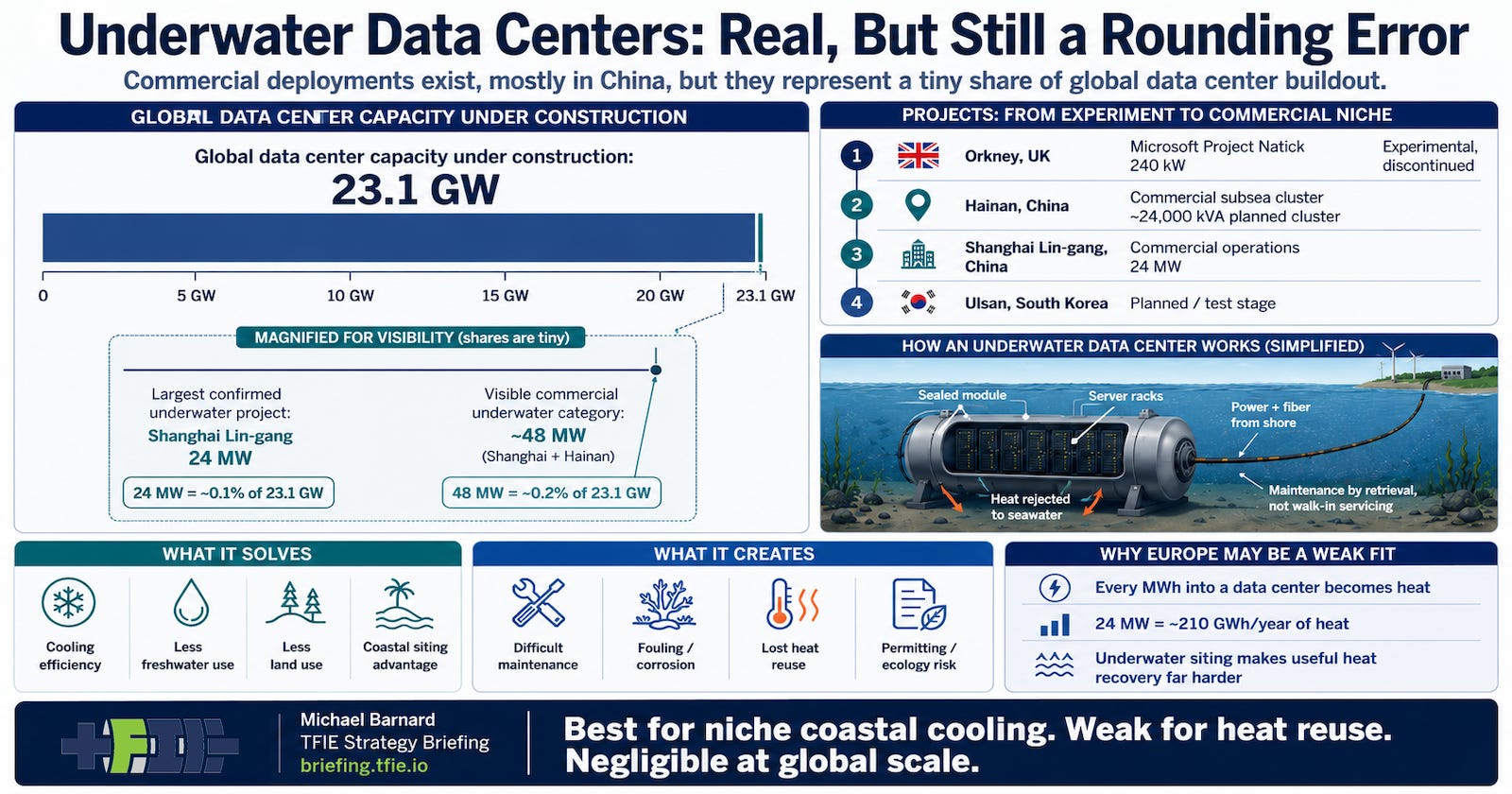
The actual deployment record is short but no longer empty. Microsoft’s Project Natick was the important experiment. Its Orkney phase put a sealed module with 864 servers and 12 racks under the sea and reported lower server failure rates than comparable land installations. That was useful engineering evidence, not a commercial rollout. Microsoft later confirmed that Natick was no longer active and that it was not operating underwater data centers. The project proved that sealed subsea compute could work technically. It did not prove that it was the next default architecture for cloud infrastructure.
China has moved the concept from experiment into commercial niche. The Hainan deployment is described by MERICS as a shallow-water underwater data center with cabins around 35 meters below the surface, 24 server racks per cabin and up to about 500 servers. Reports describe a larger planned cluster around 24,000 kVA. The more important current example is Shanghai Lin-gang. Data Center Dynamics reported that HiCloud’s offshore-wind-powered underwater data center in Shanghai’s Lingang Special Area has a capacity of 24 MW and reached full commercial operation after trials. That is real infrastructure, not just a rendered concept image.
The technology is simple in concept and hard in the real world. A subsea data center is not a room full of technicians in diving gear. It is a sealed pressure vessel or module on the seabed. Power and fiber run from shore. Servers operate inside a controlled atmosphere. Heat moves from racks into an internal thermal path and then to seawater through heat exchangers or module surfaces. Maintenance is not walk-in servicing. It is redundancy, monitoring, tolerance of failures and eventual retrieval. That is an engineering model borrowed more from subsea telecoms and offshore equipment than from a normal data hall beside a substation.
China is a logical early mover. It has large coastal load centers, dense cities, land constraints, port and marine engineering capacity, offshore wind buildout and a state-directed appetite for infrastructure pilots. A coastal province can frame underwater compute as part of a blue economy, AI infrastructure, offshore renewables and land-saving industrial policy. That does not mean the model generalizes. Technologies scale inside institutions and geographies, not in slide decks. China can make a project worth doing for reasons that do not apply in Dublin, Frankfurt, Amsterdam, London or Virginia.
The denominator makes the scale clear. BloombergNEF reported that 23.1 GW of data center capacity was under construction globally across 831 sites. A 24 MW underwater data center is 0.024 GW. Divide 0.024 by 23.1 and the result is about 0.1%. If Hainan and Shanghai are generously counted together at roughly 48 MW, the category is about 0.2% of current global construction. Against a 100 GW buildout through 2030, 24 MW would be 0.024%. That is not nothing, but it is a rounding error.
The cooling advantage is real, but it is not magic. Underwater projects report attractive power usage effectiveness values around 1.1 to 1.15. PUE is a blunt but useful metric. A PUE of 1.15 means that for every 1 MW delivered to IT equipment, the site uses another 0.15 MW for cooling, power distribution and overheads. That is good. It is also not beyond what land-based leaders can do. Google reports a 2024 fleet-average PUE of 1.09 across its global data centers. That does not make underwater cooling irrelevant. It makes the claim narrower. Underwater cooling may be attractive in a few constrained coastal contexts. It is not uniquely efficient by default.
That matters because the proper comparison is not an underwater data center against a badly designed desert data center with poor cooling. The proper comparison is an underwater data center against a well-sited land-based facility using direct-to-chip liquid cooling, rear-door heat exchangers, efficient power electronics, good airflow design, grid-aware operations and heat recovery where the geography supports it. The less novel infrastructure often wins because it is easier to permit, easier to finance, easier to inspect, easier to upgrade and easier to repair.
The maintenance model is the hidden cost center. On land, a failed power supply, switch, fan, cable, optical module or GPU can be replaced by a technician with a badge and a cart. Underwater, the design assumption shifts to longer sealed operating periods and tolerance of failures. That might be fine for some workloads and hardware generations. It is less obviously fine for AI infrastructure, where GPU clusters, high-speed networking, liquid cooling manifolds, hardware refresh cycles and workload changes are moving quickly. The ocean can be a coolant, but it is also a service barrier.
Marine fouling and corrosion are not footnotes. Anything placed in seawater becomes part of a chemistry experiment and an ecosystem. Surfaces foul. Heat-transfer performance can degrade. Cables need armoring and protection. Seals, connectors and metals have to live with salt, pressure, currents and storms. Offshore wind, subsea telecoms, naval systems and oil and gas have managed these problems for decades, so none of this is impossible. But manageable is not the same as cheap, flexible or comparable to a concrete slab with road access.
The European heat-reuse issue is the strongest reason to be cautious about the sovereign-data framing. The recast Energy Efficiency Directive requires data centers above 1 MW to assess and, where feasible, use waste heat or other heat recovery applications. A 24 MW facility operating for 8,760 hours produces about 210 GWh of heat in a year before considering overheads. Put that near a city, district heating loop, greenhouse, industrial heat user or heat pump plant and some of the waste heat has a pathway to value. Put it underwater and the pathway starts with heating the sea.
That does not make underwater data centers impossible in Europe. It makes them harder to justify in many European contexts. Europe does not only need sovereign bits. It needs resilient grids, lower fossil gas use, better district heating, efficient urban infrastructure and public confidence around electricity demand from digital systems. A sealed compute can on the seabed may be inside national waters, but it is poorly aligned with the idea of data centers as nodes in useful local energy systems.
Sovereignty is also not the same thing as geography. A data center under national waters may be physically inside a jurisdiction, but sovereign data depends on ownership, cloud control planes, encryption keys, administrative access, procurement rules, cybersecurity certification, backups, operations staff and legal exposure. A module on the seabed operated by the wrong entity with the wrong stack is not sovereign because it is wet. For Europe, the stronger model is likely EU-controlled infrastructure with auditable operations, resilient power, transparent governance, strong cybersecurity and useful heat integration.
There are niches where underwater data centers may make sense. Small or medium coastal jurisdictions with severe land constraints could be candidates. Hot, humid markets with expensive cooling and limited freshwater could be candidates. Locations with offshore wind, port infrastructure and short fiber runs to dense coastal demand might find value. Specialized sealed compute for research, defense-adjacent, remote industrial or physical-isolation use cases may also have merit. The key is to bound the claim. Niche coastal cooling infrastructure is a credible category. Default future of data centers is a much larger claim.
There are also many places where they probably do not make sense. If land is available, road access is easy, grid interconnection is the bottleneck, heat reuse has value, district heating exists or could exist, hardware changes rapidly, marine permitting is slow or ecological scrutiny is high, the case weakens. AI-scale infrastructure in particular wants power, speed, flexibility, networking density and hardware refresh options. Sealed subsea modules pull against several of those needs. They may be clever. Clever does not automatically mean bankable at hyperscale.
The AI boom complicates the denominator, but not enough to change the conclusion. Many announced data center projects will be delayed, resized or cancelled. Power constraints, grid queues, transformer shortages, water concerns, local opposition, financing costs and speculative AI demand will all filter the pipeline. But the denominator can shrink a lot before 24 MW or 48 MW becomes material. A 90% haircut to the 23.1 GW under-construction figure would still leave 2.31 GW. The visible underwater category at 48 MW would still be about 2.1% of that smaller denominator.
Better land-based alternatives are not hard to identify. Data centers can use liquid cooling, rear-door heat exchangers, direct-to-chip systems, efficient power architectures, heat pumps, district heating connections, industrial heat offtake, brownfield industrial sites, grid-interactive operations, batteries and colocated renewables where they make sense. These options keep the facility serviceable while creating more system value. They are less visually novel than lowering a pressure vessel onto the seabed, but infrastructure is not a novelty contest.
The next five years will tell us whether this remains a Chinese coastal niche or becomes a repeatable category. The useful evidence will not be another press release about PUE. It will be operating data from Hainan and Shanghai, retrieval cycles, failure rates, fouling impacts, corrosion management, insurance costs, permitting timelines, cable performance, hardware refresh economics and whether anyone can scale from tens of MW to hundreds of MW without the marine side overwhelming the cooling benefit. Hyperscaler behavior will matter too. If the largest cloud operators leave underwater compute to niche firms, that is evidence.
Underwater data centers are real, interesting and worth watching. They are not vaporware, and China has moved them beyond the experiment stage. But they remain a small niche solving cooling, freshwater and land constraints at the cost of maintenance complexity, marine exposure and lost heat-use optionality. In a European sovereign-data context, they are usually less compelling than land-based facilities that are auditable, maintainable, grid-integrated and thermally useful.
Underwater data centers are a useful denominator test: technically interesting, but strategically small beside the grid, siting, cooling, and electricity procurement decisions shaping compute infrastructure. Paid subscribers get that same discipline across the briefing archive, with scorecards, evidence notes, update triggers, and decision-grade context behind the public argument.