

The core assumption underneath TFIE Strategy Briefing is that the world will continue to respond to climate change materially, unevenly, belatedly, and often while protecting incumbent fossil fuel interests. That is different from assuming adequate climate policy, a smooth glide path to net zero, or sudden coherence in energy strategy. Those would require stronger evidence than is usually available from legislative calendars, oil company transition plans, or hydrogen announcements attached to airports.
The language around the transition has shifted. In a lot of policy and investor circles, climate is no longer the only front-door argument. Security, resilience, affordability, competitiveness, supply-chain control, industrial strategy, and exposure to fuel-price volatility now do more of the public work. That shift is not a retreat from the transition so much as a change in how the transition is justified. The same practical measures keep showing up: renewables, grids, storage, electrification, efficiency, methane reduction, industrial substitution, and less dependence on imported or volatile fuels. The label changes by audience. The denominator does not.
That matters because a century of fossil-fuel persistence is not a neutral baseline. It is a high-damage, high-exposure scenario. If the world keeps burning fossil fuels at something like today’s scale through 2100, the result is not the present economy with a modest climate adjustment. It is a world with more uninsurable property, flood and fire loss, heat and water stress, crop volatility, forced retreat, infrastructure repair, migration pressure, and political instability. Those are not externalities in the ordinary sense. They become part of the economy being modeled, leaving communities, taxpayers, and balance sheets carrying risks that were once treated as distant.
Many long-range scenarios blur that point. A high-fossil pathway is often treated as a familiar economy with climate damages added later. That framing is backwards. If emissions remain high, the economy in which those emissions occur is not the same economy. More capital goes to repair, retreat, cooling, disaster response, water infrastructure, health impacts, food-system resilience, and security. Some regions lose productivity. Some assets lose insurability. Some infrastructure loses its design climate. Those changes feed back into demand, capital allocation, migration, politics, and the transition itself.
The current security and affordability language strengthens that point. Fuel-import dependence is not just an energy issue; it hands control over household bills, industrial costs, trade balances, and national strategy to suppliers and commodity markets elsewhere. Gas-linked power prices make affordability hostage to fuel volatility, while long fossil supply chains add fragility exactly where economies need resilience. Methane leakage cuts across categories as well, worsening climate outcomes while degrading the credibility of supposedly cleaner fuel products. Underbuilt grids then turn the solution pathway itself into a reliability constraint, slowing the electrification that would reduce exposure in the first place. None of this vanishes because the word “climate” has become less fashionable in some political rooms. The same infrastructure choices still sit underneath the problem: cleaner power, stronger grids, electrified end uses, efficiency, methane reduction, and less dependence on volatile fuels.
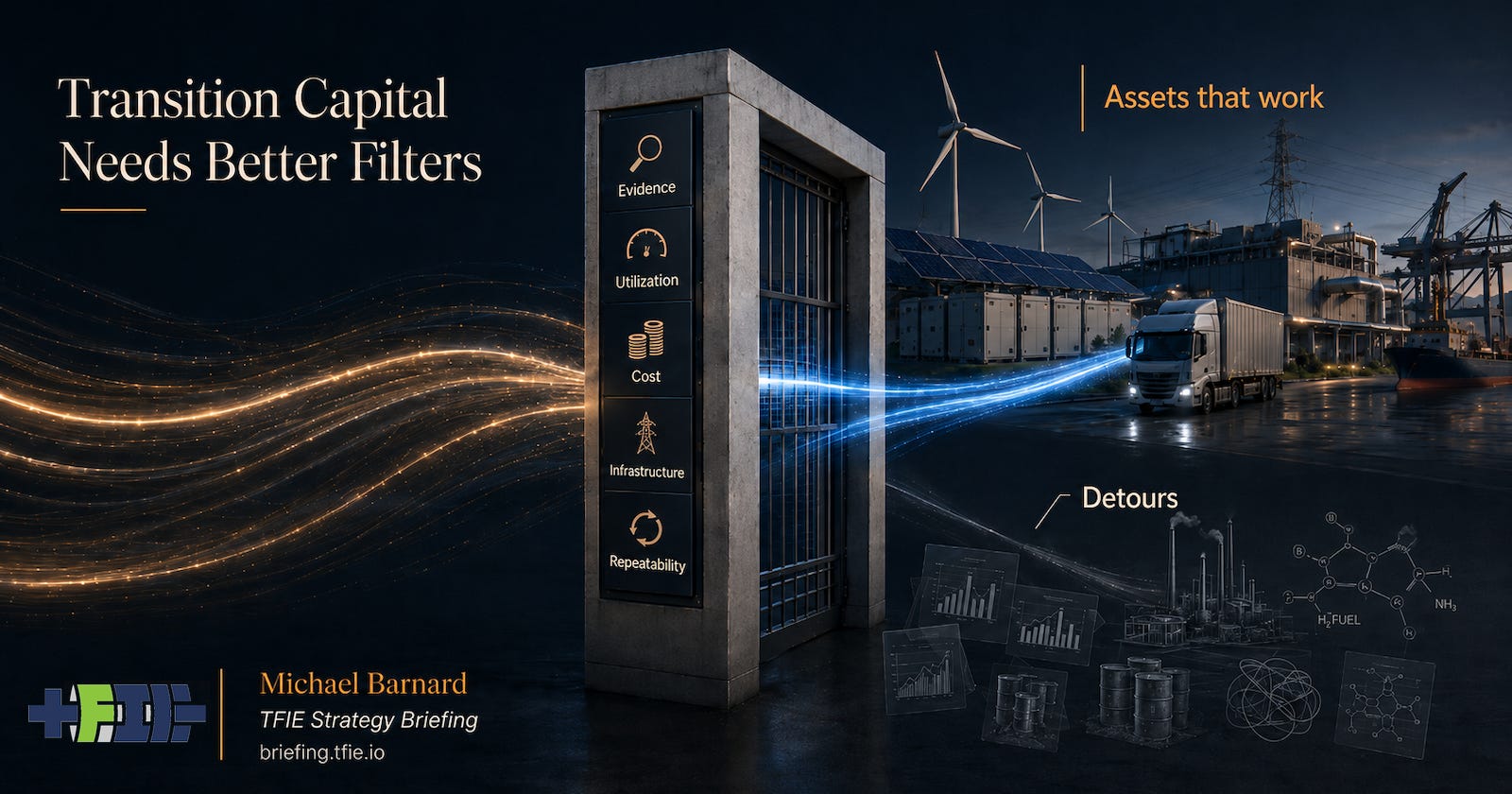
That is the work Briefing is built for. Very large sums of capital are moving through power systems, grids, ports, vehicles, buildings, industrial heat, hydrogen, fuels, aviation, shipping, steel, cement, methane mitigation, mining, and adaptation. Some of that money will accelerate the transition. Some will buy learning. Some will buy assets with durable utilization, falling cost curves, and real emissions reductions. Some will buy another round of engineering work for a pathway whose main product is still a slide deck.
This is why the older economic treatment of climate damages remains consequential. In my piece on how climate economics got the risks wrong, I discussed William Nordhaus and the influence of integrated assessment models such as DICE. Nordhaus deserves credit for forcing climate change into macroeconomics, but the damage functions that became influential were too smooth for the physical and institutional risks they claimed to price. The important point for Briefing is that climate damages do not arrive as a single global cost coefficient. They show up through insurance, infrastructure, productivity, food prices, public health, migration, and fiscal exposure. A high-fossil pathway is not today’s economy with a damage coefficient attached. It is a different operating environment.
The practical response is already visible. Renewables, batteries, electrification, transmission, heat pumps, electric transport, storage, and industrial substitution keep getting cheaper, better, more modular, and easier to deploy than the incumbent alternatives in more markets. This does not make the transition automatic, painless, fast enough, or immune from policy reversals. It does mean the old fossil baseline is no longer the low-risk default.
The policy problem is not simply ambition. It is allocation. Mandates, tax credits, contracts for difference, procurement rules, port strategies, grid plans, permitting, interconnection reform, and industrial programs can accelerate the transition, or they can create expensive compliance markets for pathways that do not scale. The useful policies are the ones that pull forward assets, infrastructure, standards, and markets that still make sense once the slogan on the program changes.
The short list of climate actions that will work has been stable for years because the physics and economics keep pointing in the same direction: electrify as much as practical, overbuild renewables, build transmission and markets, build storage, shift transport to electricity where feasible, clean up industry with the simplest working pathways, reduce methane, change agriculture, price carbon where politically durable, and retire coal and gas wherever cleaner substitutes are already cheaper and reliable. The list is not interesting because it is new. It is useful because it keeps surviving contact with evidence, and because it leaves countries and communities with lower exposure, cleaner air, more reliable infrastructure, and assets that still make sense in twenty years.
Solar, wind, and batteries have spent the last decade doing what modular manufactured technologies do when they scale: they got cheaper and better. Electric vehicles are spreading because they are better vehicles for a growing share of use cases. Heat pumps are growing because they deliver heat efficiently without burning fuel at the point of use. Solar and wind are being built because, in more places every year, they are cheaper, faster to deploy, less exposed to fuel-price volatility, and better aligned with the direction of policy and capital. The transition is stronger when it is built around useful assets, high utilization, ordinary operating competence, and technologies that improve with scale.
Climate-labeled spending is not automatically useful, and neither is spending relabeled as security, resilience, or affordability. Early evidence matters, but it has to stay in its lane. Grants, pilots, targets, offtake discussions, orderbooks, and lifecycle claims are evidence only at the right rung of the ladder. They are not substitutes for operating assets, high utilization, audited performance, delivered cost, and repeat procurement. A lot of transition capital is still being steered toward technologies and business models that mainly preserve incumbent fuel volumes, infrastructure, and narratives for another planning cycle.
The problem is not risk, pilots, or early technology. The transition needs all three. The problem is bad inference from them. Early evidence should answer the next scale question, not be inflated into proof that the whole pathway is bankable. A serious pilot reduces uncertainty about cost, utilization, infrastructure, permitting, safety, performance, or repeat procurement. It becomes theater when those questions are treated as already answered.
For investors, the difference shows up as utilization risk, subsidy risk, policy-durability risk, feedstock risk, offtake risk, cost of capital, terminal-value risk, and the familiar disappointment of discovering that a strategic asset is mostly strategic for the seller. For policymakers, it shows up as programs that either build useful markets and infrastructure or create expensive detours. For serious cleantech companies, it shows up as the difference between patient scale-up and being crowded by weaker claims with better branding.
The purpose is to distinguish pathways that are adding evidence from pathways that are adding excuses. That requires denominators before stories. What is the actual service required? What stock already exists? What cargo is being moved? What fuel volume is genuinely needed? What infrastructure must be built? What technology is getting cheaper with scale? What pathway has repeat procurement after real operation? Where is capital buying decarbonization, and where is it buying optionality for an incumbent that would rather not choose?
That denominator discipline is why my 2100 projections often look different from incumbent scenarios. I do not start with today’s fuel volumes and ask how to preserve them. I start with the service, stock, cargo, chemistry, infrastructure, and constraint denominators. Aviation is not a kerosene-preservation problem; it is a passenger and freight movement problem with hard long-haul residual liquid-fuel needs and more room for regional electrification than the incumbents prefer to admit. Shipping is not an ammonia-sales problem; it is a cargo-work problem in a world where fossil fuels and raw iron ore are themselves major cargo categories exposed to transition. Steel is not a hydrogen-demand entitlement; it is a materials-stock, scrap, route, electricity, ore, and policy problem. Hydrogen is not an economy. It is an industrial molecule with some real jobs and a much larger number of organizations trying to assign it work it is unlikely to win.
Emissions-gap work remains a warning label. Current policies still point toward dangerous warming, and current national commitments are not enough. But that is not evidence that simple fossil persistence is a stable central case. It is evidence that the response is too slow, too uneven, and too exposed to political reversals.
Those are the maintained assumptions behind the 2100 work: no second population doubling; first-build infrastructure demand giving way to replacement and recycling; economic growth no longer guaranteeing fossil fuel growth; service as the denominator rather than fuel volume; low-carbon molecules shrinking to their real jobs; cargo changing with the transition; and constraints moving as technology, supply chains, and policy respond.
I do not claim to be right. I claim to be less wrong than most. That is the right ambition for 2100 work. The next several decades will move trillions of dollars through power systems, transport, industry, buildings, ports, mines, farms, fuels, grids, storage, and adaptation. A lot of that money can build assets, reduce exposure, improve resilience, cut operating costs, strengthen domestic capability, and remove emissions. Some of it will still fund elaborate detours. Some of it will buy learning. Some of it will buy press releases.
Briefing exists for the difference.
If this framing is useful, subscribe to TFIE Strategy Briefing. The paid work goes deeper into the denominators, evidence tests, and 2100 pathway reviews behind the public arguments.