

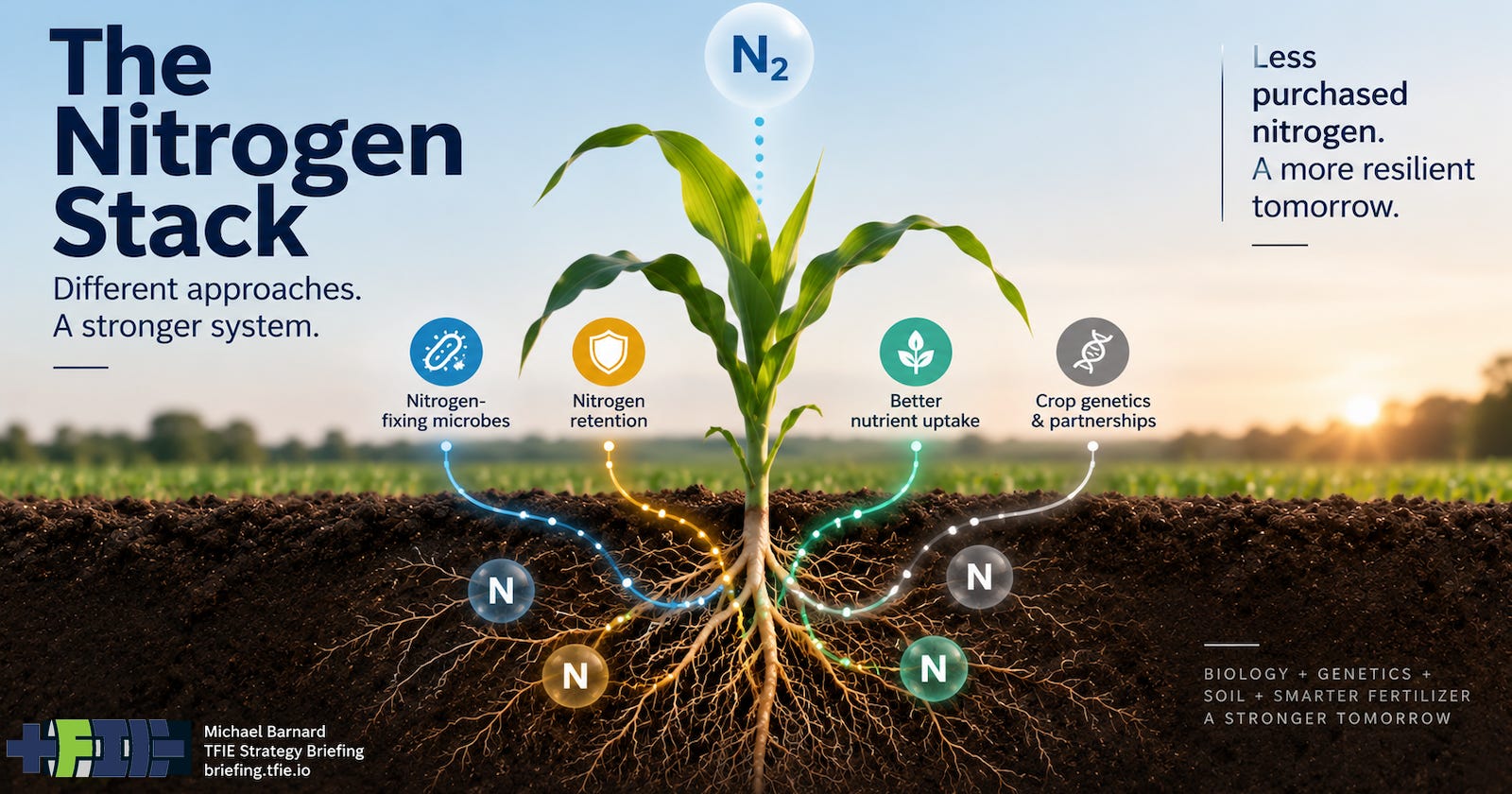
Nitrogen is one of the least optional inputs in modern agriculture. Crops need it to build proteins, chlorophyll and ultimately yield, but most major crops cannot use the nitrogen gas that makes up almost four-fifths of the atmosphere. Farmers buy nitrogen in chemically usable forms such as ammonia, urea and nitrate instead, with most of that fertilizer produced industrially using large amounts of energy and, historically, natural gas. The combination of necessity, cost exposure and emissions has created a large target for agricultural technology companies promising to replace part of the purchased fertilizer bill with biology.
Pivot Bio is probably the best-known venture-backed example. Its approach uses genetically altered bacteria living around crop roots to convert nitrogen gas from the air into forms the plant can use. Pivot reported that in 134 US corn trials with 129 growers during 2025, users of PROVEN G3 replaced an average of 33 pounds of conventional nitrogen per acre while gaining 2.1 bushels per acre relative to their standard practices. Those are company-reported results rather than an independent industry benchmark, but they illustrate the proposition clearly: substitute biology for part of a volatile, fossil-dependent farm input.
The market is often presented as a contest among companies trying to do variations of the same thing. Pivot competes with other engineered microbes, naturally occurring microbes, mixtures of microbes, products that improve nutrient uptake and, eventually, crops redesigned to need less purchased nitrogen. Sorting those technologies by what they actually do produces a different picture. Some approaches try to add new nitrogen to the crop. Others try to prevent existing nitrogen from being lost. Some improve roots or nutrient uptake so plants capture more of what is already present. Still others alter the plant itself so it cooperates more effectively with microbes. Conventional fertilizer remains part of the picture as well, which means the amount, timing and placement of that residual fertilizer belongs in the same system.
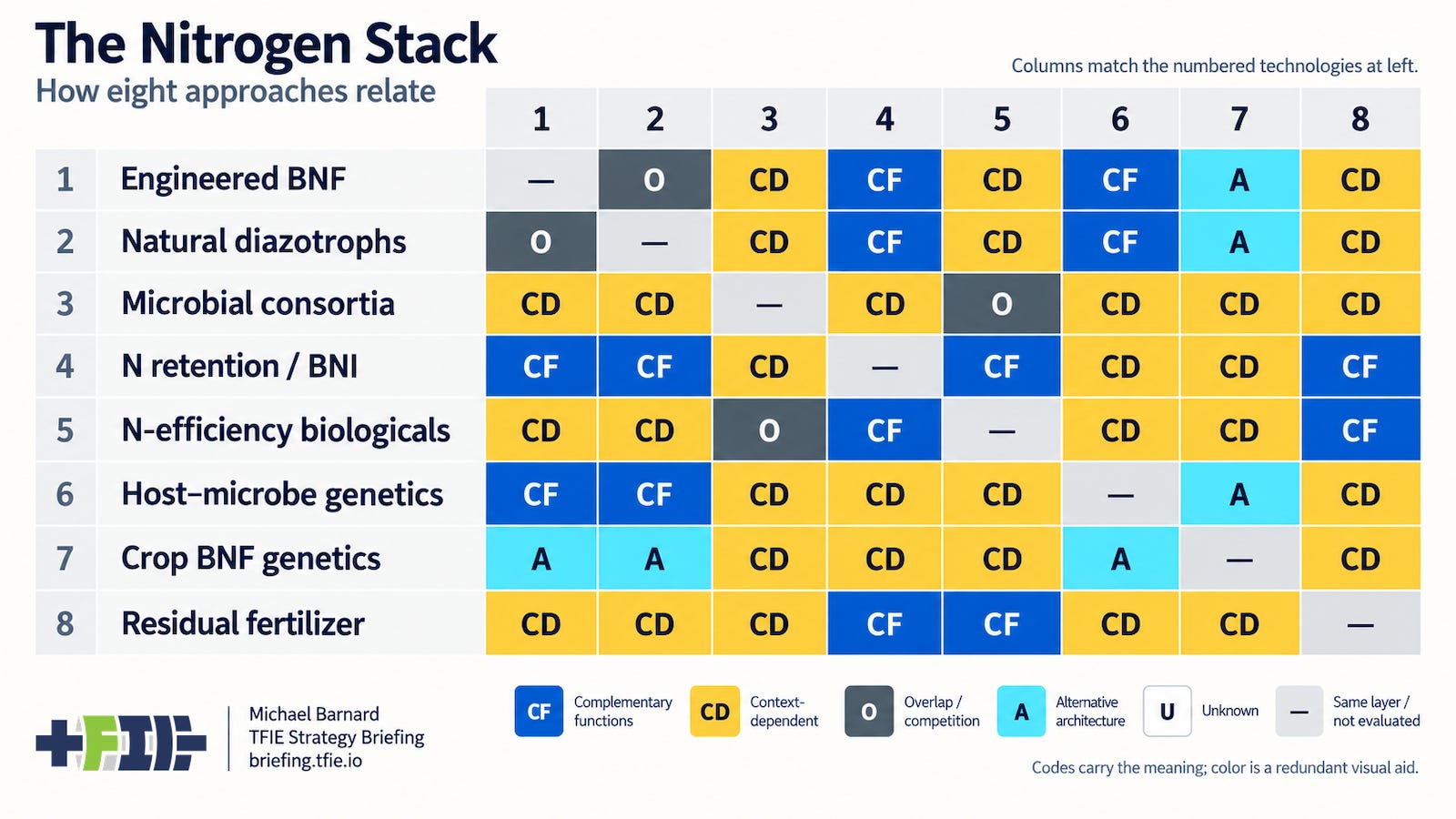
The matrix maps those relationships rather than recommending that eight technologies be piled onto the same acre. CF stands for complementary functions: the two approaches act on different parts of the nitrogen system and could fit together. CD stands for context-dependent: whether the combination helps depends heavily on factors such as the crop, soil, organism, fertilizer rate and weather. O stands for overlap or competition: the approaches may act on the same nitrogen pool, biological niche or plant resource, creating redundancy or interference. A stands for alternative architecture: the two approaches are better understood as different ways of solving the same problem than as natural partners. The letter codes carry the meaning; color is only a redundant visual cue so the matrix remains interpretable for readers with impaired color discrimination.
Several terms require translation outside agronomy and microbiology. A nitrogen-fixing microbe is a bacterium capable of converting nitrogen gas from the atmosphere into chemically usable nitrogen. Scientists call such organisms diazotrophs, but the investor-relevant distinction is simpler: they can potentially introduce new nitrogen into the crop system rather than merely help the plant recover nitrogen already present. A microbial consortium is a mixture of microorganisms intended to perform several useful functions together. Nitrogen retention means slowing processes that turn fertilizer into forms more vulnerable to loss. Nitrogen-efficiency biologicals are products that improve roots, stimulate useful soil organisms or otherwise help crops capture nitrogen more effectively without necessarily adding much new nitrogen from the atmosphere.
The two genetic categories are longer term. One involves breeding or engineering crops to cooperate more effectively with useful microbes. The more ambitious route would give cereal crops more of the machinery required to fix atmospheric nitrogen themselves. The resulting investment question is less about which biological can replace the most fertilizer in isolation and more about which combination of biological supply, nitrogen retention, crop genetics and fertilizer management can reliably reduce purchased nitrogen without reducing yield.
That systems view I put together looked suspiciously obvious. If these technologies intervene at different points in the same nitrogen cycle, agronomists should already have considered using them together. And, of course, they have. A 2009 review was already placing microbial inoculants inside integrated nutrient management, the practice of managing biological inputs, fertilizer and other nutrient sources as parts of one crop system. A 2015 review treated integrated nutrient management as a developed strategy for maintaining productivity while improving resource efficiency and reducing environmental impacts.
The matrix above is not a new agronomic theory. Its value is more modest and more useful: several technical literatures that normally sit in different professional silos can be viewed on one page. For an investor trying to distinguish direct competitors from technologies that might eventually sit beside one another, that synthesis is useful.
The systems idea was already established. Several commercial categories turned out to be much less settled.
