

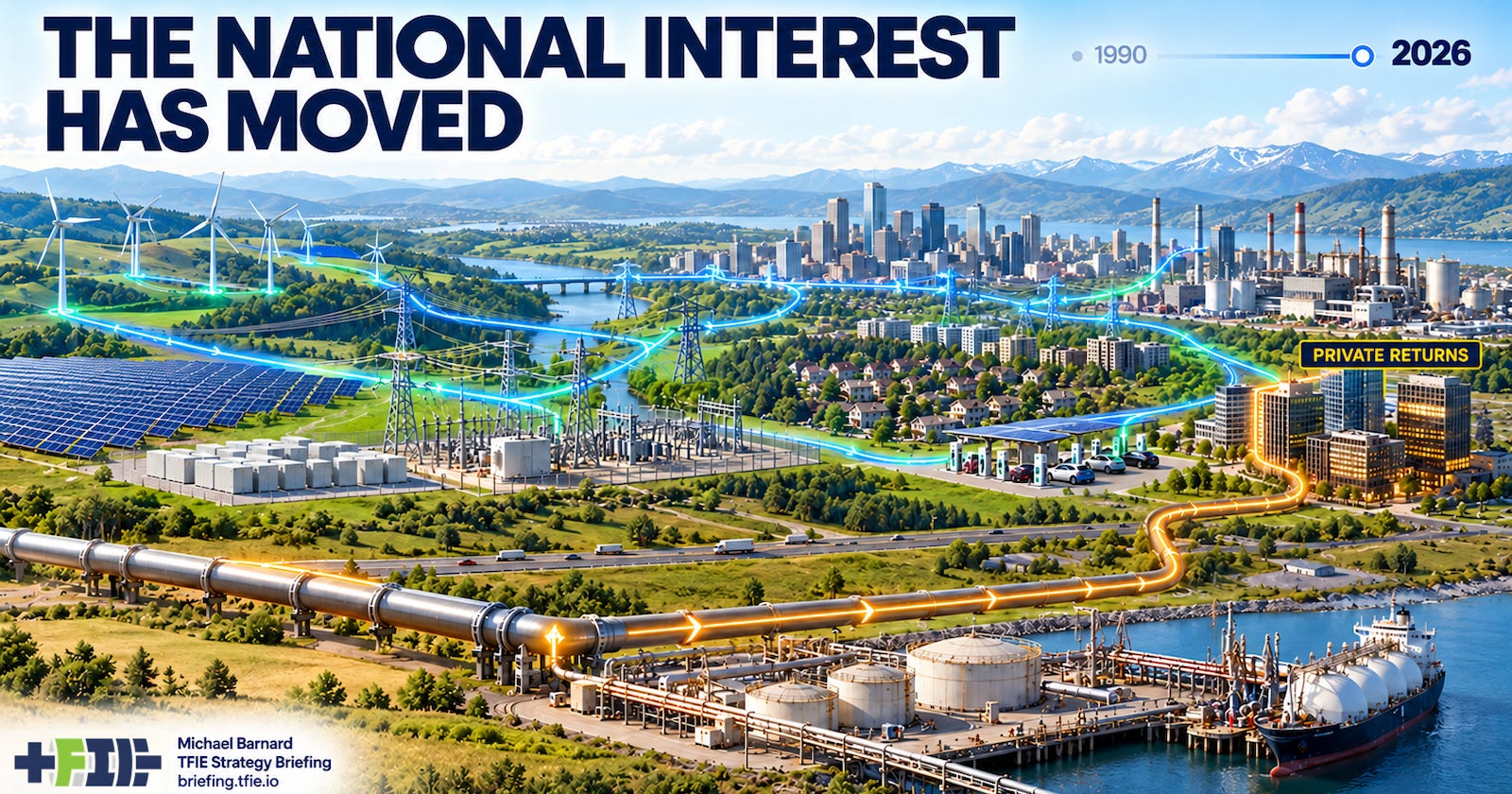
For decades, the climate free-rider problem seemed to describe a straightforward national calculation. A country could let others bear the cost of cutting emissions while it kept using familiar fuels. That calculation made more sense when the alternatives were expensive or could serve only part of the economy. A country-energy simulation I’m developing comparing the choices available around 1990 with those available in 2026 prompted a more immediate question: what if a government that delays electrification now pays a substantial cost at home, even before the climate damage is counted?
The ongoing simulation work is value neutral, running 50 year scenarios with coal-heavy, nuclear-heavy, gas-heavy and renewables heavy grids across countries with a variety of domestic resources and geographies. It provides annual updates on GDP growth (which is somewhat causally related to cheap supplies of useful energy), energy related mortality (related dominantly to coal and gas generation), public sentiment (impacted by energy prices and air pollution) and a other indicators. One finding leapt out at me. If the simulation started in 1990, GDP growth was highest with coal- and nuclear-heavy options. Starting in 2026, GDP growth was highest with renewables heavy grids. That’s because renewables deliver the most useful energy at the lowest price now.
The comparison is between sets of available choices, not a claim that every government made the wrong decisions in 1990 or that every country should make identical decisions today. The IPCC records sharp falls in the cost of solar, wind, and lithium-ion batteries during the 2010s. Electric vehicles have moved into mass markets, while heat pumps and better power electronics can replace combustion in many uses. A minister weighing a new power plant, vehicle fleet, or heating system in 2026 has options that a predecessor in 1990 did not.
Those options still have to work together. A cheap solar panel is of little use if its power cannot reach customers, and a household that cannot finance an electric car will keep buying gasoline. A reliable system needs transmission, distribution, storage, flexible demand, and equipment that can use the electricity. It also needs capital on terms a country can afford. The IEA has warned that grids can become the bottleneck, while its analysis of financing costs shows how expensive capital can overwhelm the advantage of cheap equipment in emerging economies. The relevant comparison is the cost of providing transport, heat, industrial output, and dependable power over time, including the cost of the fuel that must otherwise be bought every year.
That fuller accounting changes the meaning of free riding for many fossil-fuel importers. They can benefit from emissions cuts elsewhere while contributing too little themselves; the international problem remains. Yet they can also hurt their own economies by prolonging fuel imports, exposing households and industry to price shocks, and tolerating pollution from burning those fuels. Electrification can redirect recurring fuel spending toward domestic power, equipment, and productive activity. Whether that raises GDP, and when, depends on imported equipment, construction costs, debt service, the electricity mix, and what else the country could have done with its capital. A lower import bill strengthens the case; it does not settle it.
The national balance looks different in an exporting country. Oil and gas revenues can support public budgets, employment, and regional economies, and a domestic switch to clean power will not replace export income overnight. Exporters should test new extraction and transport assets against plausible demand and the public liabilities attached to them, while building sources of income that can outlast those assets. The IEA has examined the transition risks facing oil and gas companies. For an exporter, the prospect of continued fossil profits and the need for economic diversification can both be real. That’s playing out in Canada right now, where the Carney government is working to build a new major oil pipeline, while at the same time driving new transmission, building electrification and transportation electrification.
Even within one country, the result depends on the year being measured. Construction can add to GDP before cheaper energy services arrive. An electricity rate increase may reach voters before fuel savings do. Cleaner air can reduce illness and deaths in particular cities without making much impression on a national income figure. The IEA’s affordability analysis finds that rapid transition scenarios can bring somewhat higher electricity prices in the near term as investment is paid for, even while running costs fall and longer-term energy bills improve in many regions. GDP, mortality, public sentiment, and public finances therefore belong on a year-by-year ledger, with different winners and losers visible on each line. Funding approaches for transforming the grid have to be considered as national investments with long paybacks, not something to burden next years rates with.
That ledger also makes a political difficulty plain. A decision that benefits the country over time can reduce the earnings of people with influence over the decision today. A fuel supplier earns revenue for each year demand persists. A gas utility may earn a regulated return on a replacement pipeline. A generator may be paid to remain available, and a developer may persuade the state to guarantee a project whose downside later falls on customers or taxpayers. These incentives do not require a conspiracy. They do give firms and their owners a reason to argue that the next investment should keep the old system in place.
The same scrutiny must apply to the industries that would replace them. A renewable developer may seek an unnecessarily generous guaranteed price; a battery maker may shape a subsidy around its product; a transmission contractor may favor construction over cheaper ways to relieve congestion. A domestic manufacturer can call import restrictions an energy-security policy even when the public pays more for the result. The OECD’s work on integrity in the green transition describes the risk of misleading influence and conflicts of interest. Governments need to ask what a contract will deliver, what it will cost, and who keeps the gain if the public purpose is missed.
Electricity networks are a good place to put that test into practice. New wind and solar, growing electric loads, and storage will all compete for connection and grid capacity. Planners should publish demand forecasts, identify the lines and substations needed, and compare new construction with storage, flexible demand, and better use of existing assets. Connection queues should favor projects capable of building, rather than allow speculative projects to occupy scarce capacity. The cost of a line should be stated alongside the cost of the congestion and delayed investment it would remove. Otherwise, the institution making the decision may be rewarded for building an asset while the economy bears the cost of waiting for useful power.
Utility regulation then has to make delivery worth more than asset accumulation alone. A utility can earn part of its return by connecting customers promptly, keeping power reliable, reducing congestion, and controlling the total cost of service. Those measures need careful design and independent checking: a company will learn to satisfy a narrow metric even if the wider system suffers. Performance-based regulation offers regulators a framework for tying financial rewards to specified outcomes. The outcomes must be ones that households and businesses can recognize in the service they receive.
The same discipline belongs in the treasury. Before approving a new gas terminal, a clean manufacturing grant, a loan guarantee, or compensation for retiring an old plant, government should publish the credible alternatives and the expected public exposure. It should name the beneficiaries, use competition where competition is possible, pay against delivery milestones, and recover support when promised results fail. Sunset dates matter because a subsidy that helped establish a market can become an entitlement long after its purpose has passed. Existing contracts still require lawful treatment. Making customers absorb every failed private bet would reward poor investment, while arbitrary seizure would make the next grid project harder to finance.
None of those supply-side decisions will hold politically if ordinary people cannot use the alternatives. A driver who cannot afford an EV’s purchase price is exposed to gasoline costs even if the vehicle would be cheaper over its lifetime. A tenant cannot readily replace a landlord’s boiler; electricity levies can make a heat pump unattractive even where its useful heat is economical. Finance at the point of purchase, support for renters and lower-income households, used EV markets, public transport, and targeted building work turn a modeled saving into an available choice. The IEA finds that upfront costs can otherwise lock poorer households out. A government should measure total household energy spending as well as the price of electricity.
Making those decisions openly requires institutions that can withstand pressure from both incumbent and emerging industries. Meetings with decision makers, political finance, ownership of bidders, changes to tenders, and the assumptions behind energy forecasts should be available for scrutiny. The OECD’s 2026 review of lobbying safeguards finds that many registers reveal too little about the particular decisions being targeted. Disclosure alone will not choose a good project; regulators, competition authorities, consumer advocates, and independent technical reviewers also need enough staff and access to challenge the claims on which public money is spent. Each year, the government should compare promised and delivered connections, costs, imports, bills, reliability, emissions, and local air quality, then explain material misses.
That annual test is politically as important as the distant target. A minister has to manage construction disruption, a rate case, and a plant closure during the current term. Savings may accrue over the next two terms, and the communities losing fossil income may be far from those gaining new investment. Removing fuel support before affordable alternatives are available can turn a sensible long-run reform into an immediate loss. The World Bank’s political economy research emphasizes sequencing and institutions for this reason. Build and connect the alternatives, protect exposed households, and make regional employment and tax plans credible before expecting people to trust a national GDP forecast.
The comparison between 1990 and 2026 does not abolish international free riding. It shows why the old account of national self-interest is often incomplete today. For many importers, keeping fossil demand alive can mean giving up cheaper domestic energy services, cleaner air, and protection from fuel shocks, while particular firms still earn from delay. For exporters and countries facing expensive capital or weak grids, the tradeoffs are harder and must be tested on their own terms. The developing TFIE year-by-year country simulator is intended to make those choices and their timing visible. Outside the simulation, the task for policy makers is to make every large energy decision answerable to the same questions: what useful service will it deliver, who pays before the benefits arrive, who profits if it is delayed, and what evidence will tell the public whether it worked?
What would your country gain by acting now? Reach out to TFIE Strategy to explore scenarios in the energy simulator.