

The reaction to my recent Briefing on Ireland’s National Heat Study and Nigel Banks’ Fabric Fifth work included a familiar objection from someone working in social-housing retrofit in the UK. Deep retrofit, they argued, is not merely about saving energy. Warmer homes improve comfort and health, especially for people on low incomes and those already vulnerable to illness.
That is true, and the previous Briefing on SEAI’s National Heat Study and Fabric Fifth said so explicitly. SEAI accounted for people taking some efficiency improvement as warmer rooms rather than lower energy consumption and treated that additional comfort as a legitimate health and wellbeing benefit. Cold, damp and mould are genuine health problems, and social housing contains plenty of households struggling with them. The latest English Housing Survey found about 23% of social-rented households could not keep comfortably warm in winter.
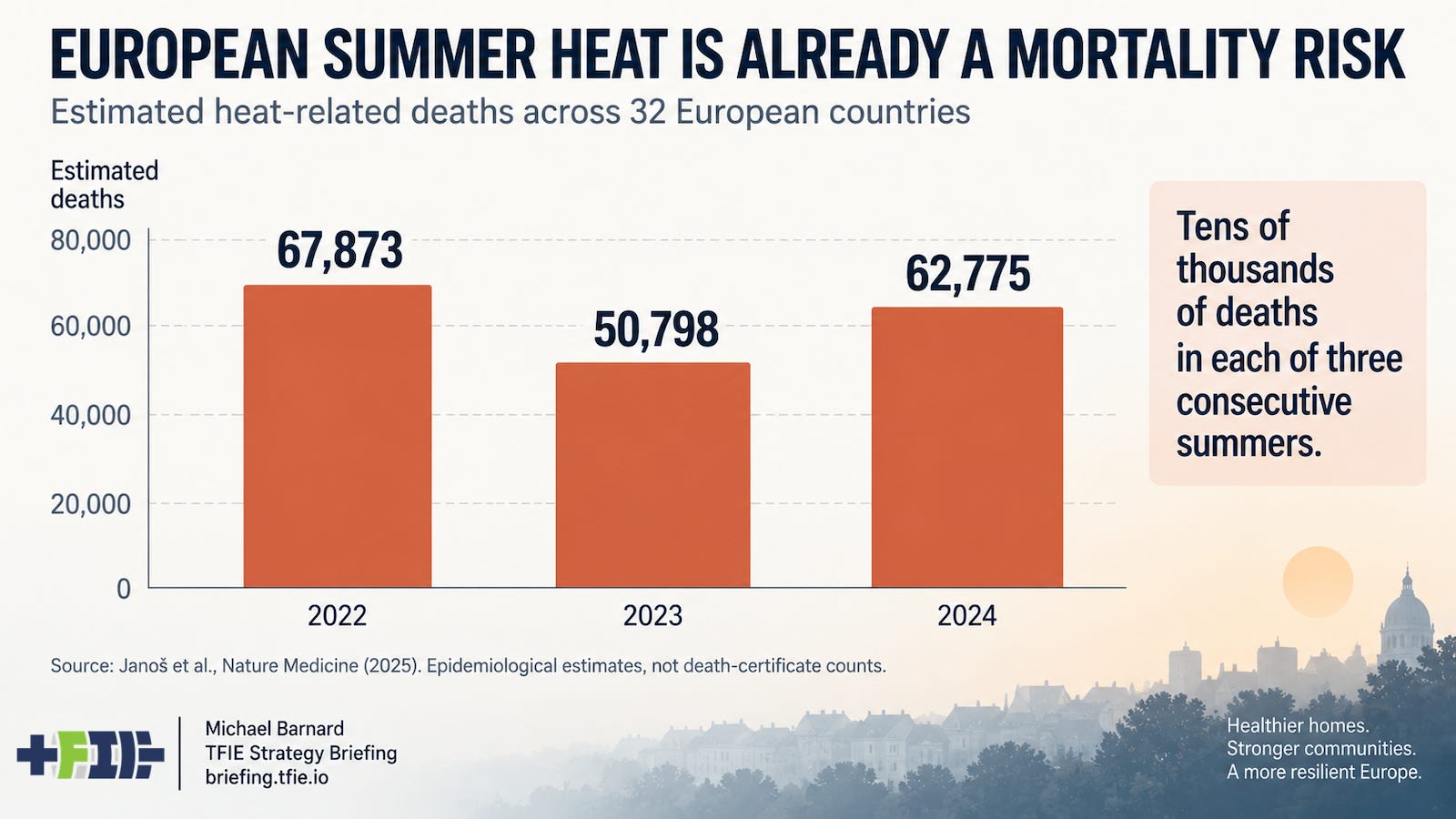
But the exchange exposed something that was largely missing from my article as well. We were discussing healthy homes almost entirely as a winter problem. That leaves out an increasingly important part of the health risk. A harmonized Nature Medicine analysis estimated 67,873 heat-related deaths across 32 European countries in summer 2022, 50,798 in 2023 and 62,775 in 2024. These are epidemiological estimates rather than counts of death certificates saying heatstroke, but the scale is no longer ambiguous. Extreme summer heat is killing tens of thousands of Europeans in bad years, particularly older people and people with existing health problems. Many of those are precisely the populations invoked when making the winter-health case for retrofit.
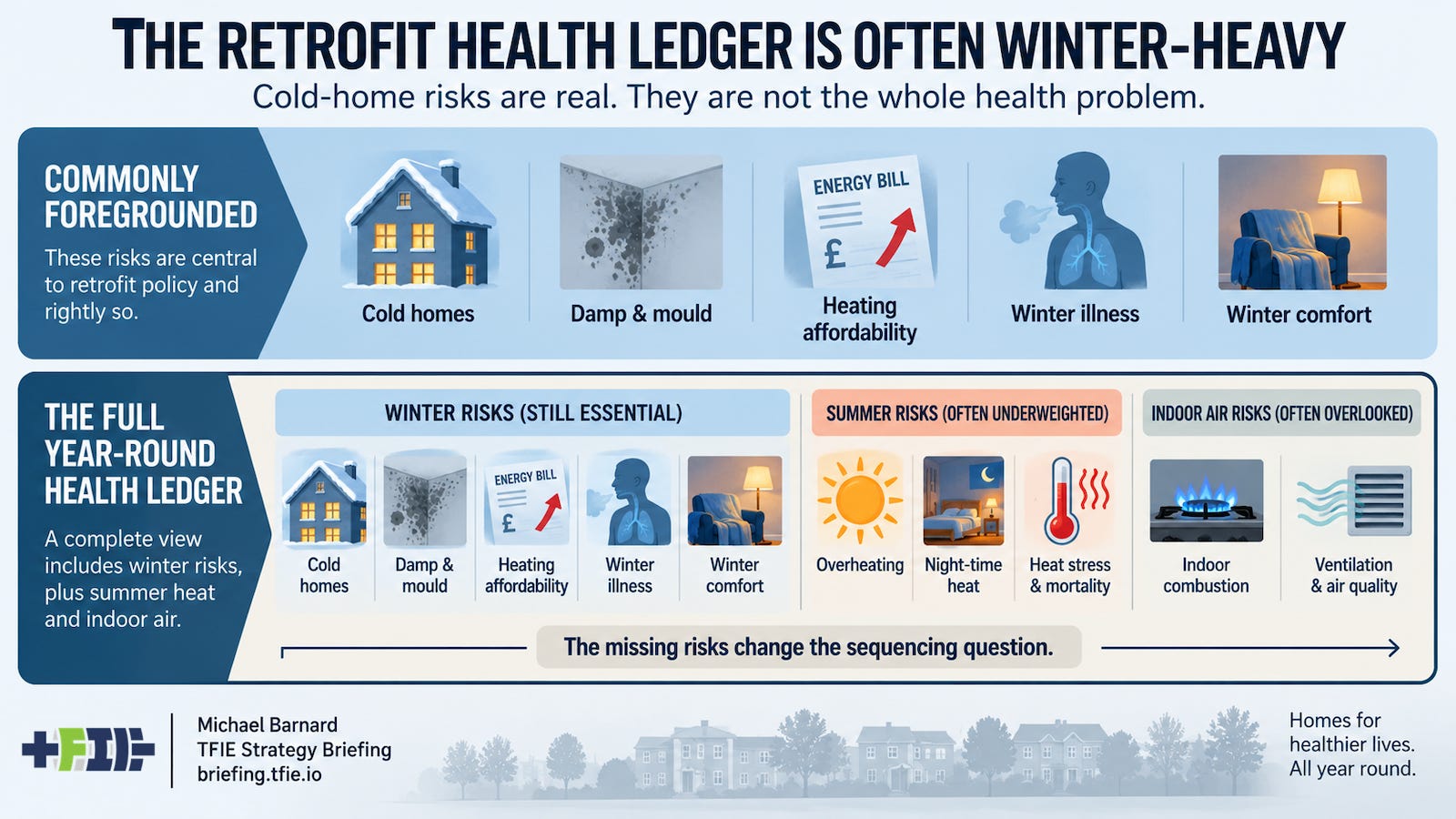
The usual health ledger is full of cold homes, winter cardiovascular and respiratory stress, damp, mould, fuel poverty and excess winter mortality. Overheating, inability to cool a bedroom overnight, heat stress, disrupted sleep and heat mortality appear much less consistently. A home that is healthy in January and dangerous in July has not solved the thermal-health problem. Once that is recognized, the objective starts to look less like minimizing heating demand and more like maintaining safe indoor conditions throughout the year.
That matters to the Fabric First Trap because the argument has never been that insulation is bad. Cheap loft insulation, draught repair, ventilation fixes and other worthwhile building measures should be done. Some buildings genuinely require substantial remediation, and deep retrofit can be justified on comfort, maintenance, peak-demand, health or economic grounds. The trap comes when evidence that better fabric is beneficial gets turned into a sequencing rule: therefore extensive fabric work should precede electrification. The benefits of an intervention do not by themselves establish the order in which every intervention must occur.
Once summer heat and indoor air are put on the same health ledger as winter warmth, the sequencing question looks rather different. So does the role of the heat pump.