

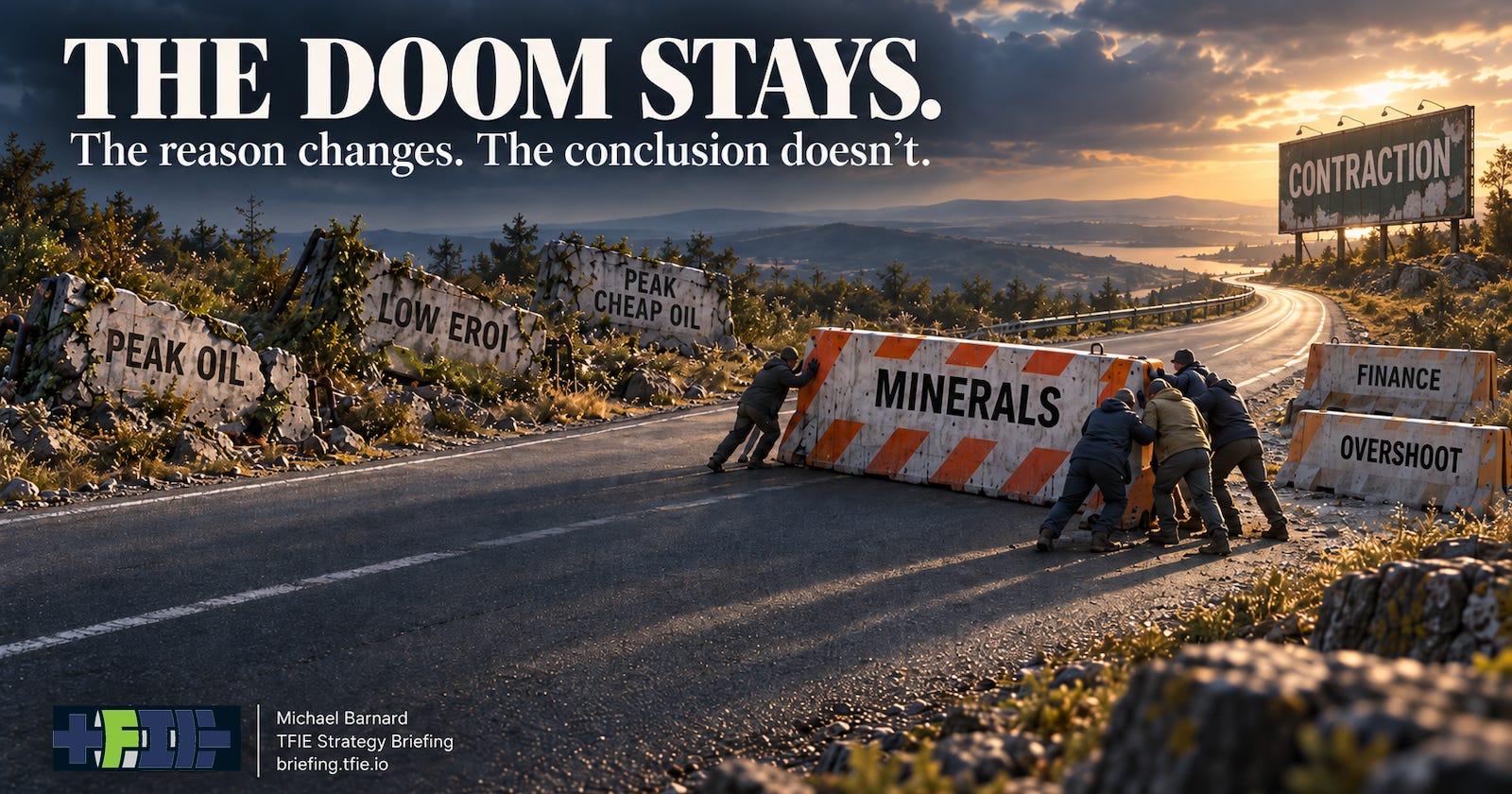
A forecast that survives the failure of its predicted mechanism without losing much confidence is no longer functioning very well as a forecast. That is increasingly how I see a recognizable intellectual lineage running from the peak-oil movement of the early 2000s through Richard Heinberg and The Oil Drum to Nate Hagens’ The Great Simplification, with Simon Michaux providing an especially revealing modern example. The original claim was not merely that petroleum was finite, mature oilfields decline or conventional crude production would eventually peak. Those were and remain reasonable observations. The consequential claim was that an imminent petroleum-supply constraint would leave industrial societies without adequate substitutes, force economic contraction and begin a substantial simplification of modern civilization. The constraint did not arrive as forecast. Instead of that experience substantially reducing confidence in the expected outcome, a portion of the movement found new reasons why essentially the same outcome remained imminent.
Richard Heinberg’s The Party’s Over said in 2003 that global oil production would peak within the next few years, after which industrial societies would have progressively less net energy available, with managed contraction presented as the sensible response. By 2010, Heinberg was saying that conventional economic growth was effectively over and that aggregate economic activity would probably never again exceed its 2007 level. The global economy subsequently grew far beyond that level. Heinberg eventually acknowledged the uncomfortable evidence. In a 2018 retrospective on The End of Growth, he noted that both US and global GDP had risen rather than continued to fall, but interpreted the result largely as postponement rather than falsification: unconventional energy, financial interventions and debt had bought time, while the ultimate encounter with limits remained certain. That may be a hypothesis worth investigating, but it does not validate the forecast that growth had already ended.
The distinction matters because “growth cannot continue infinitely on a finite planet” and “this particular constraint will terminate economic growth within the period I am forecasting” are entirely different propositions. The first is almost definitionally true if the timeframe is long enough and growth is defined in sufficiently material terms. The second is a prediction with timing, mechanisms and opportunity costs attached to it. Utilities, governments, investors and households make decisions over decades, not geological eternity. Being correct that something cannot continue forever does not make someone correct about what prevents it from continuing in 2008, 2018, 2028 or 2038. A forecasting tradition that repeatedly retreats from a specified mechanism and timeframe toward the proposition that limits must eventually assert themselves is steadily moving from empirical prediction toward an unfalsifiable worldview.
Nate Hagens did not independently rediscover this framework years later. He was inside the movement. He became a major contributor and eventually managing editor of The Oil Drum, the most technically serious online centre of peak-oil analysis. In 2010 he explained that the Institute for the Study of Energy and Our Future, ISEOF, had been incorporated in 2007 as The Oil Drum’s nonprofit corporate parent. That same organization now produces The Great Simplification. This is not merely intellectual resemblance. There is direct institutional continuity between the peak-oil project and Hagens’ current media platform.
That history makes the important question less whether Hagens sincerely believes the current version of the story than whether the framework has learned enough from the failure of its earlier version. The more revealing evidence is what happened when the oil constraint failed to produce the expected economic result—and why Simon Michaux’s minerals argument fit the successor story so perfectly.
