

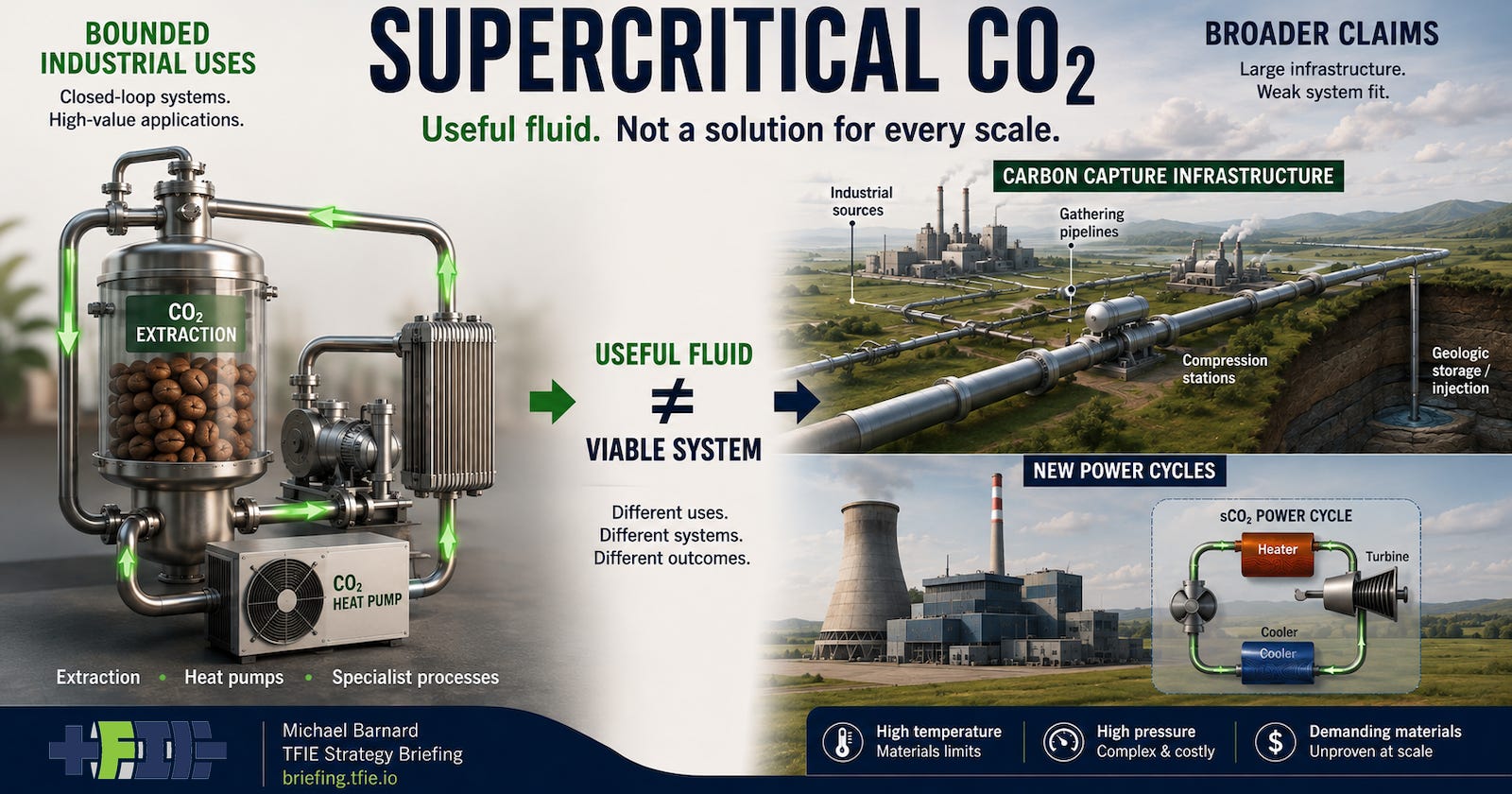
Supercritical CO2 is having a moment in the sun again, at least from my admittedly odd point of view. The US DOE is once again touting the use of the substance in thermal electrical generation. The carbon capture and sequestration crowd are touting supercritical CO2 pipelines as the answer to the reality that burning fossil fuels makes CO2 that’s 2-3 times the mass and 450 times or more the volume of the fuels. And it’s being used in textiles and to extract interesting herbal elements from high-value plants that are legal in many jurisdictions. It’s even in heat pumps.
Phases Of Matter
There’s a lot to unpack here, so lets head back to the 19th century to figure out what the heck supercritical CO2 is. No, lets head back further to the ancient Greeks. And to be clear, it’s entirely probable that the ancient Chinese and ancient Arabians figured this out independently and possibly before Europeans did, but English-language histories were written by Europeans, so we’ll live with this version of the story. (If anyone has references to non-European scientists and phases of matter, please let me know. I love good parallel invention stories.)
Humans have known pretty much forever that water and ice are the same thing, with the difference between them being heat. Summer and winter with icing and melting are pretty obvious phenomena, and humans have been smart enough to remember and figure things out for probably 450,000 years. Gases took a lot longer to understand as another state of matter. The Greeks knew this and mistakenly thought that with water being able to exist in three states, everything in the universe was probably made of it.
It takes a lot of heat to change the phase of ice to water. The temperature of ice or any solid rises until it gets to the point where it’s going to turn to a liquid, and then it just sits there at that temperature as more and more heat is added until finally it becomes a liquid. Ditto for water turning to steam. Water gets to the boiling point and doesn’t get hotter. It sits there at that temperature for a long time, soaking up more heat, until the phase change starts happening and steam starts bubbling off.
A lot of early physics assumed that the increase in temperature was linear between ice, water, and steam and a lot of physics was rewritten when sensible people started actually measuring it. So we have three states of matter, and the energy is an indicator that something unusual is going on. Scientists love unusual things, engineers not so much.
And scientists also figured out that pressure had a lot to do with it. Higher pressures meant that water turned into steam only at much higher temperatures. Ditto the reverse, so anyone trying to make a hot cup of tea at the top of Mt. Everest gets a lukewarm cup instead. And there was a critical temperature above which no amount of pressure will force a gas to turn into a liquid and that was discovered as well.
A bunch of work had to do with ideal gases vs real ones, which is exactly what it sounds like. An ideal gas is a hypothetical mathematical construct plugged into equations for various purposes. A real gas is one that actually exists and has particles and forces within and between the particles. Messy reality again.
Supercritical Matter
That something weird was going on was observed in the early 19th century when a Baron was doing experiments and found the oddity, but it wasn’t explained or explicable until later. Similarly, chemist and physicist Thomas Andrews did a bunch of experiments that resulted in supercritical fluids in the late 19th century.
